Every week is ‘Shark Week’ for Bill Eberlein who dives the waters of Coastal Georgia in search of remnants of the dinosaurs of the seas.
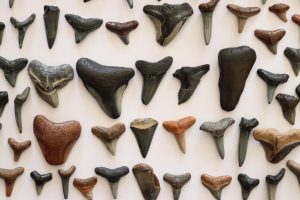
Off the coast near Savannah, Georgia, Eberlein who has dived for almost 40 years, secures his scuba gear and leans off the side of his boat, bobbing in the muddy low country water. On the count of three, he jumps off the boat into the river, making sure to connect himself to the boat’s anchor to stop him from getting lost in the low visibility waters of coastal Georgia waterways. The sun reflects off the water, and Boat Captain Josh waits patiently for Eberlein to reappear on the surface. After a little while, he pulls up from the water holding a muddy clump of what will be cleaned and polished to reveal an ancient fossil – a Megalodon shark tooth. He brushes off the excess dirt, places the fossil in the boat, and repeats the process.
Megalodons were once enormous sea creatures. Their distinctive name can be translated from Greek to ‘big tooth’ which is fitting for this creature’s stature. Evidence shows that these ancient sharks could measure up to 60 feet in length. A single tooth from this shark is generally three to four inches but the rarest examples can measure as much as seven inches long and may weigh as much as a pound. The force of the teeth added up, given that Megalodons had around 276 teeth. The bite force of a Megalodon equated to about an impressive 40,000 pounds per square inch, which is greater than the bite force of a T-rex dinosaur.
Today, only the fossils remind us of the legacy of the Megalodon which roamed the deepest parts of the oceans around 23 to 3.6 million years ago. The warm and muddy waters of Coastal Georgia now are the perfect excavation sites for these ancient relics, giving the modern world a glimpse into prehistoric times. “Our ocean floor is the secret home to these amazing ancient fossils, which are only exposed by the changing tides and currents,” Eberlein said. “It’s thrilling to have the honour of uncovering these unique pieces of history and share them with the world.”

Continue reading
This story is exclusively for Oceanographic subscribers.
