"Window into the past": Oceanic MPAs host rare shark abundance
A major survey of Eastern Tropical Pacific MPAs has revealed exceptional shark abundance around remote islands like Galapagos and Malpelo, while coastal reserves have been found depleted, highlighting the effectiveness of fully protected, isolated marine protected areas.

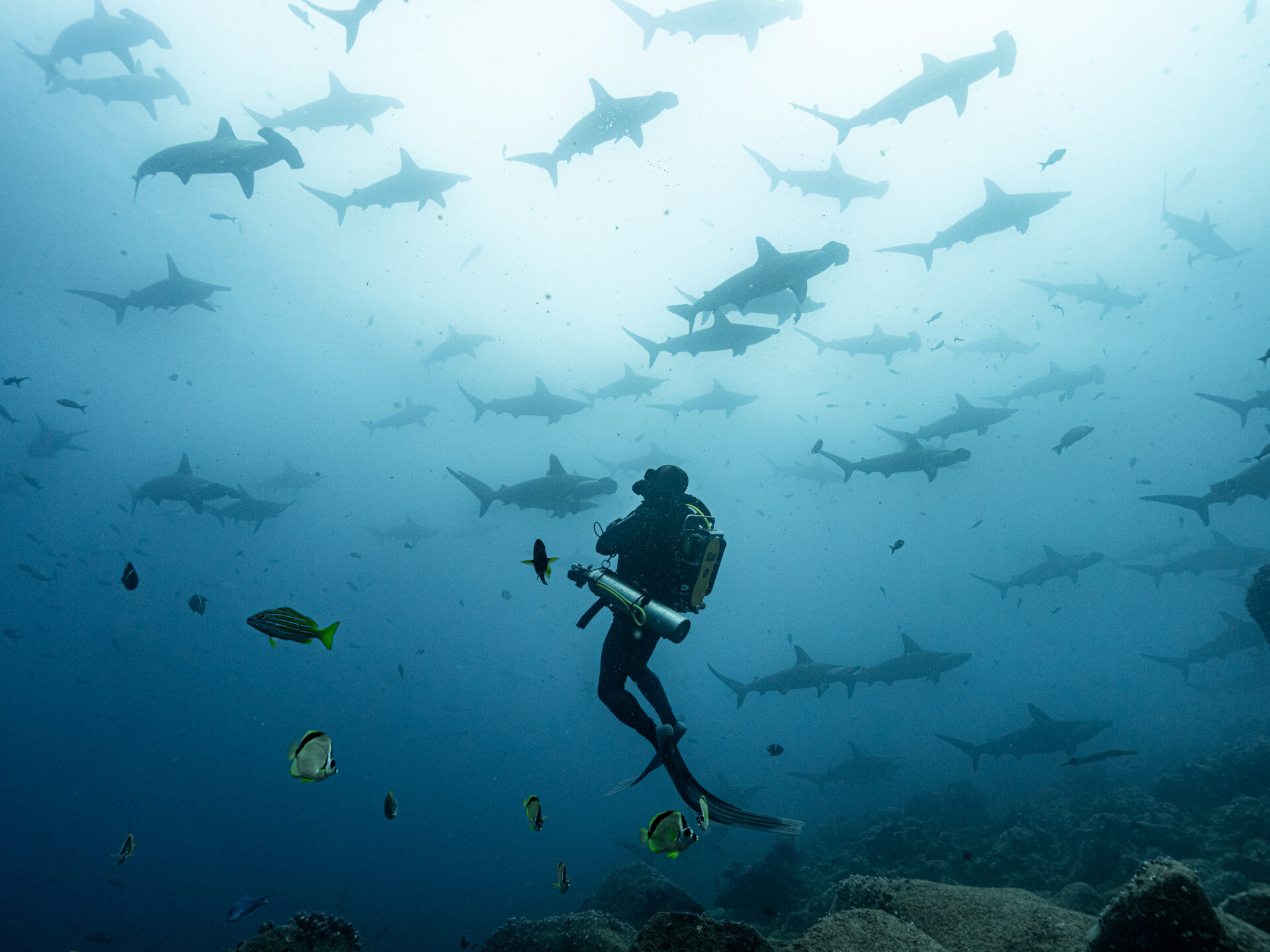
A sweeping new survey of shark and large predator populations across the Eastern Tropical Pacific has revealed that some of the world’s highest shark abundances – including critically endangered scalloped hammerheads – thrive around the isolated marine protected areas of the Galapagos, Malpelo, Clipperton, and Revillagigedo islands.
Meanwhile -and by stark contrast – coastal marine protected areas (MPAs) in the same region show signs of severe depletion, with large predators largely absent.
The study – published last week in the scientific journal Plos One – has been likened by the researcher Dr Pelayo Salinas-de-León, principal investigator at the Charles Darwin Foundation and senior author of the study, to a “window into the past” in which sharks and large predatory fish are “the norm and not the exception.”
“[The oceanic islands of the Eastern Tropical Pacific] provide a glimpse of what a healthy ocean looks like and highlight the key role ocean conservation plays in safeguarding these last strongholds from systematic overfishing,” said Salinas-de-León.
Led by the Charles Darwin Foundation (CDF) in collaboration with National Geographic Pristine Seas, the Galapagos National Park Directorate, and regional partners, the research team deployed Baited Remote Underwater Video systems (BRUVs) across seven MPAs. The approach, aligned with Global FinPrint standards, provides one of the most comprehensive predator assessments to date in the Eastern Pacific.
“Places like Galapagos and Malpelo remain extraordinary refuges,” said Simon McKinley, the study’s lead author. “Their remote location, coupled with well-enforced protected areas, allows sharks, jacks, snappers, and other predators to live out their natural lives largely undisturbed.”
In other news



Within the study, researchers discovered that Clipperton itself may be serving as a nursery while mature individuals dominated other island MPAs, evidence – the team has suggested – that the region’s reserves function “collectively as a network protecting different stages of shark life cycles.”
It also found that scalloped hammerheads were most common in southern MPAs such as Galapagos and Malpelo, while silvertip sharks dominated northern sites, including Revillagigedo and Clipperton. Each MPA appears to host distinct marine communities, underscoring the need for site-specific management.
Coastal MPAs – however – told a different story. BRUV footage revealed few large predators and low overall fish abundance – classic symptoms of “fishing down the food web,” in which the loss of top predators forces fishers to target progressively smaller species.
“The fact that we observed only a handful of sharks and large predatory fishes in these coastal MPAs is worrying,” McKinley added. “Despite their protected status, unsustainable fishing has likely removed many of these species from the ecosystem.”
More than 77 MPAs dot the Eastern Tropical Pacific, ranging from lightly regulated zones to fully protected no-take sanctuaries. But the study found that only the most restrictive MPAs – those prohibiting extractive activity – deliver meaningful conservation gains.
“This study reinforces what we already know, that strictly protected marine reserves are the best way to help the ocean recover,” said Enric Sala, National Geographic Explorer in Residence and founder of Pristine Seas, who co-authored the study. “When fishing is allowed in MPAs, they can’t replenish marine life. Minimal protection is not enough.”
The research draws on a series of expeditions undertaken with regional partners including the Malpelo Foundation (Colombia), Pelagios Kakunjá (Mexico and France), Osa Conservation (Costa Rica), and Ecuador’s Ministry of Environment. The findings contribute to broader efforts by CDF and the Eastern Tropical Pacific Marine Corridor (CMAR) to safeguard migratory species and expand science-based management.
“We only have five years left to achieve the global goal of protecting 30% of the ocean by 2030,” Sala noted. “Research shows we must establish 300 large, remote MPAs and 190,000 smaller coastal MPAs to meet that target. The Eastern Pacific’s remote island MPAs serve as inspiration to us all.”


"*" indicates required fields
Printed editions
Current issue
Back issues

Back Issues
Issue 43 Sir David Attenborough’s ‘Ocean’


Back Issues
Issue 41 Holdfast to the canopy
Enjoy so much more from Oceanographic Magazine by becoming a subscriber.
A range of subscription options are available.
