How does it feel to be on a 24-month voyage to the world’s more remote and interesting ocean destinations? Here, Andi Cross shares insights into life on the road.
 One month after leaving everything we knew behind to chase that wild dream, the reality began to set in. In the first few weeks, it felt like stepping into an alternate universe – finding ourselves face-to-face with ten, four-meter great whites, nearly 40 endangered sea lions, and over 250,000 giant cuttlefish, day in and day out. But as time went on, long-format expedition life proved to oscillate between the highest of highs and the lowest of lows.
We had been on smaller expeditions before, each with fairly discrete purposes, goals and deliverables. But this was different. This odyssey was entirely of our own making– it was our vision, our journey, ultimately resulting in the outcomes we’d sought after. But despite living in our own manifestation, we felt like we had no real grasp on how to navigate this wild way of life efficiently. Missteps were frequent, and each one cost us.
Freediving and scuba diving in freezing waters without drysuits. Losing gear to rough seas. Even how we organised and sorted all of our content while out in the field, working around the limited (or oftentimes complete lack) of wifi or cell service. We had set out to encounter the species and meet the people that defined these remote places, yet as expeditionists, we felt oftentimes completely in over our heads.
While we were steadfast in our ‘why’ behind this monumental journey, it was the ‘how’ that found itself in a constant state of transience, much like we were geographically. The ‘how’ was continually shaped by lessons we were learning in the field, each typically brought on by the result of some epic miscalculation on our part. Before we could refine our approach to exploration, we had to face a more immediate truth: we genuinely had left behind every comfort we knew to fully immerse ourselves in life on the edges. That meant full-fledged adaptation. It meant learning to embrace discomfort as a baseline, not a hurdle. And in those early days, I don’t think I fully grasped just how much effort that would take.
When you’re not used to life on a ship for days, even weeks, there’s a definitive adjustment period – a phase where you have to find your sea legs, learn to love your tight quarters, and get used to the relentless rocking and rolling of long overnight crossings on the open ocean. When your expedition is entirely self-funded – kept afloat by a consulting business still running back in the U.S. – the learning curve gets steeper. You have to navigate drastic time zone shifts, oftentimes working deep into the night, and master a brutal schedule that balances field work with the desktop hour-logging that makes it all possible. The body and mind are stretched to their limits – sometimes beyond anything I’d imagined possible.
Then there’s life lived out of a suitcase, one containing only the bare essentials. Half the time, you’re either zipped into a drysuit or wetsuit. The other half bundled up against the cold or stripped down to the bare minimum, trying to stay sane in relentless heat. In the tropics, when things get wet, they stay wet. And so, you push past the frustration of being constantly damp. In the cold, when gear starts to freeze over, you learn to block out the sting and find ways to defrost. Sleeping on boats, in tents, on floors, in shared rooms, on bunk beds – with or without blankets or pillows – it all becomes routine. But despite the discomforts, you start to slowly realise how little you need to be happy and fulfilled.
More of Andi's columns
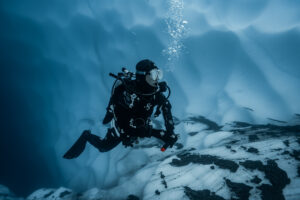

But despite the discomforts, you start to slowly realise how little you need to be happy and fulfilled.
Continue reading
This story is exclusively for Oceanographic subscribers.
