Callum Roberts is Professor of Marine Conservation at the University of Exeter in the UK. His research focuses on threats to marine life and on finding the means to protect them. Here, he discusses the importance of understanding our ocean's history in order to lay out the path for a healthy future.
This year I had the good fortune to contribute to a copy of the Proceedings of the Royal Society, in which a great amount of marine history came together in the form of studies making up part of the Sea Change Project – trying to understand how the ocean has changed under human influence over time scales of centuries to millennia.
Why is it interesting to know about this? Why is it important? Well, the history of the ocean is not just a matter for idle curiosity. It’s also very important to understanding today and what the ocean looks like, as well as thinking about the possibilities of what there might be for the sea and its denizens in the future.
And that matters because if we don’t understand the past, we simply cannot possibly build a better future.
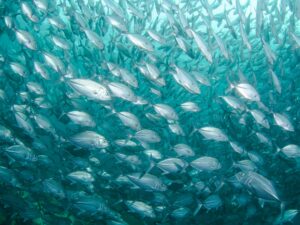
When you look at fishing history, we see that the sea used to be far more prolific. It used to support populations of fish that are almost completely gone today. Things like giant sturgeons and halibut, skates, and many more species. Those fish have gone because we caught them and we haven’t recovered them.
When the government’s scientists went to look at the Dogger Bank – formerly a great centre of fishing in the middle of the North Sea – they looked at this place and decided ‘we need a protected area here.’ But they decided not to protect it entirely, not from trawling at least.
So we created this large area of protected marine space that was not really protected – one that was still being fished at an industrial scale. Doing that had no benefit.
But thinking about what the Dogger Bank used to support in the past, that gives us the key to a better future. Realising that there is a possibility that you could have this incredibly prolific marine life as well as more intact and diverse habitats, instead of these open, barren seabeds, then we can start to think about a better future for marine life as well as for ourselves.
We need to establish protected areas that will bring back the life we had in the past. It is possible. The worst thing we can do is forget that life ever existed.
Check out Callum’s video column below:

Continue reading
This story is exclusively for Oceanographic subscribers.
