While most nations around the world are already feeling some impacts of climate change, the country of Senegal is experiencing unprecedented coastal erosion, longer dry spells and heat waves, as well as rising sea levels, threatening livelihoods and displacing entire communities.
With his gaze lost in space, a worker leans on the pillar of what remains of the Cheick Toure school in Saint-Louis, Senegal. Just over five years ago, what are now piles of rubble were classrooms full of students until the sea waves destroyed everything in March of 2018. The school had been closed preventively following a weather warning, and luckily, due to this, no lives were lost back then. Today, work is underway for the demolition of that school building which still constitutes a danger to passers-by.
The Cheick Toure school is located in the Langue de Barbarie, a thin strip of land located in the western part of Senegal which acts as a buffer between the Atlantic Ocean and the old French colonial capital of Saint-Louis. The area is severely threatened by rising sea levels generated by climate change. Around 80,000 people live in Saint-Louis, 80% of whom live just a few metres from the sea. Many of these inhabitants have seen their homes swallowed by the waves, and so have been forced to move to the temporary resettlement camps of Djougop and Khar Yalla which are funded by the Senegalese government. A sea of anonimity, it’s within these camps people live dozens to a tent, without electricity or running water and where the toilets are shared.
Upon visiting the Djougop camp to see the living conditions for myself, I spot women washing dishes and clothes and fetching water from one of the installed water fountains until the early hours of the afternoon. Before that, all children attend school in make-shift classrooms set up within the camps. The heat here is suffocating and the spirit of adaptation on the part of students and teachers is essential to complete the lessons. The men in this part of the country are mostly fishermen and are out at sea from early morning until late in the evening. For them, the rise in sea levels has had significant consequences as it has become impossible for them to live close to the coast of Saint-Louis any longer. They now have to undertake long and expensive journeys to go to work. A few dozen metres from the Djougop camp, I spot a large-scale construction site where dozens of buildings are being built to host all families currently housed in the impermanent city of basic tents next door.
Returning to the Langue de Barbarie, I meet Boubacar, a man who lives in a small house on the beach with his children. The paint that once decorated the walls of his house is slowly fading month after month, as hungrily the waves lap at his home. “The government offers money to people like me who live so close to the sea,” he tells me. “Their hope is that we will accept their offer so that they can proceed with the demolition of the buildings considered at risk. Some of the people who live near me accepted and others, like me, did not.” He says that some of the inhabitants of Saint-Louis have started defending their homes against the unrelenting waves by cementing patches across their walls. Others have started to build wooden barricades to keep the rising sea out. The truth is, however, when sea levels rise further, all of these defences will inevitably prove to be futile.
In Senegal, climate change has not only had major repercussions on the local housing infrastructure, but on one of the region’s largest industries, too – fishing, which represents 3.2% of the country’s gross domestic product. The increase in water temperature has caused changes in the marine ecosystem as the migration patterns and habits of many fish species have been altered. In combination with the intensive fishing practiced by foreign fishing boats in Senegal’s waters, the country’s fish resources have steadily been declining and work is becoming increasingly scarce for the Senegalese, forcing many young people to abandon their country in search of a better future.
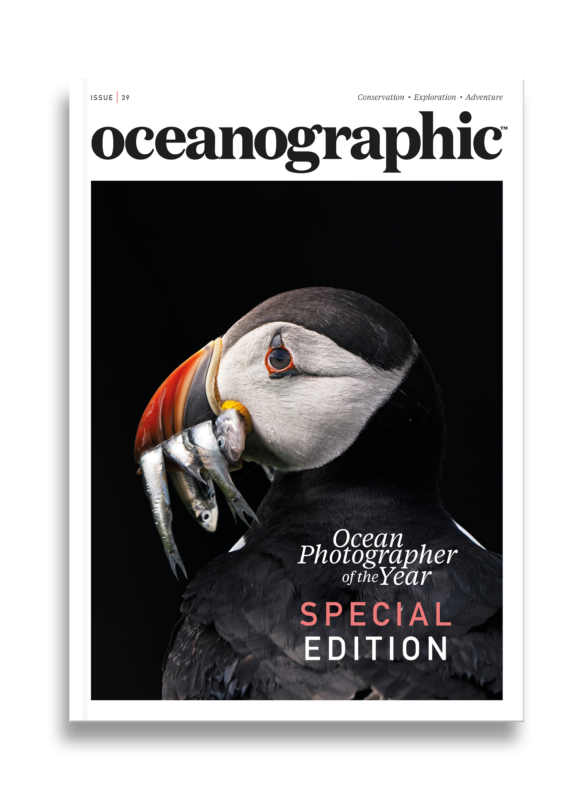

This feature appears in ISSUE 39: OPY SPECIAL EDITION of Oceanographic Magazine
Continue reading
This story is exclusively for Oceanographic subscribers.
