How long can Pintuyan's whale shark tourism remain ethical?
In Pintuyan, Philippines, a small fishing community has built an ethical whale shark tourism model that prioritises animal welfare over profit - but the lure of guaranteed sightings and greater revenue is testing that commitment.
“We jabbed them with paddles,” a local fisherman recounted.
In the early ’90s and even before, these gigantic sea creatures were not considered special in the community and, like many other species of sharks, were routinely targeted for finning. “Some villagers would cut off their fins and sell them in Surigao, then export them to China through the black market,” he added, his eyes now fixed on the silent sea before us.
Fishing for whale sharks was once a common practice, especially in the Visayas and northern Mindanao, until Fisheries Administrative Order No. 193 was issued in 1998, outlawing it across Philippine seas.
Today, whale sharks are considered “celebrities” and have significantly contributed to the local economy of Pintuyan, a small fishing town in the southwest of Panaon Island in Southern Leyte. Although not conveniently accessible and located roughly 110 miles from the regional centre, Pintuyan has not escaped the attention of foreign tourists, while the town’s approach to marine wildlife tourism has steadily become its main attraction.
The municipal government started whale shark tourism in 2005, and it was formally regulated by a local ordinance in 2009 – one of the world’s first. Whale shark watching in Pintuyan starts in October and lasts until May.
Since the establishment of the small-scale tourism industry, KASAKA – a community-based tour guide group – has been responsible for ferrying tourists to the areas of water where the sharks are expected to be found while ensuring that all guidelines are followed. Upcoming changes to both the group’s charter and its name, however, will see it soon renamed the “Son-ok Spotters and Tour Guide Association”. The group’s president, Mt Carlito Mosot explains that Son-ok is a barrio or small village in which the association is based. Here, the group boasts some 60 trained ‘spotters’ and guides, all of whom are local fishermen.
I ask Mr Mosot just how these spotters are able to spot whale sharks, and what would happen should they fail to achieve their task.
“When spotters search for individual sharks, they are really searching for signs of them, which usually presents itself in a brown discolouration of the water,” he explains. “This discolouration means there’s a swarm of shrimp-like crustaceans. People here call it ‘uyabang’ – sergestid shrimps, a food favoured by whales and sharks.
“Of course, before we send the tourists seaward, we explain to them that whale sharks are ever mobile and sightings are not guaranteed. Unless, that is, we hand-feed them with processed uyabang.”
Not only is hand-feeding not practiced in Southern Leyte, it is – in fact – not permitted under the Joint Memorandum Circular (JMC) directive No. 01 of 2020 as well as the Local Ordinance governing whale shark tourism in Pintuyan.
Other features



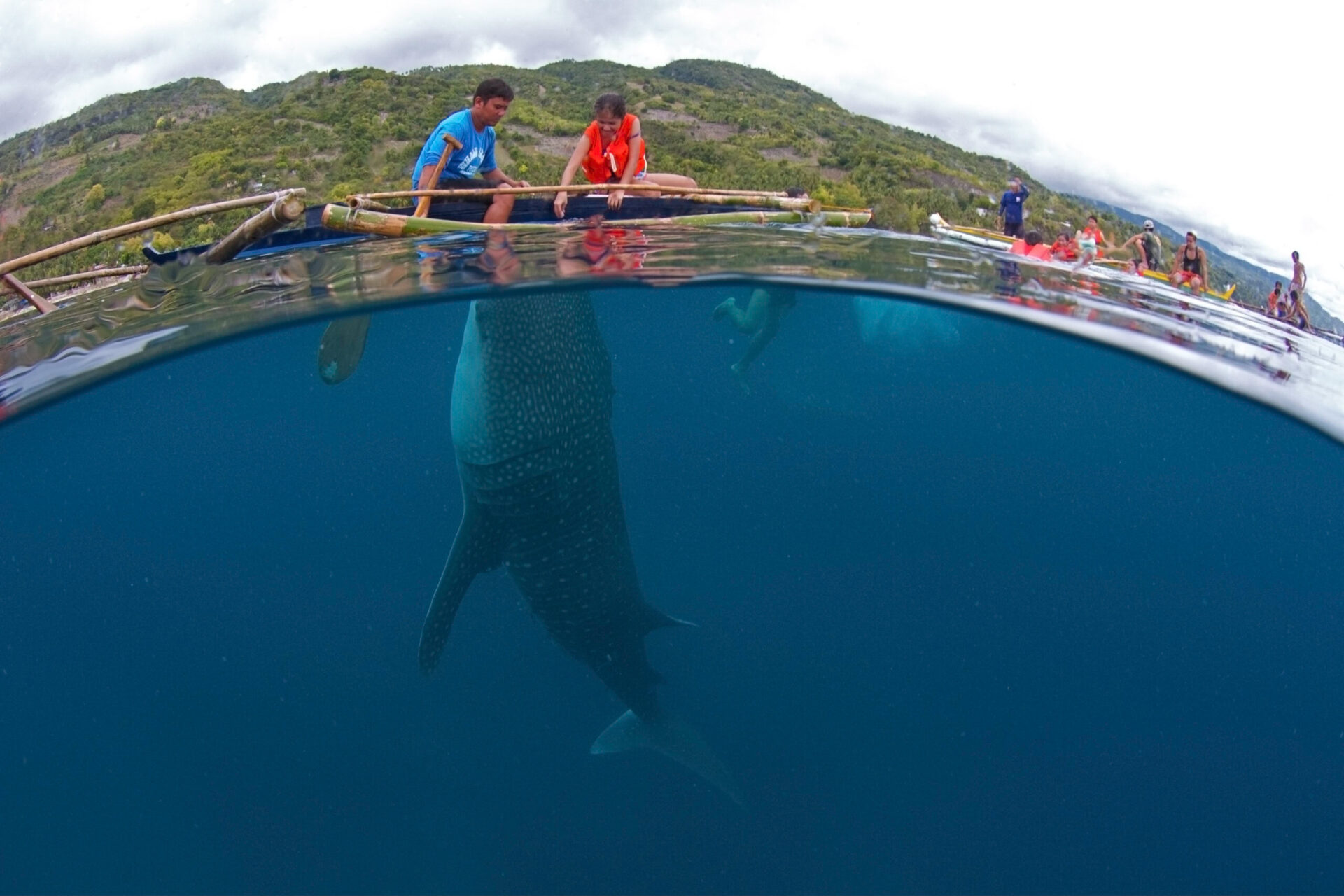
In the Philippines, there are four main known aggregation sites across Sorsogon, Palawan, Oslob in Cebu, and Pintuyan in Southern Leyte.
The whale shark tourism operation in Oslob is the most famous, the largest, and the most controversial precisely because whale sharks here are fed daily, year-round, to guarantee sightings. Despite the pressure from conservationists over its negative impact, the practice continues. Provisioning disrupts the natural behaviour and highly-mobile nature of whale sharks, as well as increased metabolic and injury rates as shown on several studies at the site.
The operation in Pintuyan is an antithesis. “Ours is not unethical,” Mr. Mosot declared. “The endangered species feeds on our clean waters of their own volition.”
In Pintuyan, the sharks show site fidelity because food is naturally available and not because of consistent feeding. And this is the real draw here.
However, the local government unit (LGU) is at a crossroads. Government officials are becoming increasingly enticed by the allure of larger tourist numbers, something which guaranteed whale sightings would surely increase.
Edilberto Alapag is a tourism officer working out of Pintuyan. Following a recent visit to Cebu, he believes the tantalising promise of tourists’ dollars could be enough to reverse the current local restrictions.
“Our local government conducted a benchmarking activity in Oslob. We observed their practices. And you know what? We were enticed,” he explains. “The most enticing was the feeding model.”
“The practice makes sightings guaranteed. So, hundreds of tourists come to their place every day. It’s is a lucrative operation, a multi-million-dollar industry.”
Their whale shark tourism venture now finances their public works and social services, he said. “There was a year when their tourism revenue from whale shark tours alone reached $1.5 million U.S. dollars, while ours only earned $50,000.”
If the LGU were to adopt the provisioning practice, then a possible prospect would be a tourism boom.
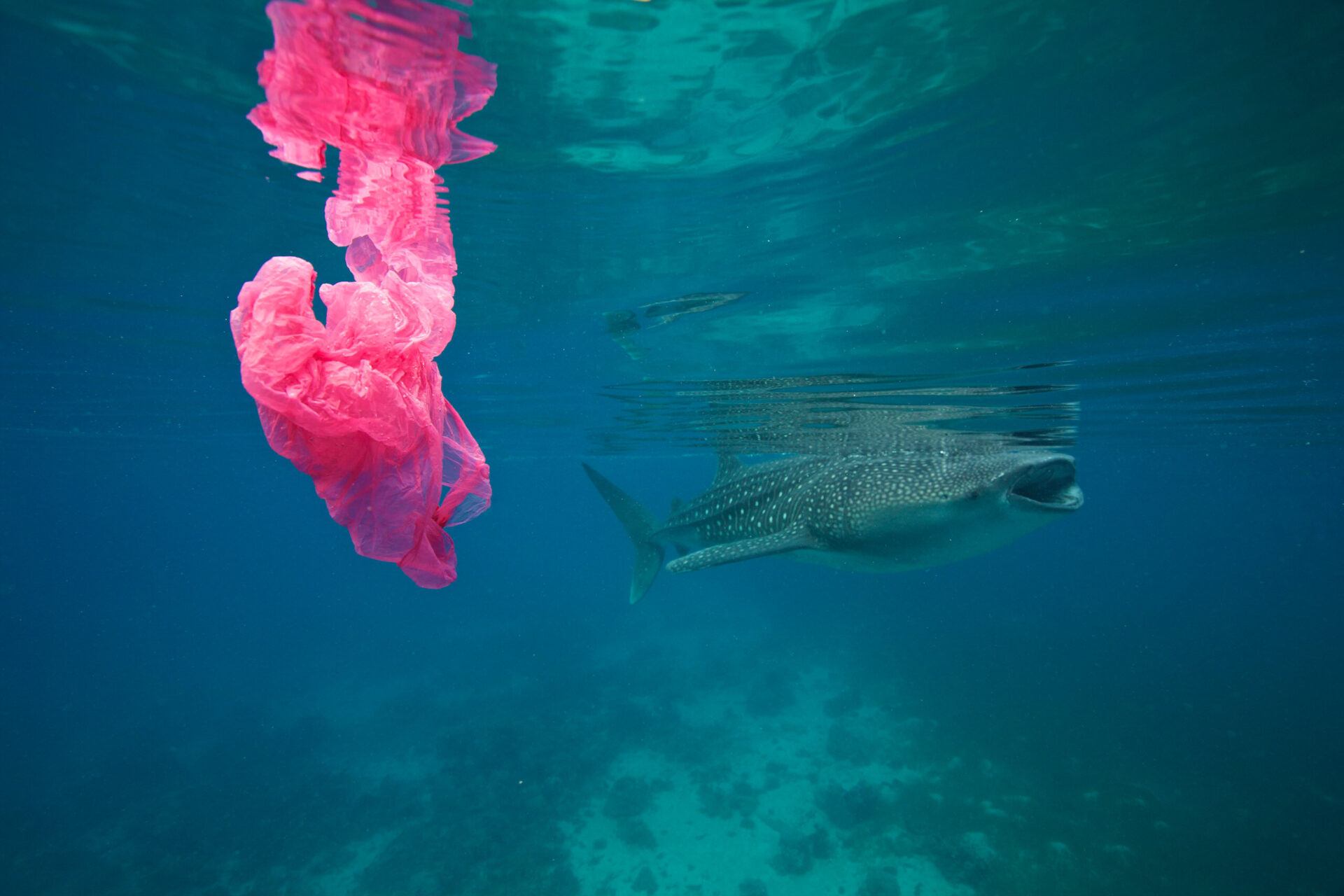
For now, however, Alapag assures that adopting this “unethical” model remains only a remote possibility. Their visit to Cebu also revealed the worst of the industry: Stinking and murky water from thawed-out krill and rambunctious large groups of tourists ignoring regulations, such as distance rules.
Alapag also emphasises the lack of accommodations and commercial buildings in town. “We’re not ready for mass tourism because we have very limited inns and restaurants. We even struggle to meet the demand of present foreign tourist arrivals, so we are considering the idea of home stays.”
Based on office data, the present season has seen record-high tourist figures, with monthly totals surpassing 800, most of which are French, Spanish, or Portuguese. This growth in popularity, Alapag suggests, is down to one vlogger from Barcelona named Domingo whose content has helped raise awareness of this small town, globally. Today, tourists from various across Europe – including those from Greece, Belgium, the Czech Republic, the United Kingdom, Ireland, Denmark, the Netherlands, and Luxembourg – fill the town.
For now, it is the ethical foundation upon which the current town administration stands that keeps Pintuyan from adopting the controversial feeding model. But for how long will this line be held? What would future leaders make of the opportunity to boost its municipal income?
“The future of our operation, whatever changes, is up to the wisdom of our future leaders.” says Alapag.
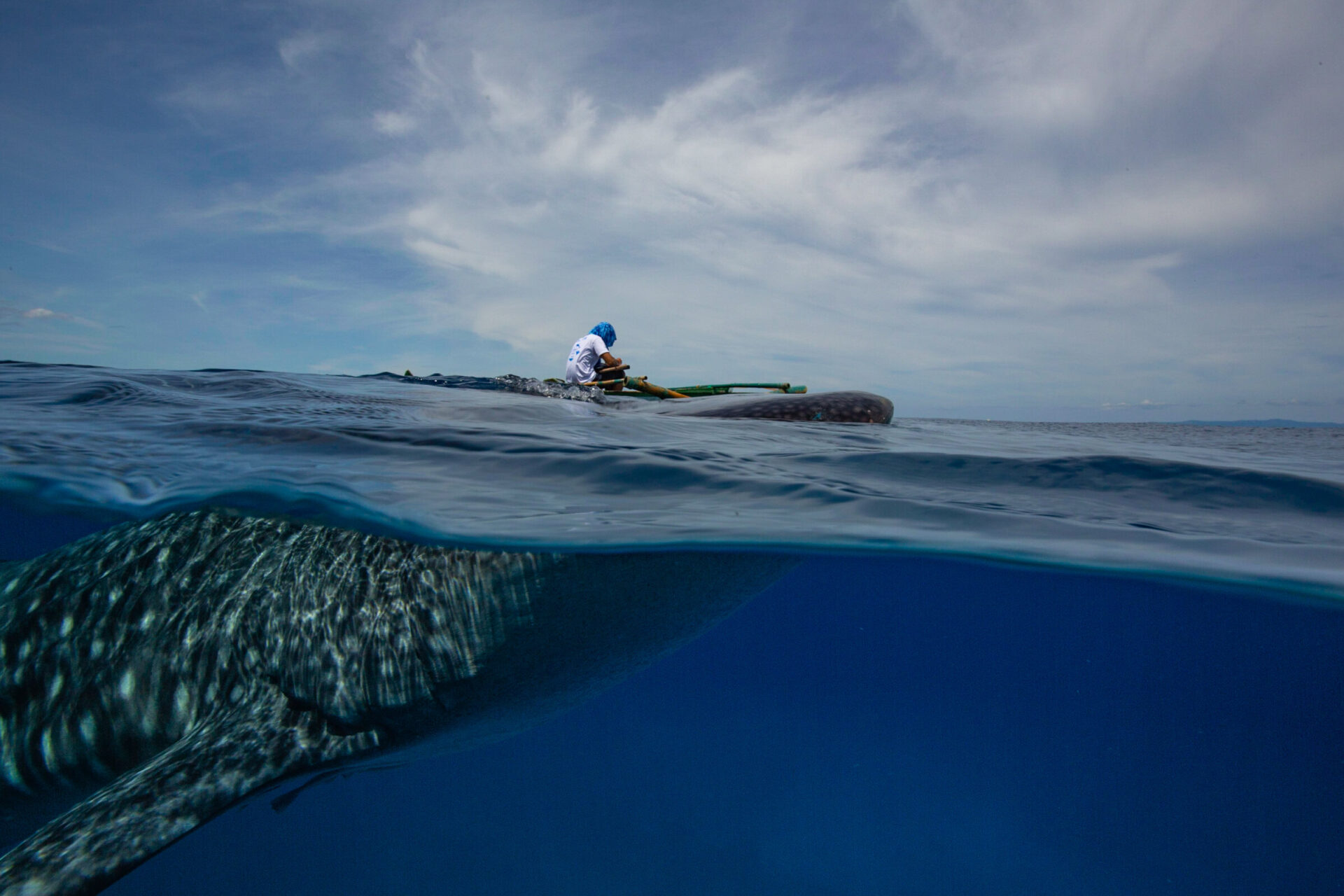
Throughout my days in Pintuyan, I stayed at a beachside resort owned by Mr. Ricarte Estrella, the town mayor. At the back of my room was the base camp of KASAKA, where tourists are briefed on interaction rules before the tour. It’s here they are instructed to maintain a three-metre distance from the sharks, no flash photography, no selfie sticks, no scuba diving, and strictly no feeding.
Townspeople here call this charismatic species tiki-tiki – a play on the Cebuano word for lizard. I have long been baffled by how the two creatures came to be compared. It was an elderly local who informed me that it was ‘because of their wide heads, rough skin, and blotchy patterns.’ I called to mind the appearance of a gecko living in the hollow bole of the neighbour’s old jackfruit tree or at my maternal grandmother’s house.
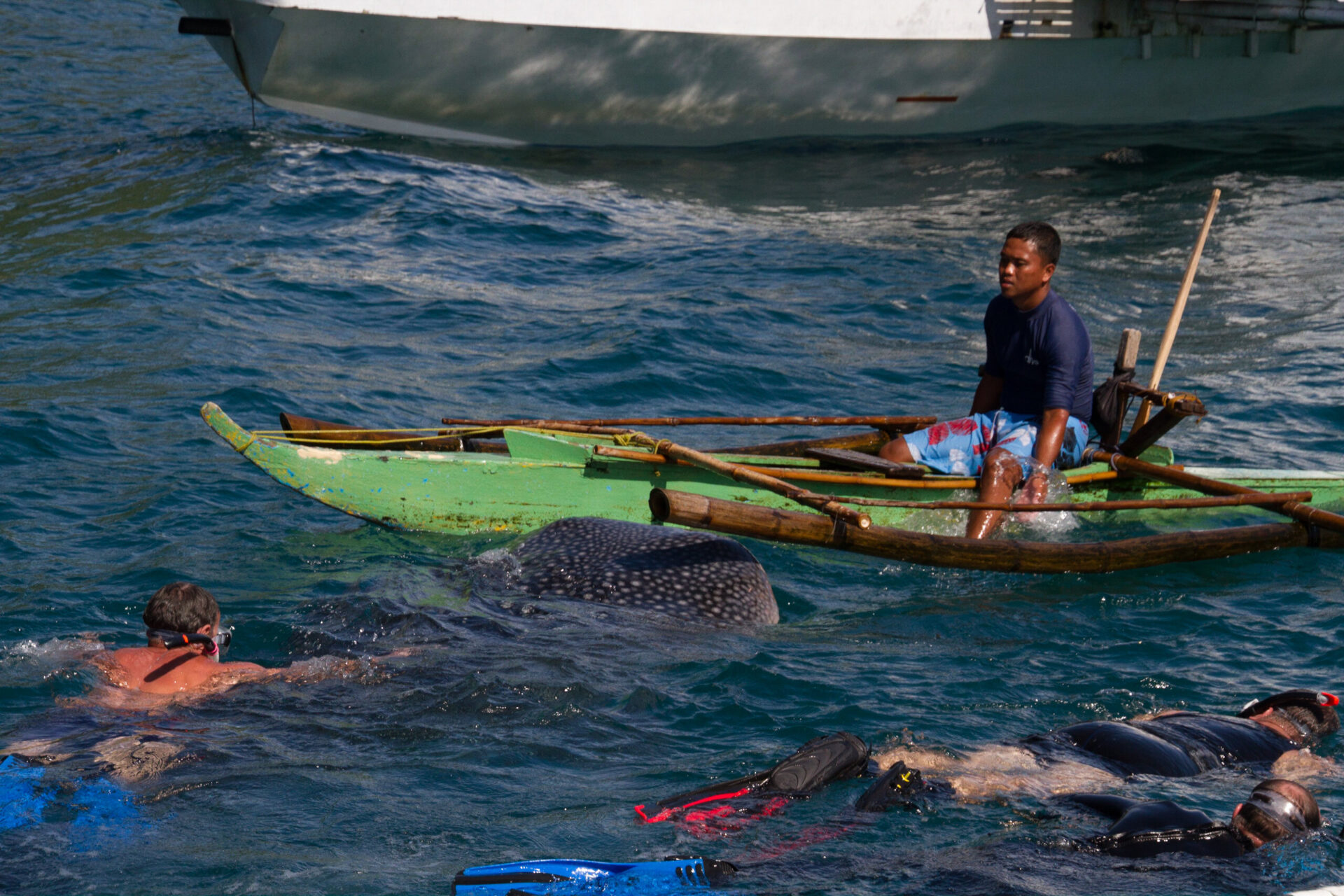
On a hot April morning, I boarded a rescue motorboat en route to the interaction area. Two town hall staff members accompanied me. We cruised northbound from the boulevard and – in just a few minutes – we had reached our target destination: the natural feeding ground.
We scanned the water for any signs of the giants. It wasn’t too long before we spotted a big dorsal fin knifing through the water.
“Whale shark!” I couldn’t stop myself from shouting.
The water was dark blue, concealing its massive body as it went to a considerable depth. But the opportunity to catch a glimpse was one not to be missed. They handed me a life jacket and threw a ring buoy with a rope attached at the stern, encouraging me – surprisingly hesitant – to jump in. Having built up just enough courage to do so, I was but a fraction of a moment from taking the plunge when I was stopped in my tracks.
The first boat to arrive was that of Kuya Baloy Cordova, a veteran KASKA diver and spotter. Not long after, several boats – each transporting tourists – began to populate the area. In total, I counted 16 foreign tourists gathering at this precise spot. Baloy invited me instead to join him in his boat. I gingerly obliged.
He explained to me how proficient he was at identifying individual whale sharks just by the spot patterns behind their gill slits. With his own specialised underwater camera – gifted to him by a local non-profit – Baloy had become an expert in photo identification and has been contributing to local and global efforts to understand and track whale sharks since 2013.
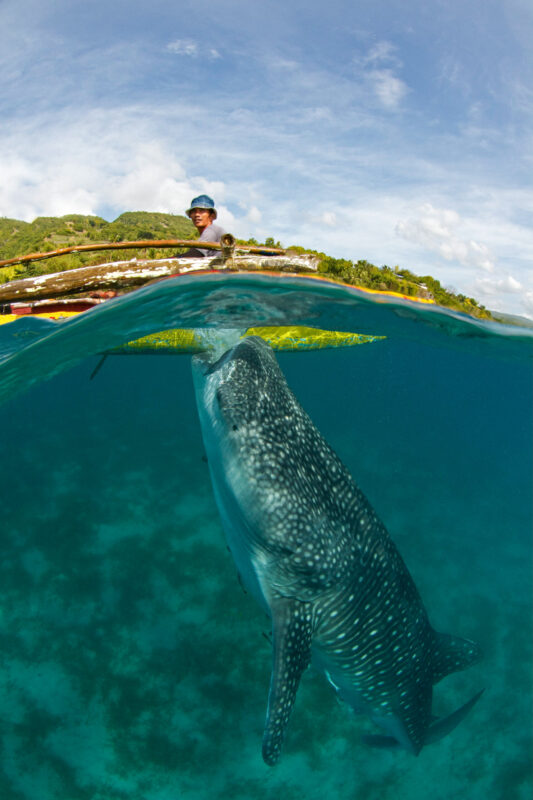
Taking the lead, he dived first only to resurface and give me the cue. I swam out with my mask on, but held a solid grip on the outrigger. The ocean was generous that day.
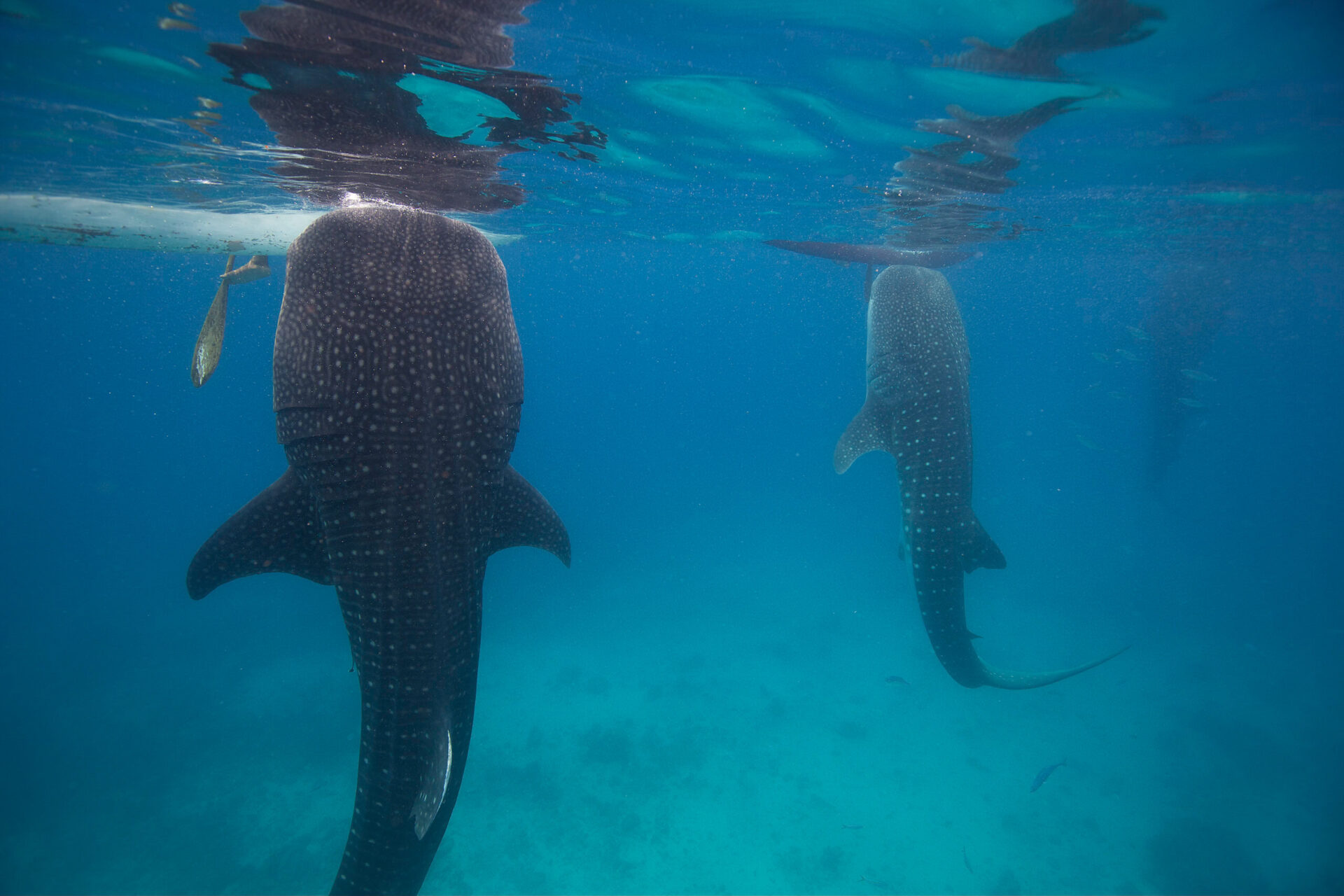
Despite their size, whale sharks move gracefully and in circular motions. They disappear for a moment only to reappear. The thousands of sulid, or yellowtail fusiliers, swimming around made the spectacle below more magical, if not poetic. I expected them to hang vertically, mouths gaping, as if ready to swallow up our boat. But when a shark moved toward me, I was terrified.
I remembered what Mr. Mosot said about calling this giant fish ‘gentle’. “It’s sort of a misnomer, because once it hits you, it has the capacity to hurt,” he had joked.
As filter-feeders, whale sharks can grow up to 18 to 20 metres in length. The four sharks crossing below were around five to six metres. Baloy told me the biggest he had seen in this region was around eight metres. All of them here, young males.
The Pintuyan waters are dominated by juvenile males, like those in Ningaloo Reef, Australia, or most other coastal whale shark aggregations. By contrast, the famous Galapagos Islands are a rare aggregation site for adult females.
Where is the rest of the population? Not even Baloy can answer that. And neither can many marine scientists. As a species, whale sharks remain surprisingly mysterious. To this day, researchers are still to understand where whale sharks mate and give birth. It’s speculated that whale sharks dive to great depths for these activities. “If it’s happening, and we know it is, it must be happening out of sight, i.e. where we aren’t looking or fishing.”
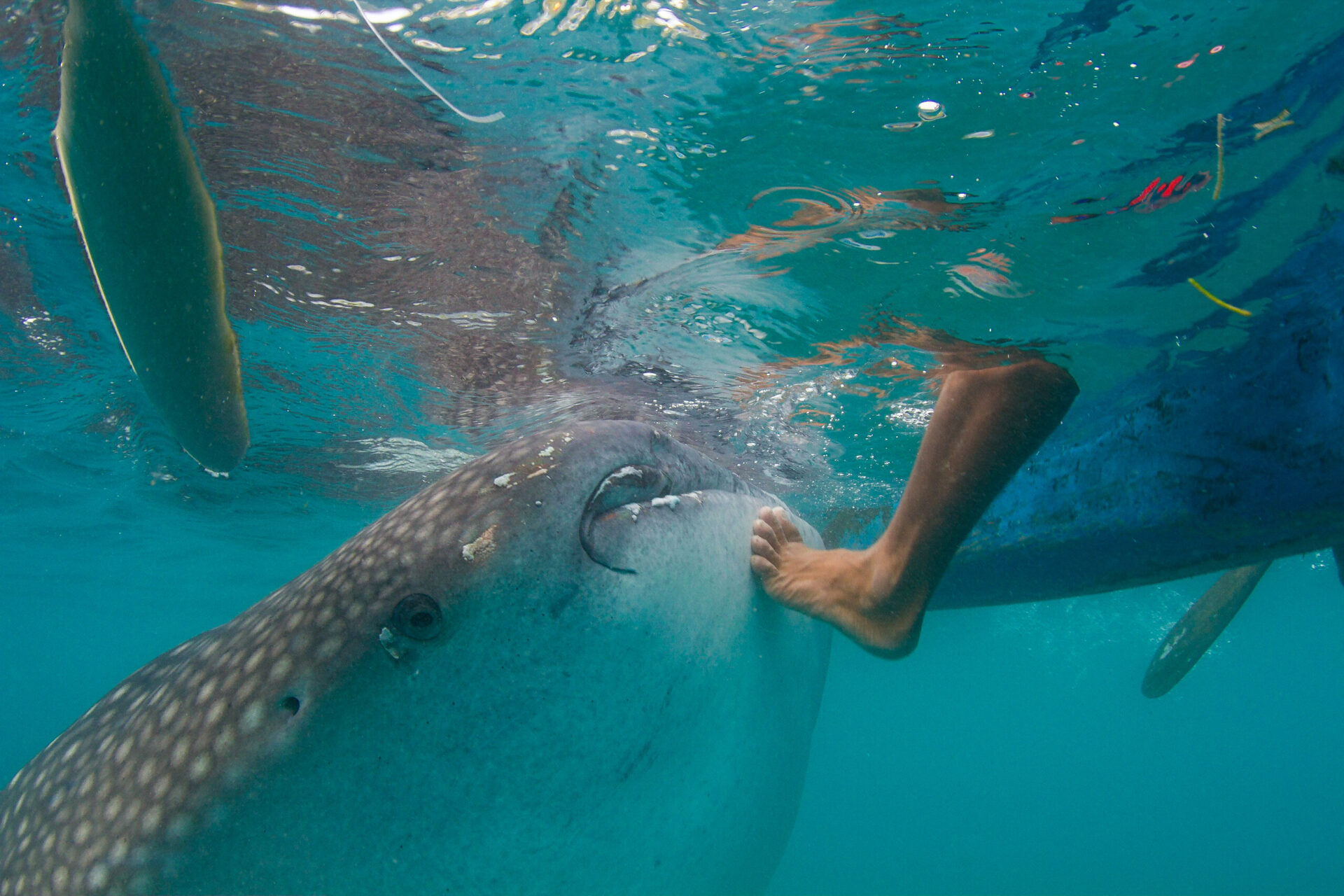
Minutes into awkwardly bobbing my head up and down, I started to notice the viscerally saddening condition of at least two of them. One had a scar on its fin; the other, on its mouth.
But if – as I have been assured – whale shark viewing here is done in the right way, what is the cause of these kinds of injuries?
Alapag and the KASAKA members insist such scars are not owing to their own activities and are prudent to switch off their motors as they approach any known feeding site. Instead, Alapag posits, whale sharks are known to feed close to the surface at night. It’s possible these injuries could have been sustained by accidental collisions with locals – and non-locals – moving to and from the local fishing grounds.
Alternatively, they may have been trapped by gill nets beyond protected areas, or have sustained their injuries within waters outside of these, along their vast migratory routes. Each is a possibility that Dr Gonzalo Araujo, the Director of Marine Research and Conservation Foundation (MARECO), can readily subscribe to.
Dr. Araujo lived and worked in Pintuyan for years and is now working with Qatar University to help safeguard the world’s largest known aggregation of whale sharks in the Arabian Gulf.
He explains that scars can originate from many different locations. “From Pintuyan, they can travel to Mindanao and Bohol and back in a matter of days. There is also strong evidence of whale sharks moving between the Philippines and neighbouring countries, including Malaysia, Indonesia, Taiwan, and even as far as Japan.”
At a local level, last year (2025) President Ferdinand Marcos Jr. signed a landmark legislation under the Panoan Island Protected Seascape (PIPS) Act in which it was mandated that the Philippine Coast Guard (PCG) regulate the speed of all vessels operating in the waters around the island.
Oceana, an international advocacy organisation that lobbied for PIPS in Congress, said it is “actively coordinating with the Protected Area Management Board and the PCG to have speed limit guidelines issued this year.”
Dr Araujo continues: “Large vessel collisions, or ‘ship strikes,’ are a major cause of whale shark mortality globally and are likely hindering their population recovery.” Such a concern was highlighted as a conservation priority in the latest 2025 IUCN Red List assessment, as well as in the resolutions of the Convention on the Conservation of Migratory Species of Wild Animals (CMS).
My whale shark interaction couldn’t have lasted longer than 30 minutes. My first true wildlife experience. I thanked Kuya Baloy for his thoughtfulness and jumped back onto the speedboat, and back to my accommodation to decompress and reflect on everything I had learnt. I considered myself very lucky to have seen four of these gentle giants, and among the chatter with other visitors to the town, I was not the only one to be blessed that day. Yet underneath the excitable discussion was a thread of concern.
“I really don’t want this place to end up like Oslob,” was the ultimate conclusion amongst us.
For the time being, Pintuyan prides itself on this distinction. Its whale shark tourism operation – currently – values animal welfare over profit. For how long it can hold on to this model remains to be seen. For the time being, town officials and local fisherfolk-led association maintain a “responsible” and relatively less intrusive operation. And that’s what matters most.
Jeric Olay is a Filipino teacher and writer born in Macrohon, Southern Leyte. He writes about the beauty of his small, sleepy province. His poems have appeared abroad, but this is his first article to be published outside his home country.
Printed editions
Current issue
Back issues



Enjoy so much more from Oceanographic Magazine by becoming a subscriber.
A range of subscription options are available.
