Ian Urbina is the director of The Outlaw Ocean Project, a non-profit journalism organisation based in Washington D.C. In this column, he explains how the Chinese fishing fleet has managed to increase its control over global fishing, using some controversial practices.
On March 14, 2016, Argentina’s coast guard detected a Chinese vessel fishing illegally in national waters. When the ship attempted to ram the coast guard cutter, the Argentinians opened fire on the vessel, which soon sank. The Lu Yan Yuan Yu 010 was one of 11 Chinese squid vessels that the Argentine navy has chased for suspected illegal fishing since 2010, according to the government. But one year after the incident, Argentina’s Fishing Council announced that it would grant fishing licenses to two vessels owned by the same Chinese operator that owned the Lu Yan Yuan Yu 010. These ships would sail under the Argentine flag through a local front company. The decision seemed to violate Argentine regulations that not only forbid foreign-owned ships from flying Argentina’s flag or fishing in its waters but also prohibit granting licenses to operators with records of illegal fishing. This move is an increasingly common one around the world.
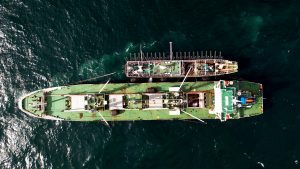
Over the past three decades, China has gained supremacy over global fishing by dominating the High Seas with more than 6,000 distant-water ships. When it came to targeting other countries’ fishing grounds, Chinese fishing ships typically sat ‘on the outside’, in international waters along sea borders, running incursions across the line into domestic waters. In recent years, China has increasingly taken a ‘softer’ approach, gaining control from the inside through legal means by paying to flag in their ships so they can fish in domestic waters without the risk of political clashes, bad press, or sunken vessels. This method typically involves going around prohibitions on foreign shipowners by partnering with local residents and giving them majority ownership stakes. Through these partnerships, Chinese companies can register their ships under the flag of another country, gaining permission to fish in that nation’s territorial waters. Sometimes Chinese companies sell or lease their ships to locals but retain control over decisions and profits. In other places, these companies pay fees to gain fishing rights through ‘access agreements’.
Chinese companies now control nearly 250 flagged-in vessels in the waters of countries including Micronesia, Kenya, and Iran. Many of these companies have been tied to a variety of fishing crimes. Trade records show that some of the seafood caught on these vessels is exported to countries including the United States and Spain. Most countries require ships to be owned locally to keep profits within the country and make it easier to enforce fishing regulations. Flagging-in undermines those aims. Food security and local livelihoods are also undermined by the export of this affordable protein. In the Pacific Ocean, Chinese ships comb the waters of Fiji, the Solomon Islands, and Micronesia, according to a 2022 report by the U.S. Congressional Research Service. “Chinese fleets are active in waters far from China’s shores,” the report warned, “and the growth in their harvests threatens to worsen the already dire depletion in global fisheries.”
The tactic of ‘flagging in’ is not unique to the Chinese fleet. American and Icelandic fishing companies have also engaged in the practice. But as China has increased its control over global fishing, Western nations have focussed attention on its misdeeds. Even frequent culprits can also be easy scapegoats. When criticised in the media, China pushes back, not without reason, by dismissing their criticism as politically motivated. Still, China has a well-documented reputation for violating international fishing laws and standards.



Continue reading
This story is exclusively for Oceanographic subscribers.
