Ian Urbina is the director of The Outlaw Ocean Project, a non-profit journalism organisation based in Washington D.C. In this column, he covers conservation concerns around the Saya de Malha Bank, the world’s largest invisible island.
The most important place on earth that virtually no one has ever heard of is called the Saya de Malha Bank. Often referred to as the world’s largest invisible island, it is situated in the Indian Ocean between Mauritius and Seychelles, more than 200 miles from land. The Bank extends over an area the size of Switzerland and is home to the world’s largest seagrass fields, which make it the planet’s most important carbon sink. The Bank, which in some spots is barely hidden under 30-feet of water, offers an unprecedented diversity of seagrass habitats for turtles, along with breeding grounds for sharks, humpback whales, and blue whales.
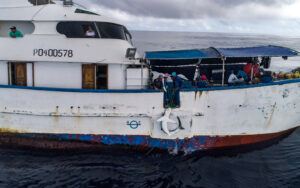
Researchers say that the Bank is one of the least scientifically studied areas of the planet – partly because of its remoteness. The area’s unpredictable depths have also meant that, over the centuries, merchant ships and explorers tended to avoid these waters. It has long been the type of fantastical realm so uncharted that on the old maps, it would be designated, ‘Here Be Monsters’. More recently, though, the Bank is traversed by a diverse cast of characters, including shark finners, bottom trawlers, seabed miners, stranded fishers, starving crews, wealthy yachters, and libertarian seasteaders.
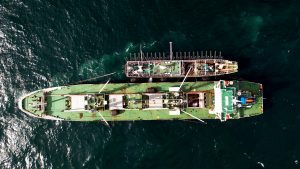
The tragedy, however, is that since the Saya de Malha Bank is mostly located in international waters where few rules apply, its biodiversity is being systematically decimated by a huge fleet of industrial fishing ships that remain largely unchecked by government oversight. The Bank remains unprotected by any major binding treaties largely due to an anemia of political will by national authorities and a profits-now costs-later outlook on fishing interests. This issue has spurred the Outlaw Ocean Project to conduct a year-long investigation into the Saya de Malha Bank, raising the question: why should this matter to us?
The Bank got its name, which means ‘mesh skirt’, more than 500 years ago, when Portuguese sailors came across it on the High Seas and noticed rolling waves of seagrass below the surface. Much like trees on land, seagrass absorbs carbon dioxide from the atmosphere and stores it in its roots and soil, and does it especially fast – at a rate 35 times that of tropical rainforest. However, they are far less protected than other offshore areas. Only 26% of recorded seagrass meadows fall within Marine Protected Areas, compared with 40% of coral reefs and 43% of the world’s mangroves.
Seagrasses are also home to vast biodiversity. Thousands of species, including in the Saya de Malha Bank, many as yet unknown to science, depend on seagrasses for their survival. But the planet has lost roughly a third of them since the late nineteenth century and we lose 7% more each year – which is roughly the equivalent to losing a football field of seagrass every 30 minutes.



Continue reading
This story is exclusively for Oceanographic subscribers.
