Professor Enric Sala
Professor Enric Sala is a marine conservationist and National Geographic Explorer in Residence as well as the Founder and Executive Director of Pristine Seas.
More from The Innerview

Astronauts who first saw our planet from space experienced a mystical awakening. Through the portholes of their capsule, they beheld Earth as a whole: a solitary, shimmering cell. They saw a planet devoid of the artificial boundaries of man – bound instead by a single, global ocean. That Overview Effect gave astronauts a deep feeling of respect for our common home. The photographs they took – flat snapshots of this blue marble – can make us ground-based people understand that Earth is our only home, but for a shift of perspective to be deep and permanent, it must be felt.
If we can’t leave our planet to look back, we can instead look around us. The view from space may terrify some and produce cosmic anxiety. The view from within may also produce deep malaise as we witness the scars of our insatiable consumption. But it can also produce a sense of awe, wonder and reverence as powerful and transformative as the Overview Effect. I have experienced this Innerview Effect countless times, relishing the majesty of an old-growth forest, listening to the soothing hum of a million bees in a meadow, and diving in remote places. It is the latter that has given me the deepest spiritual feeling and driven my purpose.
Since 2008 my National Geographic Pristine Seas team and I have explored some of the most remote places on Earth. I remember vividly the first time – over 20 years ago – I jumped in the water at an uninhabited and unfished coral atoll in the middle of the Pacific. As soon as the bubbles of my entry cleared, I noticed I was surrounded by a dozen grey reef sharks, curious at first then quickly uninterested. Looking down, the seafloor was teeming with life: a thriving coral garden, a green turtle swimming peacefully among a school of convict tangs, a band of unicornfish with a Pinocchio-like nose. When the sharks left, two-foot-long twinspot snappers, with fangs sticking out of their mouths like vampires, approached and timidly bit my fins and ponytail. We were probably the first humans they had ever seen.
On that first dive I felt as if I had jumped in a time machine and travelled to the past, a thousand years back. Unlike the Mediterranean Sea of my childhood where I was in awe of tiny wrasses and crabs – unaware of everything that was missing – here I could see the ocean web of life at its best: unimpeded, unconstrained, exuberant. I lived a quasi-mystical experience that became indelibly written into my soul: all creatures on Earth are connected. We depend on them for our survival; ironically, their lives depend on our ability to respect them.
We’ve jumped in that time machine many times, travelling to faraway places: giant kelp forests where diving is like flying through a gothic cathedral, sunlight filtering through stained glass; Arctic islands where polar bears maraud walrus colonies; offshore islands where if you’re patient enough you can witness a school of two hundred hammerhead sharks swimming synchronously above you.
These places provide us with an Innerview of what our ocean used to be like, and make us fully understand all we destroyed as our civilisation flourished. But most importantly, this Innerview could also be a blueprint for the ocean we want for the future. At Pristine Seas, we have worked with local and Indigenous communities, partners and governments, to safeguard over 30 of the most vital places in the ocean in marine reserves where fishing, mining, drilling and other damaging activities aren’t allowed. In these places – from the poles to the tropics, covering a total area the size of the Amazon region – marine life thrives and helps replenish degraded areas nearby, benefitting both nature and people. It’s like the miracle of the fish. It’s a miracle and it’s real, for I have seen it many times.
If we leave it, the ocean will bounce back to life, faster than we ever imagined. It is now up to us to decide what we want our common home – our only home – to be: the collateral ruin of our folly, or the testament of our hard-earned wisdom.
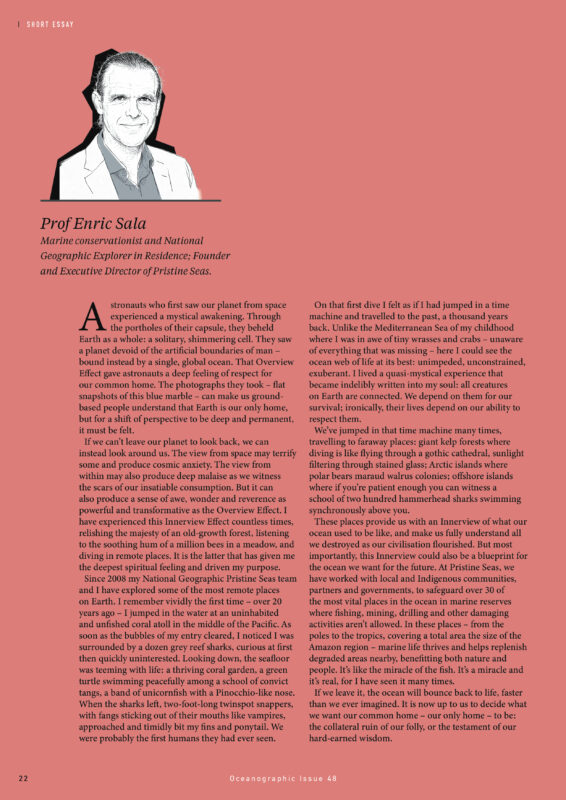
This is how this short essay appears in the special Oceanographic publication, The Innerview
Printed editions
Current issue
Back issues

Enjoy so much more from Oceanographic Magazine by becoming a subscriber.
A range of subscription options are available.
