Incidental catch, accidental curse
When photojournalist, Sirachai Arunrugstichai helped push through laws to protect sharks from open trade in Thailand ten years ago, no one expected it would create a 'darker route' to market. So, what have we learned about conservation laws in the last decade?

I don’t remember exactly how many hammerheads I saw that day—maybe two hundred, maybe more, but I was also too lazy and too busy to count. It was right after the new year of 2013, and I was still just a student without any grey hair who tagged along with another researcher to assist with market surveys at landing sites along Thailand’s Andaman Coast. The cool morning air smelled like blood and brine, while the ground was covered in slime and squished fish guts that reflected sunlight.
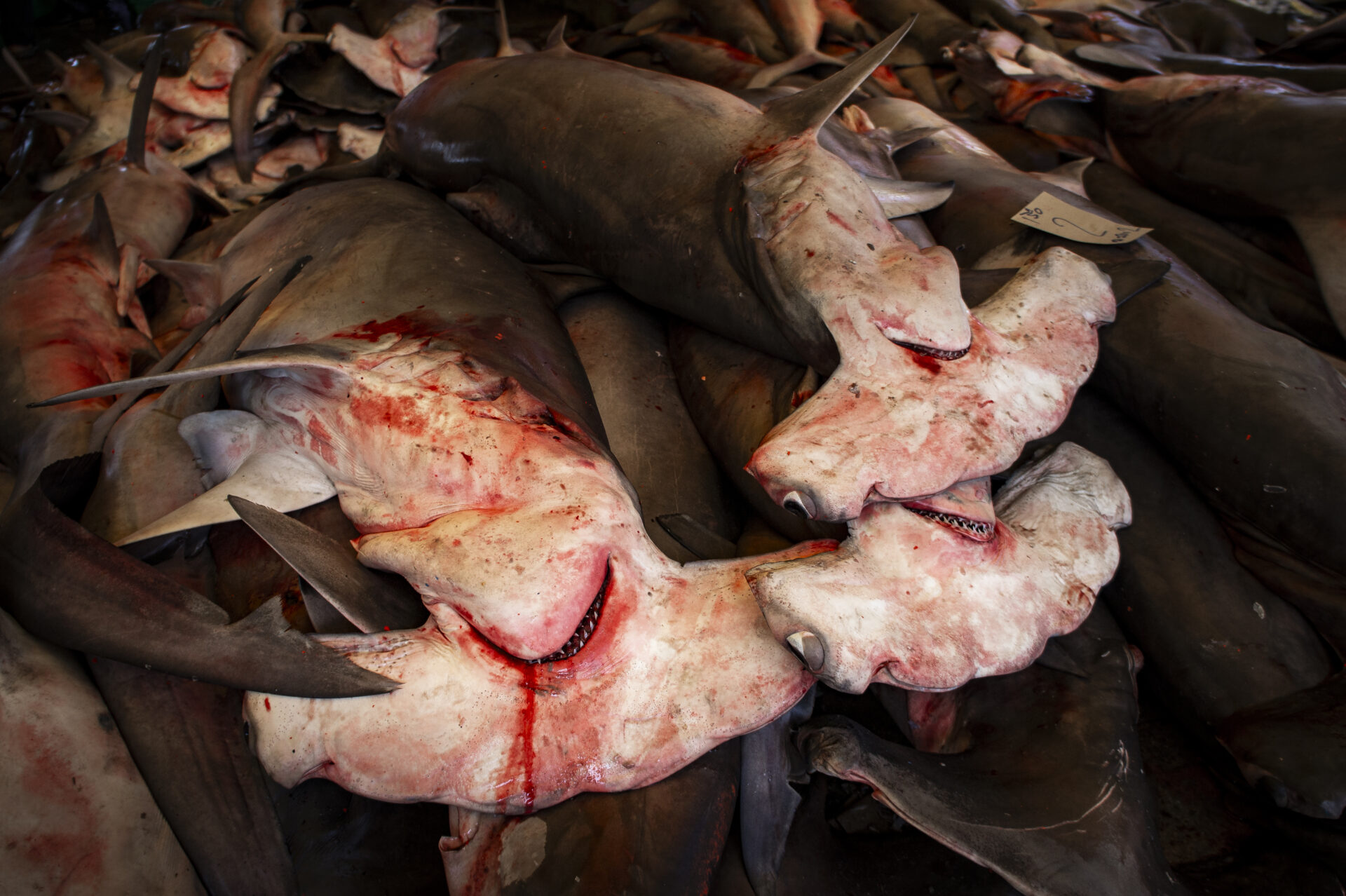
The sharks were laid out in a messy pile along the street—their eyes still open, as were their gaping maws with visible trails of dried blood. Their strange, iconic heads are unmistakable even in death. I didn’t really know its significance back then, and took a few frames with a camera I borrowed. It was the last time I saw hammerheads in such numbers.
Time flies. Fast forward a few years to 2014, then 2015. By then, I was neck-deep in my master’s research. Same landing sites, same dirty t-shirts and worn-out flip-flops, with new data collection gear. But this time, the hammerheads were mostly gone—so were the thresher sharks, and nearly all of the big ones. Most large species had simply vanished. The landings were now filled with smaller, faster-growing species like bamboo sharks or spadenose sharks. That drastic shift—between the abundance of large species I saw as a young student and the eerie absence just a few years later—became the core concept of my study on shark fisheries in the Andaman Sea.
The results showed that sharks had declined by more than 90%, according to the landing data, when compared with fisheries data from 10 years ago. Large-bodied species, especially requiem sharks (Carcharhinids) and hammerheads (Sphyrnids), which tend to be slow in reproduction and slow-growing, had practically vanished from the landings. Hammerheads, in particular, had fallen to about 1% of their previous numbers, despite being the most abundant sharks caught in Thai commercial fisheries only a decade ago.
More columns from Sirachai


The sharks were laid out in a messy pile along the street—their eyes still open, as were their gaping maws with visible trails of dried blood.
The findings were picked up instantly after I presented my study at a Marine Science Conference in Thailand. The Thai Marine Science Association highlighted my master’s research to propose that three hammerhead species be listed as Protected Species under national law. At the time, I saw it as a rare conservation win—a rare chance where science drives policy changes to protect something before it disappears.
I got myself totally smashed that night in celebration. The listing proposal came in 2016, and the law became fully adopted and implemented in 2021, with the inclusion of one more hammerhead, the winghead shark. But with that new law came something we didn’t expect or prepare to handle, like a curse.
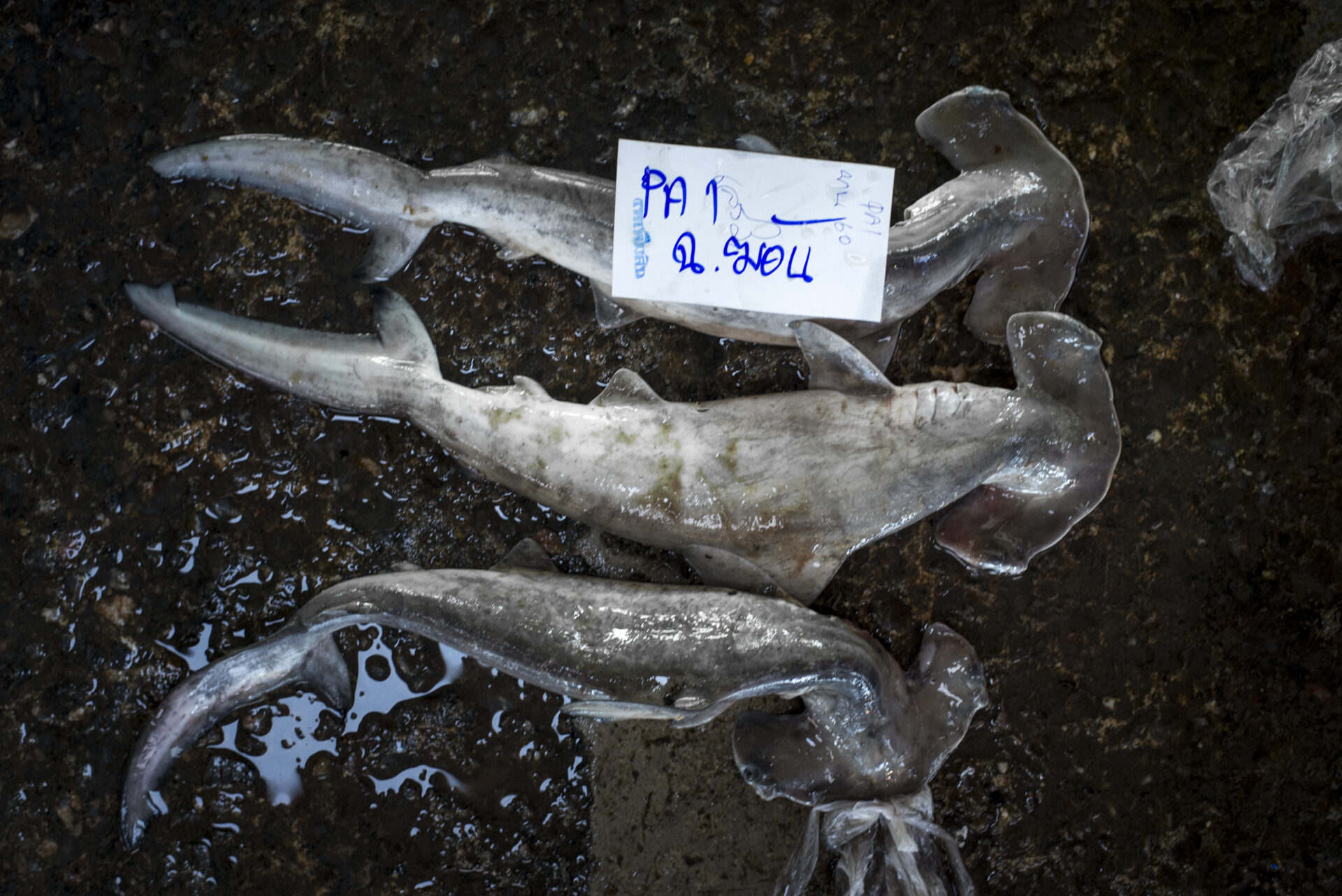
Sharks, which had been openly landed and displayed at landing sites in hundreds, either large or small, protected or not, quickly began to vanish from sight, not in the ecological sense, but from public view. Fishers, fearing legal trouble or backlash from the public, simply stopped displaying them for auction, but stealthily sold directly to traders who became very discreet. What used to be an open transaction turned into something harder to trace, harder to study, harder to regulate.
To understand how this happened, we have to look at the broader context of marine fisheries in Southeast Asia. Here, industrial fleets dominate the capture fisheries, where they rely on non-selective fishing gear—bottom trawls, purse seines, longlines—that catch everything, whether they want it or not. Sharks, along with rays, are typically caught as “Incidental Catch” that are retained and not discarded, since they still have value. And while shark finning in its textbook form, which cuts the fin and kicks the body overboard, isn’t the norm in Thailand, fins in the markets are mostly processed from sharks caught this way.
Meanwhile, meat, cartilage, offal, and jaws are fully utilized, in contrast to the traditional image of finning. That is not the case here. Based on my other work, when I traveled along the Andaman coast collecting anecdotal interviews from fishers on a road trip, there are hardly any targeted shark fisheries, as the population decline in these waters doesn’t make it feasible to do so anymore.
Ironically, even if the hammerheads were protected, in a fishery like this, it doesn’t matter much. They will die once caught and retained anyway, while the intensity of the fishing operation is enough to collapse their population. And now, although we have stronger laws in place, the data we used to rely on to monitor these collapses or, on a slim chance, potential recoveries, is nearly impossible to obtain. Landings become obscured, so the data is inconsistent. Trade routes go dark. Not just for hammerheads, but for nearly all sharks here at Thai landing sites.
In some ways, the conservation progress we hoped for ended up creating a black market by accident. In trying to save them, we also drove the trade underground.

I wanted to save the sharks. I still do. But part of me wonders if the path we took to protect them was built on sand—if we were too focused on getting the law adopted and not enough on the big picture of fisheries issues and the data monitoring and enforcement system. Conservation laws without robust monitoring, without enforcement, without alternatives, without cooperation from stakeholders in the industry to support it, can backfire.
It’s been ten years since the regulation was proposed at that conference. Ten years without reliable data. A decade of oblivion. I thought we were writing a better ending. But we weren’t. On paper, it looked like progress. In reality, it was an utter failure.
I still think of those early days—when hammerheads stretched across the street, and I was too naive to imagine what would follow. The memory clings, as does the sting of regret. I hope we know better now. Do we?
Meet all of our columnists here.
