'Aulani Wilhelm
'Aulani Wilhelm is the Chief Executive of Nia Tero.
More from The Innerview



Kanaloanuiākea
Kanaloanuiākea (Kanaloa of the vast expanse)
E Kanaloa Haunawela (Kanaloa of the depths of intensity)
Kanaloa ke ala ma’awe ‘ula a ka lā (Kanaloa of the west sky, the setting sun)
Kāne ke ala ‘ula o ka lā (Kāne of the east sky, the rising sun)
Kanaloa noho i ka moana nui (Kanaloa residing in the great sea)
Moana iki (Small sea)
Moana o’o (Mottled sea)
I ka i’a nui (In the big fish)
I ka i’a iki (In the small fish)
I ka manō (In the shark)
I ka niuhi (In the tiger shark)
I ke koholā (In the whale)
A hohonu (Of the depths)
‘O ke kai hohonu a he’e (The depths transcending)
‘O ke kai uli a palaoa (The dark depths of the sperm whale)
‘O ke kai kea a honu (White sea of turtles)
‘O ka hou ka’i loloa (The wrasse parade in a long line)
‘O nā au walu a Kanaloa (The eight currents of Kanaloa)
I pa’a ka maka (The source is stable)
I ka maka walu a Kanaloa (The numerous consciousness of Kanaloa)
Ola! (It lives)
Lana i ke kai (It floats in the sea)
Lana i ka honua (It drifts upon the land)
Lana i ka hopou a Kanaloa (It intermingles in the energy of Kanaloa)
I ka Mokupāpapa (Out to the low laying islands)
Ka papa kaha kua kea o Lono (The low laying coral islands of Lono)
‘O Lono ka pao (Lono is the bridge)
Ola i ke au a Kanaloa (Life to the realm of Kanaloa)
As a child I was always drawn to the ocean. I loved the beach, particularly the rolling, soft shore break at Waimānalo. I loved watching the ‘ūlili and hunakai run along the sand dodging the water’s edge as they searched for food. And to lay on the sand counting ‘iwa and wondering why they scared other birds into dropping their food. But most of all I loved tumbling in the surf, struggling to understand the waves and my place among them, then swimming out further where I could simply be immersed in the womb of the ocean. It was here, in the deeper parts of the ocean, where the ocean is darker – more silent somehow – that I felt more at peace. Where I could feel more deeply and hear more clearly, able to absorb more fully what the ocean was trying to teach me.
I understand these deep waters to be the realm of Kanaloa, our deity of the ocean, long-distance voyaging and navigation, deep-sea fishing, and marine life. Importantly, he is also the god of healing who holds knowledge stored in the deepest parts of the ocean where the palaoa (sperm whale) roam. This makes sense to me as I have always felt that I have obtained my most important ‘ike (knowledge) from time spent in relationship with the ocean, particularly when I have been farthest from land or in deep water.
Our origin story, the Kumulipō, tells us we descend from the ocean. Our first nonhuman ancestor to emerge out of Pō – the primordial source – was the coral polyp, from which all other forms of nature, including us, descend. As such we are the ocean and the ocean is within us.
We have many words to describe the ocean, the nearshore, the brackish water, the reefs, the waves, the currents and its many inhabitants – and we understand all of it to be within the domain of Kanaloa. Kanaloanuiākea, the subject and title of the opening chant, refers to the vast expanse of Kanaloa, recognising the entire ocean as a sacred space, and thereby assigning us kuleana, the responsibility and privilege of ensuring its care.
This understanding of the ocean as sacred is a very different view than ones historically held in dominant cultures as empty, desolate, mysterious, ominous, forbidding, unforgiving – filled with sirens beckoning sailors to their demise, or worse, the realm of the devil or underworld. With these deeply ingrained perspectives, codified in colonising languages, it is no wonder why the ocean and its abundant life have been relentlessly harmed in the pursuit of wealth, comfort and convenience. And subsequently why Oceanic peoples and cultures have been overlooked and demeaned throughout history despite our mastery of non-instrument navigation, and our unparalleled ability to settle, develop complex societies, and thrive across the vast Pacific Ocean. Like nomadic cultures of the deserts, ice, or grasslands, Polynesians were nomads traversing
the world’s largest ocean with a territory larger than Russia – over a thousand years before European exploration of the sea.
This deep understanding of the celestial universe and the natural world that made this possible is rooted in kinship, recognising, relating and respecting all living beings as family: understanding the functions of and relationships among all natural elements and all life, including guardians and ancestors.
Kanaloa for instance has many kinolau, body forms, where he exhibits his presence and mastery – some of which are described in the chant [see left]. If we stop to observe and absorb, we can learn valuable lessons from the characteristics and behaviours of these kinolau, and from their relationships and responses to other living beings and the elements around us. Through stories and observations of our own, we learn resilience and how to adapt to ever-changing circumstances so we can make the best decisions possible now and for future generations. And by encountering and witnessing kinolau, we are reminded of Kanaloa, and the reverence and respect we should hold for the ocean and one another.
One important kinolau of Kanaloa is pa’akai, or sea salt.Although I don’t remember from whom, I learned as a kid to taste the ocean when I jumped in. Each bay, reef, wave and deep water realm tastes different. Some saltier than others, some fishy, some earthy, some filled with fresh water. Each with a set of signals as to who and what resided within: the kinds of eddies, streams, or submarine springs that fed the area with fresh water; and the type of soil or lava comprising the shoreline and adjacent upland. This practice became so ingrained in me that it is almost involuntary, I taste seawater wherever I am to try to calculate my bearings.
I remember taking this practice with me when I had the privilege of sailing on Hōkūle’a, our cherished double-hulled deep-sea voyaging canoe on a world-wide voyage in 2017. We were sailing off the coast of Colombia where the ocean had a markedly different sound against the hull as we moved through it. The currents below felt like they were contravening one another, struggling for the right-of-way. The ocean was midnight blue with a veneer of deep, olive-green foam mixed with an oil-like sheen. The scent was richer, full of nutrients. Ocean life and behaviours were unfamiliar to me. Although we were at sail and never entered the water in abyssal depths for safety, the desire to experience this water through my taste buds compelled me. I reached for a tethered bucket that we use to clean our dishes and tossed it overboard to draw in this ocean. The water was slightly oily and covered my tongue with the flavour of an omega-3 supplement capsule. It was salty too, but muddled with the taste and microscopic texture of lipids and diatoms released by kelp and their cousins.
In Hawai’i the word for sea salt is pa’akai, derived from the words pa’a (solid) and kai (ocean), literally meaning solid ocean or more poetically, the ocean made firm. The harvest and cultivation of salt is an art form, traditionally practiced at scale in places like Hanapēpē on the island of Kaua’i, and conducted as a regular practice by families to gather what they need from coastlines and tidepools today.
As in many cultures, pa’akai is used as medicine, to preserve food, and in ceremonies for protection, purification, and transformation. Salt is a humble but potent ingredient that can preserve what is good and precious, transform the taste or nature of food, and bring healing both physically and spiritually. It makes sense that as a product of the ocean, pa’akai reminds us of Kanaloa as our god of healing. It also reminds us that we are all connected and nourished by the source from which all life is derived.
Ola i ke au a Kanaloa! Life to the realm of Kanaloa!
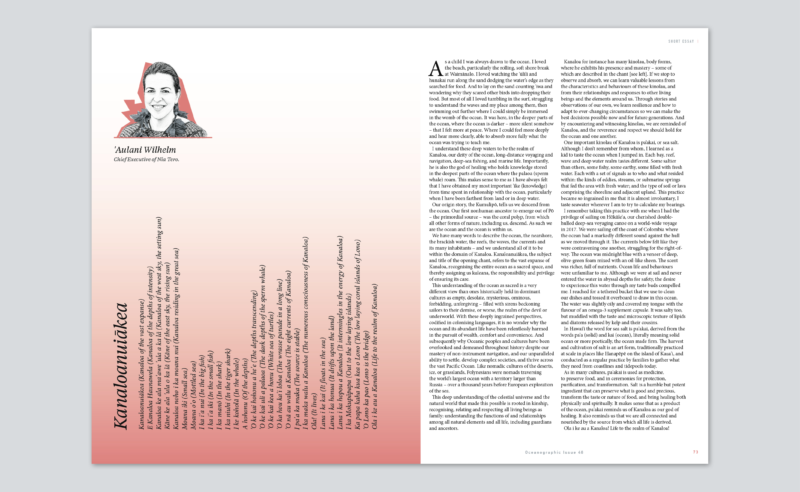
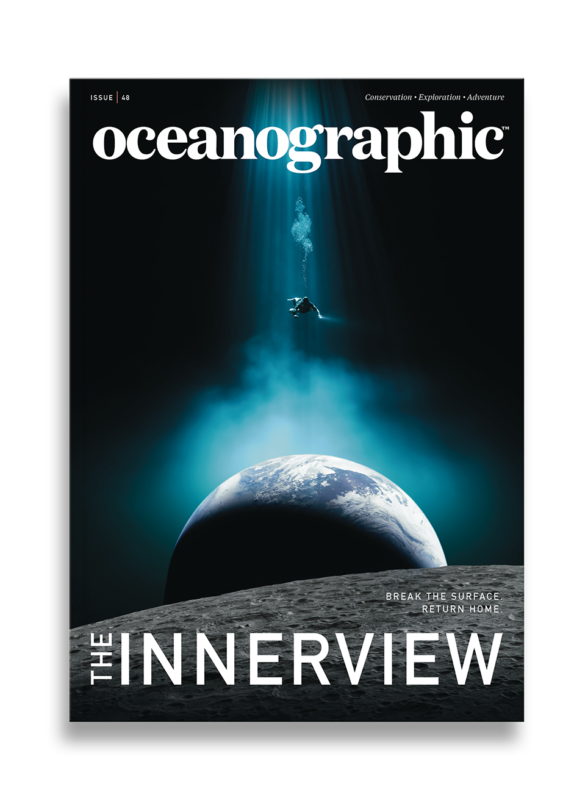
This is how this short essay appears in the special Oceanographic publication, The Innerview
Printed editions
Current issue
Back issues
Enjoy so much more from Oceanographic Magazine by becoming a subscriber.
A range of subscription options are available.
