Dr Andrew Forrest
Dr Andrew Forrest is a marine ecologist, businessman and philanthropist; Founder and Executive Chairman of Fortescue and Founder of Minderoo Foundation.
More from The Innerview





The Urala coast is where burnt orange earth meets bright blue water, near Minderoo Station in Western Australia. As a boy, I camped on the beach near the Exmouth Gulf and watched the Indian Ocean at night. For every star above me, there was a light on the water. I asked my dad why there were stars in the water, I thought they were only in the sky. He explained they were prawn trawlers. Dad explained they dragged dredge nets over the pristine ocean floor, turning the clear water murky.
I have spent a lifetime in those waters at Ningaloo, and other great Australian reefs such as the Montebellos and the Great Barrier Reef. My fascination with these complex ecosystems led me to undertake a PhD on marine parks – and whether parks in the ‘big blue’ can protect highly nomadic megafauna like tiger sharks. (The answer: yes.)
The more I learnt, the more I saw the severity of the problems our great ocean faced, and it was heartbreaking.
Scientists warned us that coral reefs would be among the first great climate tipping points, at a global warming of 1.5ºC. Like clockwork, that is what has happened.
Through Minderoo Foundation, we established the Minderoo Exmouth Research Lab close to where I first saw those prawn trawlers with my dad. One of the lab’s first projects was to crossbreed corals to make them more resilient to warmer waters.
However, in 2025, Ningaloo – so resilient for so long – was finally struck hard by climate change for the first time. Large sections of the reef bleached white. Many corals did not recover, becoming algae-covered rock.
During the first coral spawning event following the bleaching, we partnered with Taronga Conservation Society Australia to cryopreserve the genetic material
generated from our crossbred corals. This work may give future reefs a fighting chance – but only if the rest of the world rapidly phases out fossil fuels.
Philanthropy has a vital role to play here. It backs science early, scales solutions fast and bridges the gap between discovery and protection when time is the one thing ecosystems lack.
But above all, global leadership matters. Leadership willing to confront the root cause of ocean warming, our continued dependence on fossil fuels. Leadership prepared to act ahead of certainty, to invest ahead of consensus, and to take responsibility beyond electoral cycles or balance sheets. It is asking something of those with influence, resources and authority.
I will personally take any leader who doubts this diving on these reefs, so they can witness firsthand the ocean’s greatest achievement – and its gravest warning to humanity.
We can still protect what we have: the area that I once looked out onto as a kid will soon, hopefully, be the Exmouth Gulf Marine Park.
But we will only fully protect our ecosystems the day we stop burning fossil fuels.
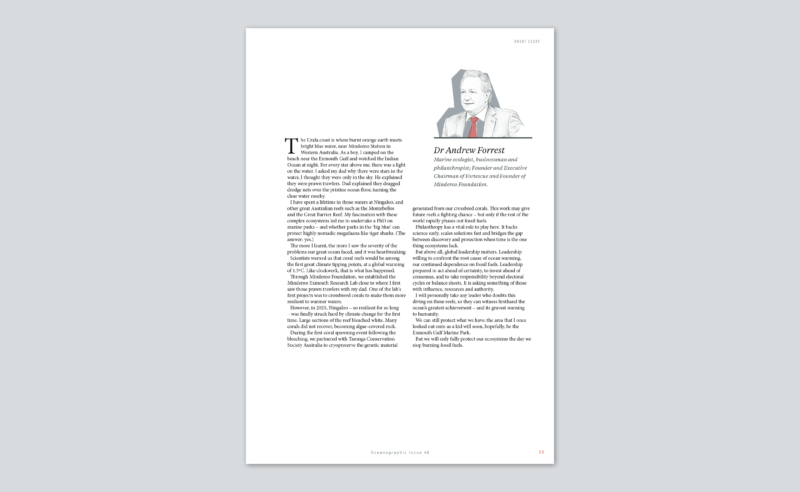
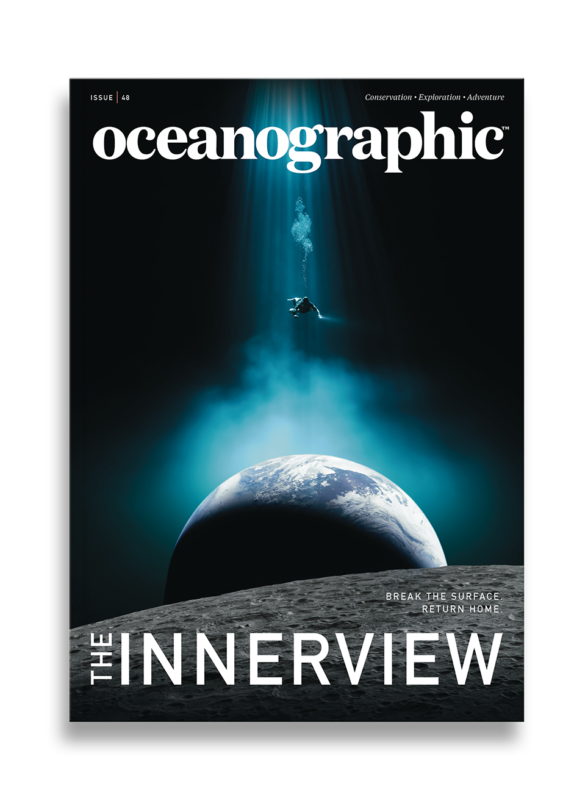
This is how this short essay appears in the special Oceanographic publication, The Innerview
Printed editions
Current issue
Back issues
Enjoy so much more from Oceanographic Magazine by becoming a subscriber.
A range of subscription options are available.
