Dr Carmody Grey
Dr Carmody Grey is a marine ecologist, businessman and philanthropist; Founder and Executive Chairman of Fortescue and Founder of Minderoo Foundation.
More from The Innerview

Tadpoles are swimming on my desk. I collected them carefully from a pond in a local wood, to grow to maturity in an aquarium at home, before releasing them back into the wild waters; froglets ready to take on the world. Their bodies move fluidly in the water, as though it were silk. They are tiny, fragile. And yet their movements have a touching confidence.
The tadpoles are here on my desk primarily for my son Benjamin, because they are more eloquent teachers than I ever could be in one of the most important lessons he can ever learn: his membership of the great community of life. And the tadpoles teach me too, as I take up my task to articulate ‘integral ecology’. Because the way the tadpoles are in the water exemplifies what integral ecology is about: unlearning the great lie of our separateness; re-learning the great truth of our belonging to this living world. We are of it. To cease to be of it is to cease to exist.
The Outerview, the view of nature as though it was ‘over there’, is a useful fiction. It has given us scientific discoveries and unique technological power. But it has only ever been a heuristic device; it is not really true. It cannot be, because we are always already part of what we observe. The Innerview is the greater and fundamental truth: we are first of all creatures of this Earth and these waters. We are only able to ‘know’ anything at all, because we are nurtured and sustained within this fragile membrane of life. All our projects of knowledge and power are relative to this most basic fact.
Western philosophy over the course of the centuries has gone on its own journey to recover and honour the Innerview. In antiquity, it was taken for granted that to really know something requires a kind of infinite proximity to it. When the mind knows a thing, the ancients thought that it has to, in some way, actually share in the nature of that thing: to know a thing you had to identify with it.
But the European Enlightenment pushed back against this ancient view. Instead, it propounded the opposite idea; that to know something truly is an act of objectification. Real knowledge is premised on standing back from a thing in order to see it from every angle: to have, literally, ‘perspective’.
Unlearning the great lie of our separateness; re-learning the great truth of our belonging to this living world. We are of it.
The development of perspectival methods in Renaissance art instantiated this new understanding of knowledge. Antique art did not pretend to present an object as though we really could stand at a distance from it. That’s why Byzantine icons look, to us, faintly weird and out of proportion. They were not pretending that objective representation was possible. But in the Renaissance period and afterwards, artists developed mathematical methods to imitate what they thought was true perspective – namely, sight from a distance. In that period, the Outerview became associated both with true knowledge and with real power. In the great age of the scientific revolutions, separating ourselves from nature seemed to be the way that we could most authentically know it, and therefore control it.
But we have come full circle. European philosophers have begun, belatedly, to realise that something went awry in that Enlightenment story. They are starting to celebrate not the view from far away, but the knowledge that comes through intimacy. Rather than seeing sight as the noblest of the senses – sight which apparently commands things from a distance – they have called for a new appreciation for touch: the most direct, the most firsthand and the most intimate mode of encounter.
When submerged in the waters of our planet, we are in a condition of complete enfoldment: an encounter with what-is-not-ourselves which enwraps us completely. To be embraced by the ocean is to experience a distant echo of the first, most all-encompassing embrace each one of us ever experiences: our enfoldment in the waters of our mother’s womb. The knowledge a mother has of her child, and a child of her mother, is a knowledge which comes not by remoteness but by closeness. This, the enfoldment in the waters of the womb, is the first and decisive Innerview. It is the first experience simultaneously of our own existence and of our belonging to a world which is more than ourselves. This is an intimacy which on some level each of us longs to recover. In the ocean, we are in the womb of our planet, and we know ourselves as her children.
It is in this enfoldment, in this Innerview, that real knowledge consists. This is the kind of knowledge we need in our desperately precarious moment. Because it is love, not control, that is the true measure of things – and the real key which will unlock a future for all life on this fragile Earth.
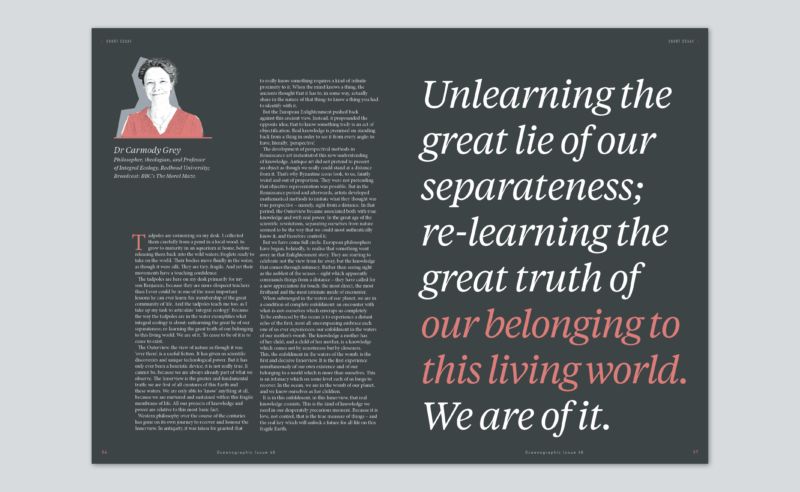
This is how this short essay appears in the special Oceanographic publication, The Innerview
Printed editions
Current issue
Back issues
Enjoy so much more from Oceanographic Magazine by becoming a subscriber.
A range of subscription options are available.
