Dr Dawn Kernagis
Dr Dawn Kernagis is a neuroscientist; a NASA-NEEMO Aquanaut; and the Director of Scientific Research at DEEP.
More from The Innerview





When you’re living and working from an undersea habitat for days at a time, you find yourself fixed inside the planet’s oldest ecosystem. However, unlike being in space and viewing Earth from above, you’re not above anything. You’re inside it. That distinction turns out to matter enormously, not just philosophically from an Overview versus Innerview perspective, but also physiologically.
I have spent years studying what extreme environments do to the brain and nervous system, and I’ve been a diver for several decades. I thought I understood what I was walking into when I joined a NASA NEEMO mission as a crew member to live and conduct research undersea. I had collaborated on scientific studies and read the literature on how living underwater leads to changes at the molecular, cellular and physiological level in our bodies, on sensory adaptation and altered circadian rhythms in remote environments. I knew how confinement reshapes the social brain and impacts individual and team performance. However, I quickly learned there were other impactful elements of undersea living that hadn’t been captured in a scientific manuscript or through data collection.
The particular quality of the sustained undersea ‘silence’ still sticks with me to this day. Even after an extended diving career, being surrounded 24/7 by this unique brand of silence – a silence that’s not empty, but full of biological sound, with the clicks and breaths of creatures living around the habitat – had an almost meditative quality over time. The brain does not treat that type of silence the way it treats a quiet room – it leans into it. The brain’s default mode network, the constellation of regions active when we are not focused on a task, seems to settle and expand while exposed to this subsea silence around the clock.
You also notice a heightened level of attention and awareness when living beneath the surface of the ocean. Some of this focus could be due to the mild narcotic effect of breathing nitrogen at depth over a prolonged period of time, but the psychological shift is likely a primary driver. Scientists working across a variety of extreme environments often report their best creative insights happen not during structured work periods, but during the liminal moments when they suit up and move through open water, neutrally buoyant and engaging with the ecosystem that surrounds them. Some of our most profound moments during our mission happened while watching through the window of the habitat or sitting in silence at the bottom of the ocean, listening to and visually observing the teeming life that surrounded the habitat, giving perspective on this ‘other’ world that we had the enormous privilege to be a part of during our multi-day mission.
At depth, the body’s chemistry shifts and the increased breathing gas density brings a heightened awareness of your breath. You are reminded with every breath that you are a biological system operating in an environment that is alien to you, while it’s home for every other species that surrounds you. There is a clarity that comes from that reminder – not fear, but precision and gratitude to participate in this shared, otherworldly experience.
I’m now working with a team at DEEP that’s building the next-generation infrastructure for continuous human habitation beneath the sea.
People often ask what drives that work. While the human, marine, environmental and engineering science that we can amplify is a major motivator, my primary driver is this: I believe the Innerview is something more people should have access to, what we learn from those who experience it will tell us things about human consciousness that no other kind of surface-based laboratory ever could.
The ocean is not a place we go to escape the human. It is, it turns out, a place we go to find it.
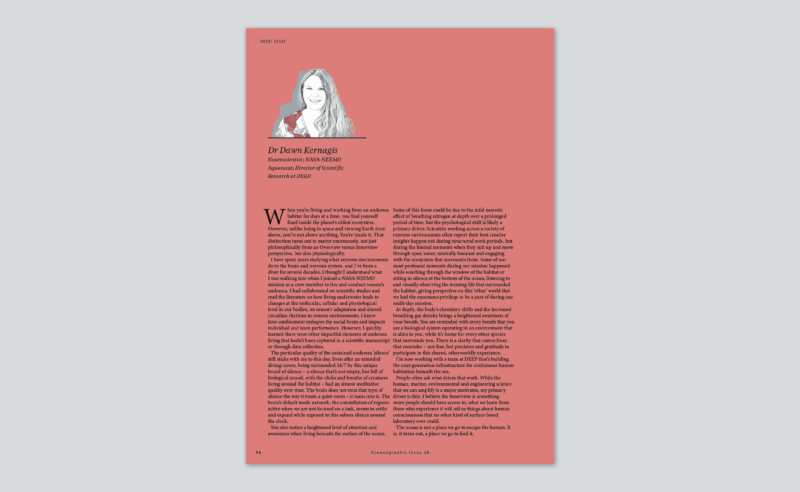
This is how this short essay appears in the special Oceanographic publication, The Innerview
Printed editions
Current issue
Back issues



Enjoy so much more from Oceanographic Magazine by becoming a subscriber.
A range of subscription options are available.
