Dr Ken Takai
Dr Ken Takai is an extremophile microbiologist and Director at JAMSTEC.
More from The Innerview

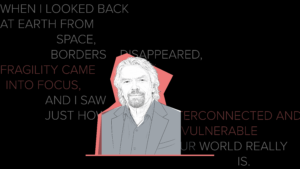



I began my scientific career at JAMSTEC almost 30 years ago with a sample of sediment from the Mariana Trench – the world’s deepest known point – the bottom of the bottom. I spent decades studying the deep ocean: descending in the Shinkai 6500 to hydrothermal vent fields across the Pacific, Atlantic and Indian Oceans; watching superheated minerals gush from chimney structures at 400°C; collecting organisms that survive at extreme heat and pressure; discovering life forms that exist entirely without sunlight – sustained instead by chemical energy, life that runs on geology rather than the sun. Life that rewrites the definition of what is possible. These are the places and the chemical reactions that could have first sparked life on Earth, 4 billion years ago.
After 30 years, I believed I had a framework and the principles to understand the deep ocean. Not completely of course – no scientist would claim that – but I had, in my mind, a reliable image of what the Mariana Trench was: quiet, homogeneous, ancient, still. The world’s deepest place as a kind of final silence.
In 2026, I returned. This time we drove nine giant piston cores down into the sediment, penetrating 20 to 30 metres below the seafloor, into layers that had never been sampled, never been seen. What we found destroyed my understanding of the deep sea entirely.
The sediments were nothing like what I had imagined. The Mariana Trench is not quiet. It is not homogeneous. It is dynamic, diverse and layered with complexity. The deepest place on Earth, the place I had held in my mind for 30 years as a kind of known entity, turned out to be almost entirely unknown.
Was I disappointed? No. The feeling that rose in me when I looked at those cores was the greatest joy of my scientific life.
This is the paradox at the heart of deep-sea science, and perhaps at the heart of science itself: the more precisely you look, the less you think you know. The ocean does not reward expertise with certainty. It rewards it with better questions.
From my 30 years of descending into the dark, of pushing the known limits of life, finding organisms that had no right to exist within what we know, the lesson I learnt was not mastery. Instead, it was humility before the ocean’s innate complexity.
What does my Innerview experience feel like from inside those hydrothermal vent fields, watching a black smoker plume rise into the darkness? It feels like standing at the boundary between what life is known and what life could be. The organisms living in those plumes – thriving at temperatures that would destroy human tissue, metabolising hydrogen sulphide, drawing energy from the chemistry of the Earth’s crust rather than from the light of the sun – are not extreme. They are simply different. They are what life looks like when it finds another way. And every time I descend to meet them, I am reminded that our definition of life is drawn only through the limited prism of our perception.
The deep ocean is not the edge of the world. It is another world within our world: one with its own rules, its own history and its own extraordinary solutions to the problem of being alive. It represents 4 billion years of evolution. Four billion years of problem-solving, adaptation, survival and thrival. We have barely begun to read it. And what I know after 30 years – more than any specific discovery, more than any new species thriving in the extremes – is that the ocean will keep surprising us, teaching us and guiding us for as very long as we are willing to ask.
That willingness – the willingness to go to the edge of the known world and discover, to be wrong, to be surprised, to hold our frameworks lightly and let the evidence destroy them – is not a weakness of science. It is its greatest strength. And it is, I think, the deepest gift the ocean gives to anyone who enters it honestly.
I have never known anything about the deep sea. After 30 years, I know this more completely than ever. That is my Innerview and a truth I hold dear. And in that truth, I have never been happier.
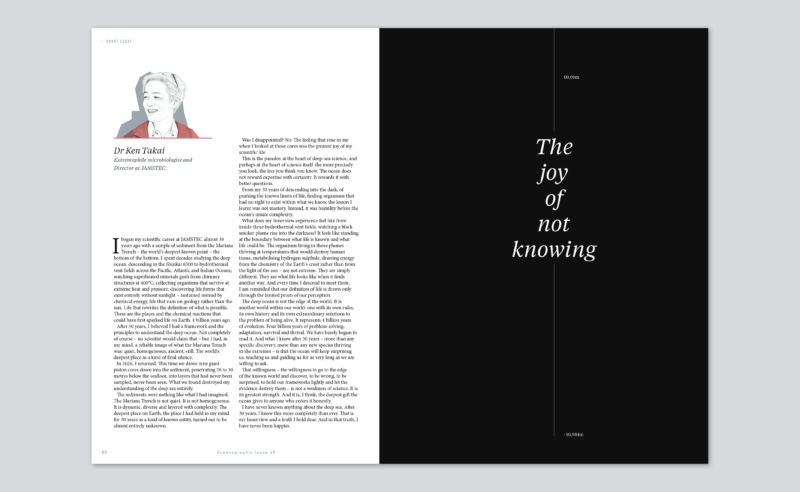
This is how this short essay appears in the special Oceanographic publication, The Innerview
Printed editions
Current issue
Back issues
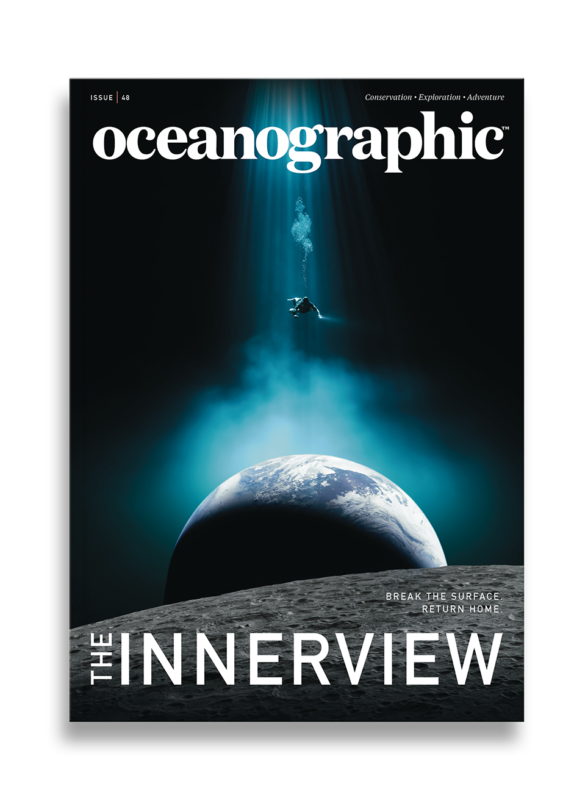
Enjoy so much more from Oceanographic Magazine by becoming a subscriber.
A range of subscription options are available.
