Dr Nicole Yamase
Dr Nicole Yamase is a marine biologist and she was the first Micronesian to reach the Challenger Deep in the Mariana Trench.
More from The Innerview




The deepest dive I made was not to the Challenger Deep, but into my cultural heritage as a Micronesian. During my dive, there were moments when I felt the presence of my ancestors and began to see the world through their eyes.
The weight of the journey was not just representing myself, but Micronesia, and more broadly, the Pacific. I carried an ocean of people, cultures, traditions, legends, history and sacredness. That responsibility was overwhelming. Tears were shed, the feeling of not being enough overcame me. And I was asking: why me?
A friend encouraged me to speak with Nainoa Thompson, who had faced similar struggles. His words grounded me: “When Mau came to Hawai‘i, he brought all of you. He brought all of us. Bring Mau. Bring a canoe.” My heart was settled and I knew I did not carry this weight alone. I carried my ancestors with me and that was enough.
Before the dive, many people asked if I was afraid of descending into a dark, lifeless place. Why would I be afraid? To me, the deep ocean was a place of magic, where life began and where my ancestors live. What about the immense pressure? The thought of being crushed never crossed my mind – I thought I was going to be embraced, and get the biggest hug you can ever get from the ocean. If I was to die, I would do so in the arms of my ancestors; our connection to the ocean runs so deep that even death is not feared.
During the first morning of my dive, I stood on the deck of the Pressure Drop. My internal storms were brewing again. Am I the right person? I’m not Micronesian enough. I asked for a sign to tell me I need to be here. A cargo ship was pulling into the harbour, its name, “Papa Mau”. He was listening and came to keep me company. “You are meant to dive. You are enough,” he said.
As we descended, Victor asked how I was feeling. I told him, “I feel like I’m going home.” It felt as though I was going to visit an aunt I had heard about all my life.
Now, I am finally going to meet her, and she will welcome me home with open arms.
After an hour, a string of tiny fireworks ignited outside the window. I felt transported into the heavens, and a sense of familiarity like I had been here before. The deeper I went into the ocean, the higher I went into the stars. The ocean mirrored the universe, and I was in the reflection! The bioluminescent creatures reminded me of the stars that once guided my ancestors home. Were they guiding me home, too? My ancestors were with me, and I was not alone. We were going home.
What was supposed to be the proudest moment of the dive was also the most disappointing. We made it to the Challenger Deep, the deepest place on Earth and the sacred resting place of my ancestors. The last thing I expected to see was trash. I felt disappointment, anger and shame – and culpable because, as part of humanity, I share responsibility for it. What have we done? We have lost our way.
After the dive, I searched for stories and legends that talked about our connection to the deep. Jermy Uowolo from Fais – the closest land to Challenger Deep – shared the legend of Mootigtiig: how his island was pulled from the ocean. Uncle Thomas Raffipiy from Satawal, Papa Mau’s nephew, told me it’s our turn to create legends, and that I was part of a new one. Many people don’t know about Micronesia. Through my dive, I pulled my islands from the deep. One story at a time, they will call us by our names.
This journey taught me that being of the ocean is about remembering who we are, honouring those who came before us,and protecting what will sustain those who come after. To carry this legacy is to continue our journey with purpose: knowing we each serve something greater than ourselves.
The ocean is not separate from us, but within us. It is our home, and finding our way back through the eyes of our ancestors may be the most important voyage of all.
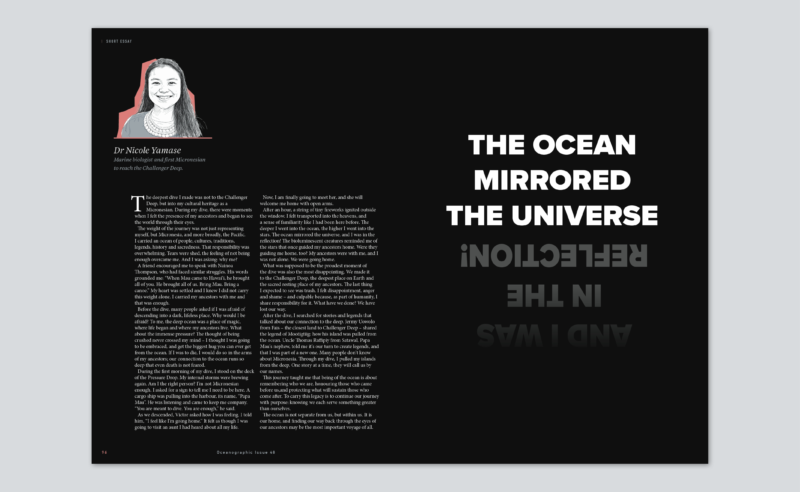
This is how this short essay appears in the special Oceanographic publication, The Innerview
Printed editions
Current issue
Back issues
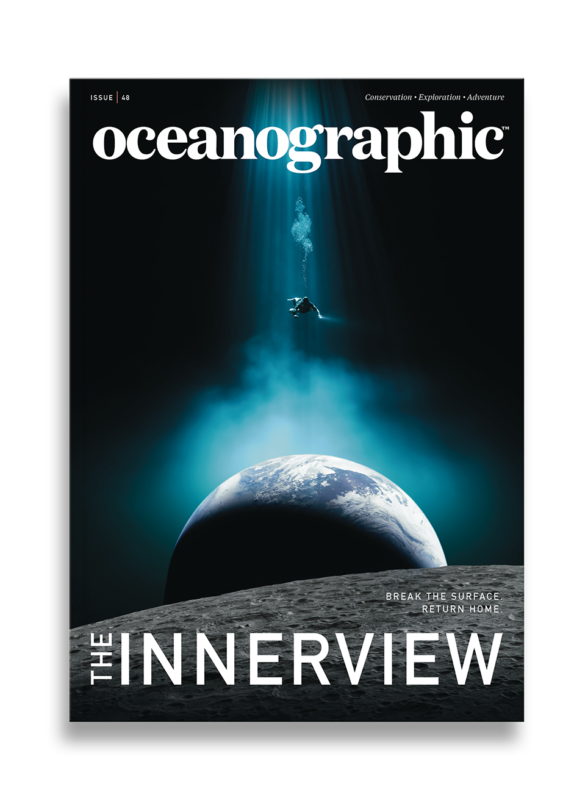
Enjoy so much more from Oceanographic Magazine by becoming a subscriber.
A range of subscription options are available.
