Dr Tim O'Hara
Dr Tim O'Hara is a celebrated Australian evolutionary marine biologist and the Senior Curator at Museums Victoria.
More from The Innerview




You need imagination to be a deep-sea scientist. From the sea surface you cannot experience the grandeur of deep-sea landscapes, the fantastic forms of deep-sea creatures, nor the viscous connectivity of its waters. Instead, you have to rely on remote sensing, underwater video and precious samples brought up from the deep. Research vessels have been traversing the globe, mapping, sampling and imaging. But zoom in on a map and you see their narrow tracks form nothing more than a fine web across the ocean. Only five per cent of the seafloor has been visualised. Research tracks are like gossamer threads of knowledge across a sea of ignorance.
So, I spend a lot of time digging into my innerverse for ways to connect these fragments of data and communicate an understanding to humanity. I have never been in a submersible to explore the depths, so I will leave it to others to focus on the intricate beauty of deep-sea organisms. Instead, I want to dissolve the sea-surface sensory barrier and reveal the large-scale patterns of the deep. The lack of a visual seascape is a gift. We can use our imagination to redraw the oceans to illustrate what really matters to deep-sea life.
I love mapping software. You can smear points of data and create a landscape. You can play thought games with colour. There need not be any conventions. Should the abyss be dark blue? Should the rim of an underwater volcano be red for lava, or white to represent extreme heat? How can you make the jagged contours of a ridge fracture zone stand out? Maybe you should speckle the abyssal plains on a map to mimic manganese nodules.
But static maps are not enough. How do you convey shifts with time, the movements of continents or the drifting of pelagic life across the ocean? For the ocean has changed much in the last 100 million years. The hot climate of the dinosaurs has diminished. The Earth cooled, creating temperate, subpolar and polar environments. Life dramatically increased in diversity and complexity. The great tropical seaways that ran through the ocean thinned and closed, creating barriers to migration. Again, this is not something you can directly experience. You must dig deep to create narratives and visualisations that reveal the evolution of marine life.
I explore evolution through the DNA of marine organisms – and especially DNA from an obscure group of animals called brittle stars. These creatures generally have five long snake-like arms joined to a central disc. They have no centralised brain, no eyes and not even an anus. But these animals are well adapted to living on the seafloor, capturing plankton or detritus with their mucus-covered arms – or occasionally dining out on a carcass. They have been honing their life skills for over 480 million years. They now live everywhere on the seafloor, from the tropics to the poles, from the coast down to the hadal trenches. They are an excellent group to map.
DNA encodes ancestry and we have created great family trees of brittle stars going back to the terrible global extinction event, 265 million years ago, when 95 per cent of life was extinguished. From this tree of life, we can piece together oceanic migrations and barriers across the planet, understand adaptations to cold and deep environments, and learn how diversity has responded over time to waves of speciation and extinction. My task is to take scattered samples and a family tree, and weave them into an insightful history of the ocean.
My Innerview is not based on direct sensory experiences but revolves around creating abstractions that can reveal the patterns and tempo of seafloor life, to build understanding and custodianship.
The deep sea is – in its absolute – not a freak show of weird critters. Instead it is a vast, vital reservoir of life on Earth that has never ceased to adapt to an incredibly demanding environment.
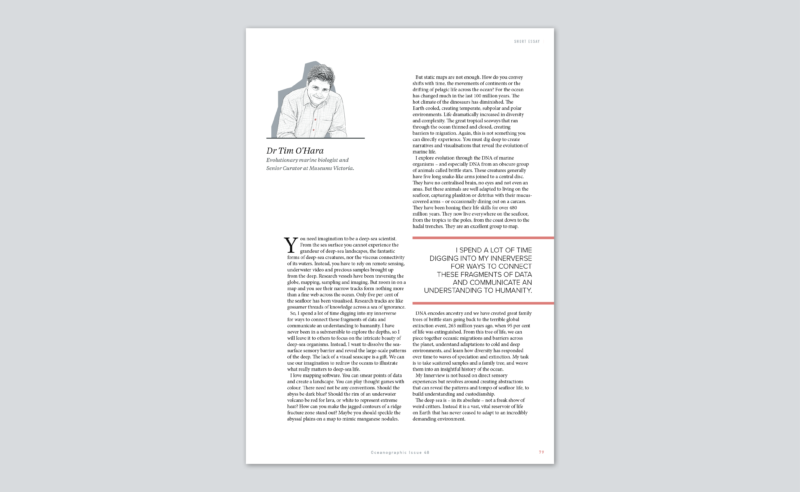
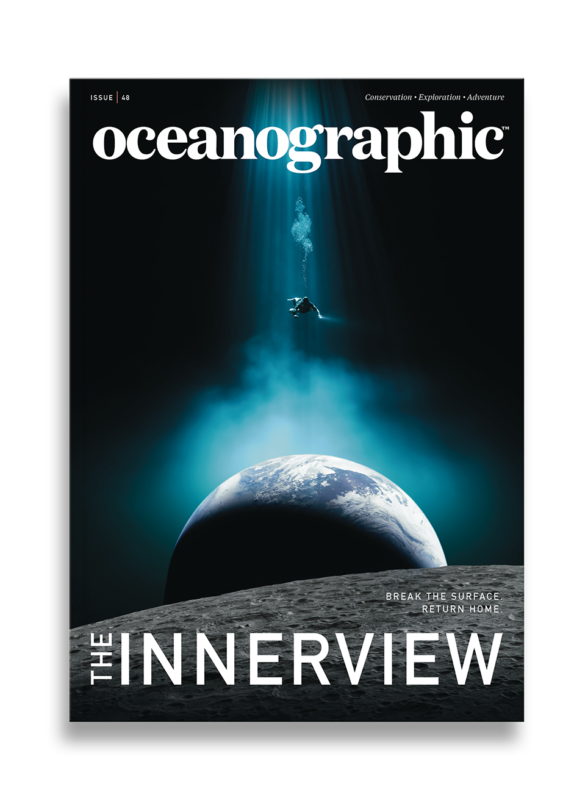
This is how this short essay appears in the special Oceanographic publication, The Innerview
Printed editions
Current issue
Back issues

Enjoy so much more from Oceanographic Magazine by becoming a subscriber.
A range of subscription options are available.
