Dr Wendy Darke
Dr Wendy Darke is a marine biologist and former Head of the BBC Natural History Unit (including Blue Planet II).
More from The Innerview



As a natural history filmmaker for over three decades, one message has stayed with me above all others. After watching a programme I produced, featuring freediver Tanya Streeter swimming with whales, a viewer wrote: “I live in a multi-storey block of flats and never get out – and tonight you took me diving with whales. Thank you.”
That became my gold standard: to create storytelling that truly transports people.
I know the power of such storytelling firsthand. At 14, watching Sir David Attenborough’s Life on Earth, I was captivated by the coral reefs of the Great Barrier Reef – the vibrant colours, the life and the invitation to see the world through the eyes of its inhabitants. It sparked a lifelong curiosity about our connection to nature and a desire to explore and share it.
Over four decades as a marine biologist and filmmaker, I have been fortunate to experience extraordinary moments beneath the surface: swimming with whale sharks in Western Australia, manta rays in the Maldives, turtles in the Galápagos and dolphins in the Azores. One unforgettable dive in Belize’s Great Blue Hole saw us film Tanya Streeter descending over 40 metres on a single breath. It is in those moments that the ocean feels pure, vast, and deeply humbling – you never see the world the same way again.
What happens when we immerse ourselves in the liquid heartbeat of our planet?
Through filmmaking, we strive to recreate that feeling of ‘being there.’ And science helps explain why it matters. Stories with a clear beginning, middle and end can trigger the release of oxytocin – sometimes called the ‘love’ hormone – making audiences more likely to connect emotionally. To reach people, we must engage the heart first with a simple question: why should I care?
The ocean naturally evokes powerful emotions: awe and wonder at coral spawning under a full moon; fear during a night dive with snakes; joy in playful animal behaviour; sadness at reefs destroyed by crown-of-thorns starfish; and tenderness in moments like a sea otter pup resting on its mother. Above all, it can evoke humility: a sense of being part of something far greater.
Storytelling also has the power to shift perceptions. In Sharks with Steve Backshall, we aimed to show sharks as marvels, not monsters – revealing behaviours that invite understanding rather than fear. Likewise, sharing both the challenges and recovery of marine environments, such as the return of whales to the Azores, can inspire hope and action.
When we immerse ourselves in the ocean – the ‘liquid heartbeat’ of our planet – we step away from daily distractions and reconnect with our senses. We rediscover awe, curiosity and ultimately a sense of belonging to the natural world. Coral reefs, in particular, are not only breathtaking but essential to the wellbeing of billions of people.
At True To Nature, we believe storytelling can help people fall in love with the natural world – and protect it. We share one life, one home and one story that unites us with all life on Earth. By telling it well, we can inspire a future where humanity and nature thrive together.
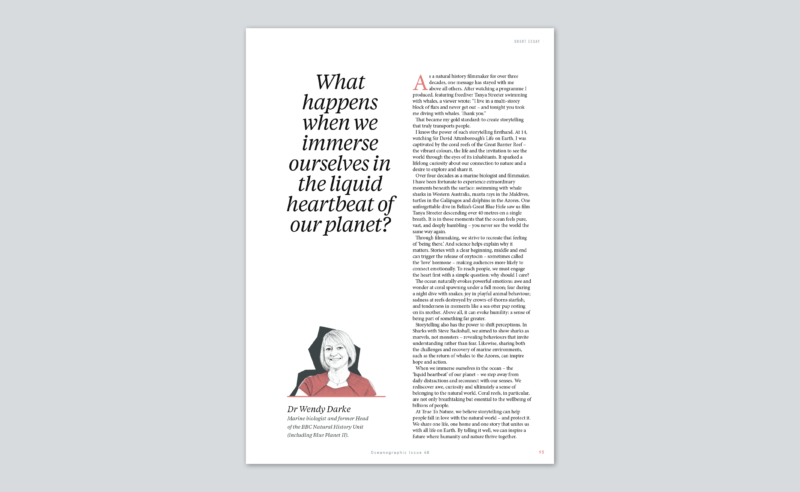
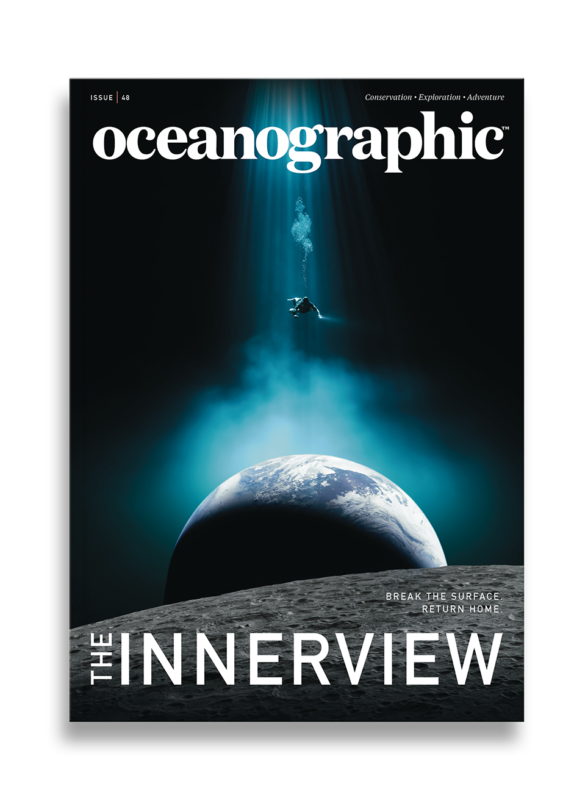
This is how this short essay appears in the special Oceanographic publication, The Innerview
Printed editions
Current issue
Back issues
Enjoy so much more from Oceanographic Magazine by becoming a subscriber.
A range of subscription options are available.
