It all begins with a snowflake. A tiny fingerprint of an era tumbling through grey skies, water vapour locked-up into microscopic crystals, before settling on the frozen freshwater mass beneath. They fall, one by one, until under the weight of a trillion snowflakes more it transforms into an ice mass, frozen in time. Until now.
There is no better window into the state of impermanence of our world than Greenland (Kalaallit Nunaat). Situated in the Arctic Ocean and warming at more than twice the global rate over the last half a century, Greenland has become a microcosm of global climate change as the impacts of glacial ice loss reverberate through every level of the ecosystem – from icecap to ocean. Like most countries on the front lines of climate change, Greenland is bearing witness to an era of major transition. A self-governing country within the Danish Realm, 89% of the population is Greenlandic Inuit, and their intimate relationship with ice has evolved through time to the present day. Today, this Arctic nation exhibits some of the most striking examples where the melting of ice is reshaping ecosystems, wildlife and people, raising questions about adaptation, resilience and the future of a nation with disappearing ice.
The story begins on Greenland’s ice sheet, aptly named ‘Sermersuaq’ (meaning ‘The Great Ice’). This unforgiving frozen mass is the second largest body of ice in the world, making up 80% of the country’s total landmass, covering 1,700,000 square kilometres and is over three kilometres thick at its maximum. Standing on the ice, my first thought is how much I am reminded of the ocean. Perhaps it’s the way it twists in stiff peaks, frozen crests of ice dusted with black as they roll away until they blur with the horizon. Or maybe it’s because it has that same feeling of infiniteness. Depth. Power. Up here at 660 metres above sea level, it feels surprisingly quiet, still, save our boots crunching across the surface. Of all the glacial ice in the northern hemisphere, Greenland’s ice sheet is by far the most impressive – and I can see why.
Ice caps are formed in a process called ‘glaciation’, as snowfall accumulates each year, it melts and compresses under its own weight into a hard ice over thousands of years. Though Greenland has had ice caps for at least 18 million years, it has only had a single ice sheet for less than 3 million, which has contracted and grown with passing eras, shaping the lives of those who have lived in its shadow.
“It’s very easy to look at the Arctic as a landscape that is frozen, unchanging, and desolate, but it’s the complete opposite. It hasn’t always been frozen,” Arctic archaeologist, Kaylee Baxter, tells me between sips of coffee as we sail from Greenland toward the Northwest Passage. “The ice cap has receded, and then it came back out again, so people had to move… They’re constantly adapting.” Kaylee’s words are a testament to how easy it is to think of Greenland’s ice as permanent, when you look at it through the lens of our relatively short human lives. “We’ve had a few periods of climate shift in the past – warm periods and cold periods. There’s always variability and instability season to season and year to year. But when you enter a period where that becomes the norm, it becomes a climate period, and we see it’s affected the way people lived in many ways,” explains Baxter.
Through an archaeological lens, there are many examples of how Greenland’s communities have co-existed with the advances and retreats of the ice cap. The Saqqaq people, the first inhabitants of West Greenland, hunted for game in the retreat of the ice margin which was, at that time, more than 40 kilometres east of its current position, over thousands of years during the last ice age. “In Greenland, archaeologically and in modern day, people are extremely resilient, extremely adaptable. Climate has always been a challenge or an opportunity to be resilient and adapt, and we see that in the material record left behind,” adds Baxter.
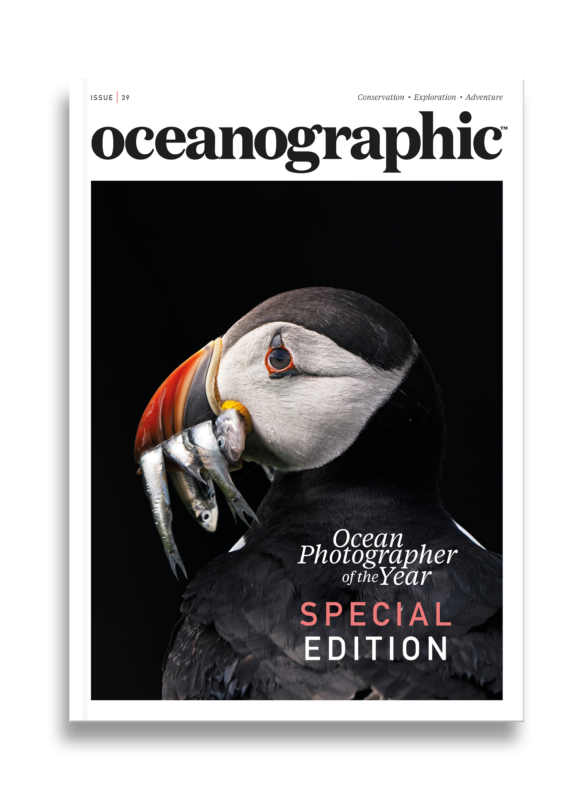

This feature appears in ISSUE 39: OPY SPECIAL EDITION of Oceanographic Magazine
Continue reading
This story is exclusively for Oceanographic subscribers.
