Hugo Tagholm and Sonia Kwami
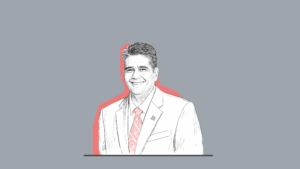
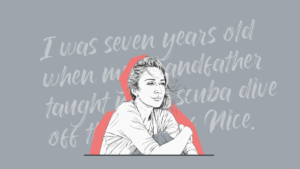
Hugo Tagholm, environmentalist and Executive Director of Oceana UK; former CEO of Surfers Against Sewage, and Sonia Kwami, head of Oceana’s Ghana office and a major voice of influence across African and global policy making.
More from The Innerview

Few are as connected to the ocean as small-scale fishers. Few are more dependent on healthy and thriving marine ecosystems. For the millions that set out to sea every day, the ocean is a source of sustenance, livelihoods and cultural identity. Their shared history, knowledge, skills and understanding of local coastlines are central to restoring abundance to our seas. It is in this local perspective, an Innerview born in community, where the conservation of our seas and the protection, guardianship and stewardship of our blue planet begins.
With Africa’s coastlines spanning over 30,000 kilometres, this relationship is especially profound.
In Senegal, rows of hand-crafted canoes, known as pirogues, launch every morning in search of a good day’s catch. In Ghana, women line the beach to preserve fish catch, using traditional techniques like smoking and sun-drying. In Kenya, along the vibrant Indian Ocean coastline, those without boats draw on their deep knowledge of tides, walking the shoreline at low tide to gather octopus and shellfish.
It’s fitting, then, that this publication – one dedicated to the concept of the Innerview – should land in the year that, for the first time, the Our Ocean Conference comes to Africa, and to the communities with whom its concept is lived each and every day. In June, government officials and other leaders will gather in Mombasa, Kenya, to discuss the top threats facing the ocean. This matters symbolically, of course. But it should also matter practically. This should be a moment to focus on the people who depend on healthy seas every day, and on the urgent action needed to secure their future.
This is especially relevant in Ghana, where the ocean and fishing have played a key cultural role for generations. More than 21 million people in Ghana rely on the ocean for food, nutrition, or both. Small pelagic fish, like sardinella, are central to food security. Known as the ‘people’s fish’, they are both affordable and nutritious.
But the ‘people’s fish’ are disappearing. Over the last two decades, small pelagic fish populations have dramatically declined, by close to 80 per cent in Ghana.
It’s not a mystery why this is happening. Overfishing, a lack of good management systems, and industrial and sometimes illegal trawling – especially by foreign-owned vessels – are threatening the health of the ocean, fish populations and local wellbeing. The ‘people’s fish’ are being plundered by profiteering corporations, the food of the many is being taken to create wealth for the few. And this is emptying local seas.
The impacts ripple through the entire community. If a fisher returns to shore with an empty net, fish cannot be processed, traded or sold. Artisanal fish processors, mostly women, lose ready access to the cheap, nutritious food source that they have historically smoked, dried and traded throughout the region. If this decline continues and Ghanaians lose access to the fish they depend on, many will face malnutrition, food insecurity or poverty. When we talk about this collective Innerview, we must acknowledge the mounting threats it is facing.
Across Africa’s coasts, communities are facing the pressures of overfishing, habitat destruction, pollution and climate change. Fortunately, recovery is possible, but only with concerted action. We know that when habitats are protected and restored, coastal communities reap the benefits. We also know that conservation is most effective when it is shaped by communities, not imposed on them.
This is a defining moment for Africa’s ocean future. It’s time for bold action on industrial fishing, stronger protections for marine ecosystems and recognition of community leadership. If African governments act now, the continent’s seas can sustain thriving ecosystems and communities for generations to come. There will be challenges, yes. But if our Innerview is harnessed to its fullest extent, our global communities will thrive.
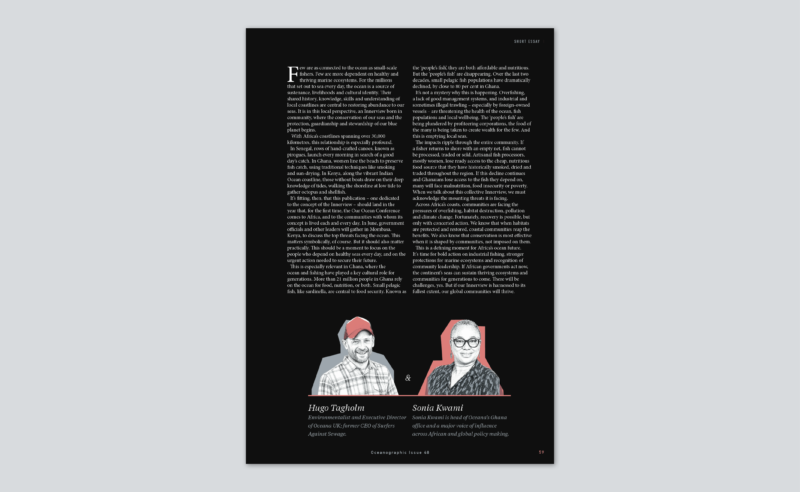
This is how this short essay appears in the special Oceanographic publication, The Innerview
Printed editions
Current issue
Back issues
Enjoy so much more from Oceanographic Magazine by becoming a subscriber.
A range of subscription options are available.
