Ian Urbina is the director of The Outlaw Ocean Project, a non-profit journalism organisation based in Washington D.C. In this column, he covers conservation concerns around the Saya de Malha Bank, the world’s largest invisible island.
Vast and sometimes brutal, the high seas are also a place of aspiration, reinvention and an escape from rules. This is why the oceans have long been a magnet for libertarians hoping to flee governments, taxes, and other people by creating their own sovereign micro-nations in international waters.
The Saya de Malha Bank has been a prime target for such ambitions.
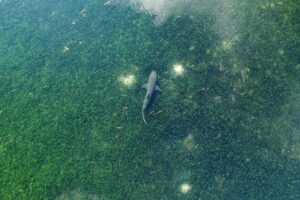
Covered with sea grass and interspersed with small coral reefs, the Bank is among the largest submerged ocean plateaus in the world – less than 33 feet deep in some areas. Near the equator, the water is a balmy 73.4° to 82.4° Fahrenheit, depending on the season. Waves are broken in the shallower areas. But the biggest allure is that the Bank is hundreds of miles beyond the jurisdictional reach of any nation’s laws.
In 1997, an architect named Wolf Hilbertz and a marine biologist named Thomas Goreau sailed to the Bank. Launching from Victoria, the capital of the Seychelles, the voyage took three days. With solar panels, metal scaffolding and cornerstones, they began constructing their vision for a sovereign micro-nation that they planned to call Autopia – the place that builds itself.
In 2002, the two men returned to the Bank in three sailboats with a team of architects, cartographers and marine biologists from several countries to continue building. They intended to create a self-sufficient settlement using a patented process involving submerged steel poles being put under a weak direct electrical current. This process gradually causes limestone to accumulate on the poles and their base, forming a habitat suitable for corals, shellfish, and other marine life.
Rushing because a cyclone was headed their way in a matter of days, the team built in six days a steel structure five-by-five-by-two meters high, anchored in the seabed and charged by a small onboard battery. Their plans ultimately stalled for lack of funds.
Two decades later, a 58-year-old Italian businessman named Samuele Landi began promoting a new vision for a micronation in the Saya de Malha Bank. He planned to park a massive barge near the seagrass patch far from the reach of extradition and police. A gifted computer programmer, avid skydiver, and motorcycle racer, Landi had been a man on the lam for roughly a decade. Accused of fraud after his company, Eutelia, declared bankruptcy in 2010, Landi and some of its executives were tried and convicted in Italy.
Landi was sentenced in absentia to 14 years, which led him to relocate to Dubai where he dabbled in crypto, hid money in Switzerland, and skated around extradition treaties. While living comfortably in Dubai, he registered companies in bespoke tax-free zones, and eventually procured diplomatic credentials from Liberia, according to a New York Times profile.



Continue reading
This story is exclusively for Oceanographic subscribers.
