Ian Urbina is the director of The Outlaw Ocean Project, a non-profit journalism organisation based in Washington D.C. In this column, he covers conservation concerns around deep sea mining and the implications is has for all life in the ocean.
For the past decade, the mining industry has argued that the ocean floor is an essential frontier for precious metals needed in the batteries used in cell phones and laptops.
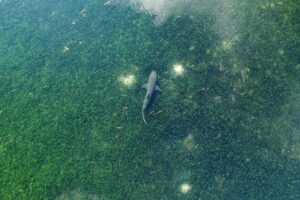
As companies eye the best patches of ocean to search for the precious sulfides and nodules – widely dubbed “truffles of the ocean” – the waters near the Saya de Malha Bank, a submerged plateau the size of Switzerland in the Indian Ocean between Mauritius and Seychelles, have emerged as rather the attractive target.
Most of the Bank is too shallow to be a likely candidate for such mining. But some of the waters surrounding the Bank – in particular those outside the seagrass area on the broader Mascarene Plateau – reach depths over 9,000 feet and are well suited for mining. This is part of why several companies have already signed long-term exploration contracts to mine the area for precious metals, among them titanium, nickel, and cobalt.
To vacuum up the treasured nodules requires industrial extraction by massive excavators. Typically 30 times the weight of regular bulldozers, these machines are lifted by cranes over the sides of ships, then lowered miles underwater, where they drive along the sea floor, suctioning up the rocks, crushing them and sending a slurry of pulverised nodules and seabed sediments through a series of pipes to the vessel above. After separating out the minerals, the mining ships then pipe back overboard the processed waters, sediment, and mining “fines,” which are the small particles of the ground up nodule ore.
In 1987, studies in the Mascarene Basin, an area of the Indian Ocean that includes the Saya de Mahla Bank, found deposits possibly containing cobalt over an area of about 4,500 square miles. South Korea holds a contract from the International Seabed Authority, the international agency that regulates seabed mining, to explore hydrothermal vents on the Central Indian Ridge, about 250 miles east of Saya de Malha. This contract began in 2014 and will expire in 2029, and explorations in the area are already underway. India and Germany also hold exploration contracts for an area about 800 miles southeast of the Saya de Mahla Bank.
All of this activity could be disastrous for the Bank’s ecosystem. Mining and exploration activity will raise sediments from the ocean floor, reducing the seagrass’ access to the sunlight it depends on. Sediment clouds from mining can travel hundreds or even thousands of miles, potentially disrupting the entire mid-water food web and affecting important species such as tuna.
The ocean floor itself is also slow to recover from mining activity. In 2022, scientists dispatched an underwater drone off the coast of Charleston, South Carolina, and found that tracks were still visible from a deep-seabed mining test that had been completed there half a century ago, according to a report by the daily newspaper Post and Courier. The areas between the tracks were devoid of fish, sponges, or nodules. Research published in 2023 found that a year after test seabed mining disturbed the ocean floor in Japanese waters, the density of fish, crustaceans, and jellyfish in nearby areas was cut in half.
Proponents of deep-seabed mining stress a growing need for these resources. In 2020, the World Bank estimated that the global production of minerals like cobalt and lithium would have to be increased by over 450% by 2050 to meet the growing demand for clean energy technology.
“It’s a race between countries to overtake one another in emerging and prime technologies,” says Arvin Boolell, Mauritius’ former foreign minister, adding that with such resources being used up on land, “the seabed is seen as the next frontier.”



Continue reading
This story is exclusively for Oceanographic subscribers.
