Jason deCaires Taylor
Jason deCaires Taylor is a sculptor and environmentalist; creator of the world’s first underwater sculpture parks and museums for reef restoration.
More from The Innerview

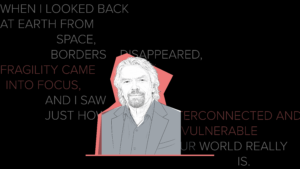




One Saturday morning towards the end of the pandemic, I was late meeting my boat captain for a sail, and getting later. Even though I was at home in Santa Barbara, I was really thousands of miles away: on my laptop screen, I was joining scientists off the coast of Costa Rica, on ‘baby watch’. Schmidt Ocean Institute’s ROV SuBastian was 6,300 feet beneath the surface, hovering over numerous brooding octopuses, their eggs about to hatch.
I was in the control room aboard R/V Falkor (too), connected with hundreds of viewers from around the world on our ‘divestream’ broadcast on YouTube. With them, I ‘ooohed’ and ‘aaahed’ as the babies suddenly burst forth from their pods. The tiny octopuses whooshed across my screen and scooted away, one by one. Some would become a meal for a predator before they grew beyond infancy; others might seek this spot years later to brood over their own hatchlings.
I couldn’t tear myself away. I realised how powerful our deep-sea technology and communications tools have become so that, for the first time in human history, we are able to encounter Earth’s creatures in the sea face-to-face in their own domain. Like visitors from another world.
I had learned to scuba dive more than a decade earlier, and knew personally what it felt like to wake up fish with my flashlight on a night dive. I felt like apologising.
As a child growing up in suburban New Jersey, I didn’t know the ocean had anything to do with me. I was aware of Jacques Cousteau, but all his explorations seemed as distant from me as the Moon.
It was some 18 years ago, however, that I entered the world of sailing and competitive racing, and it was through this connection that I really discovered what it is to ‘be on the water’; a discovery that changed my life.
Being on the water is a state of mind. It breeds curiosity about the forces you encounter on the surface: the wind, the clouds, the atmosphere – and also raises questions about what is out of sight, below the surface.
Most humans only encounter the ocean from the decks of ferry boats or from the seashore or from 35,000 feet. It seems endlessly large, the blue of our blue planet, immune to human activity. And yet here we are, with our life support system, the ocean, under attack from waste, pollution, overfishing and marine noise. In all this activity, our most destructive weapon is ignorance.
My husband Eric and I founded Schmidt Ocean Institute in 2009 as a direct consequence of my sailing and diving. We recognised that the human perception of the ocean came from fear: the gigantic forces of waves, pressure and currents; the corrosive nature of ocean water; the unknown monsters of the deep.
And yet, when we bring the tools of modern science to study how the ocean provides essential support for human life, we see a different picture – one that deeply connects us to life in the ocean. It’s something we’re only just beginning to understand and to see. For example, we discovered that deep-ocean polymetallic nodules coveted by industrial mining interests actually produce oxygen and contribute to the Earth’s climate cycle and to every breath we take. They’re as old as the Earth itself.
In fact, the more we look, the more we see and begin to make direct connections. The more we learn, the more it becomes clear humans need a healthy ocean.
We live on one planet, a minor species, in terms of biomass, with a substantially outsized footprint. The scientists that will be coming to work aboard our research vessel in all seven ocean basins over the course of this coming decade are changing the way we see our place in this magnificent, interconnected web of life. A web that begins with what we are calling the Innerview and endures with the ocean.
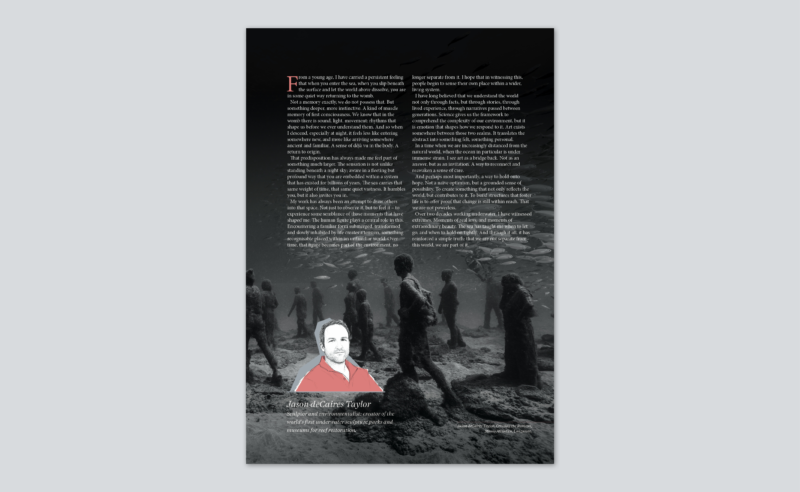
This is how this short essay appears in the special Oceanographic publication, The Innerview
Printed editions
Current issue
Back issues


Enjoy so much more from Oceanographic Magazine by becoming a subscriber.
A range of subscription options are available.
