Jialing Cai
Jailing Cai is an underwater photographer. She has won Ocean Photographer of the Year 2023 & Female Fifty Fathoms Award 2025.
More from The Innerview






I often find myself suspended in empty darkness, unbound by gravity, completely unable to tell up from down. It is an experience of absolute freedom in the most physical sense. I am not floating through
the vastness of outer space, but on the surface of the open ocean at nighttime. I am not an astronaut. I am a blackwater photographer.
Beneath me, the greatest migration on Earth is underway. Every night, billions of zooplankton rise hundreds of metres from the depths towards the surface, and then retreat back to the abyss before dawn.
Thanks to this natural rhythm, we can seek out and document these little-known drifters simply by diving within the top 30 metres of the ocean. We don’t need to go to the deep sea. At night, the deep sea comes to us.
Once in the water, I switch on my torch. A narrow column of light cuts through the darkness, becoming the only clearly defined space in my field of vision. The ocean is not transparent in the way air is. Countless grains of sand and flecks of organic debris hang suspended in the water, scattering and softening the beam.
Every so often, one of these ‘particles’ flashes back in a distinctive way. Move a little closer, and sometimes it reveals itself to be life. It might be the eye of a tiny octopus staring back, or the reflective scales of a juvenile fish. With time, I learn to recognise the subtle movements that distinguish living bodies from the surrounding chaos of drifting matter.
You might already know some classic plankton forms – jellyfish, or perpetual drifters like sea angels and sea butterflies. But here is something less obvious: no matter where a marine creature eventually settles, on a coral reef, in intertidal mudflats or around deep-sea hydrothermal vents, life often begins with a ride on the currents, as a tiny planktonic larva. The planktonic world is a vast, secret nursery, holding clues to the early development of most marine animals.
Take larval crabs for example. The square, sturdy creatures we recognise actually pass through two striking planktonic stages. In the first, the zoea, the carapace sprouts long spines stretching several times the body’s length. In the second, the megalopa, those exaggerated spines vanish but the abdomen extends behind the body like a tail. Surprising as it sounds, young crabs do indeed have tails. Countless other marine creatures undergo equally dramatic transformations we have barely begun to document.
Life originated around four billion years ago at hydrothermal vents on the deep ocean floor. We humans, walking on two legs, breathing with lungs, arrived only 300,000 years ago. We had long ago ceased to belong to the deep sea. Yet, the vertical migration of zooplankton feels like an Easter egg that evolution left behind for explorers. As blackwater photographers, we drift through the darkened ocean surface – stars above us, the abyss below. Through these sprite-like plankton, we can cross vast distances and stretches of time, to catch an Innerview of the primordial deep, where all life was born.
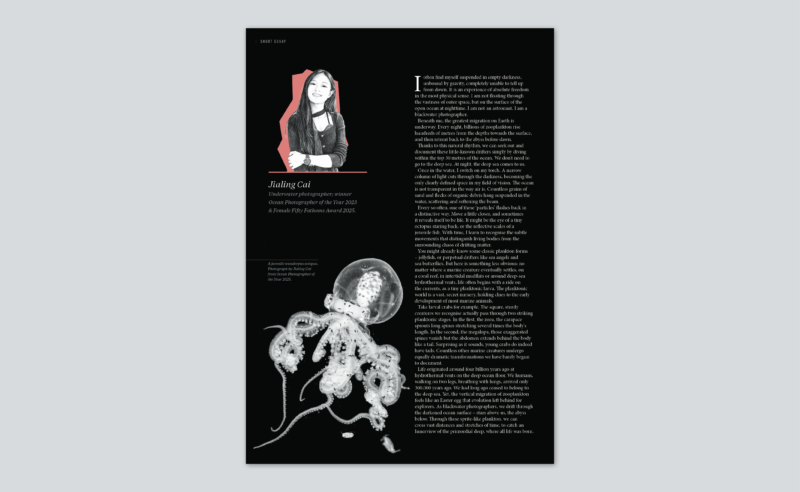
This is how this short essay appears in the special Oceanographic publication, The Innerview
Printed editions
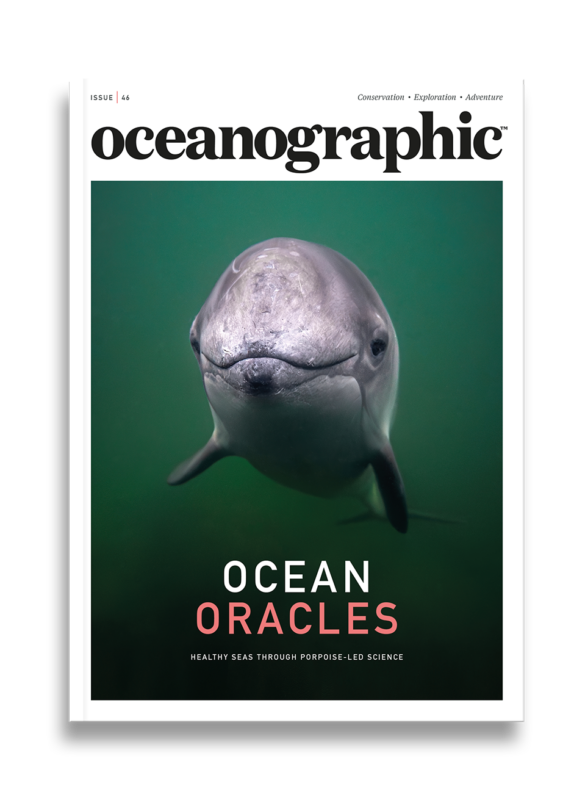
Current issue
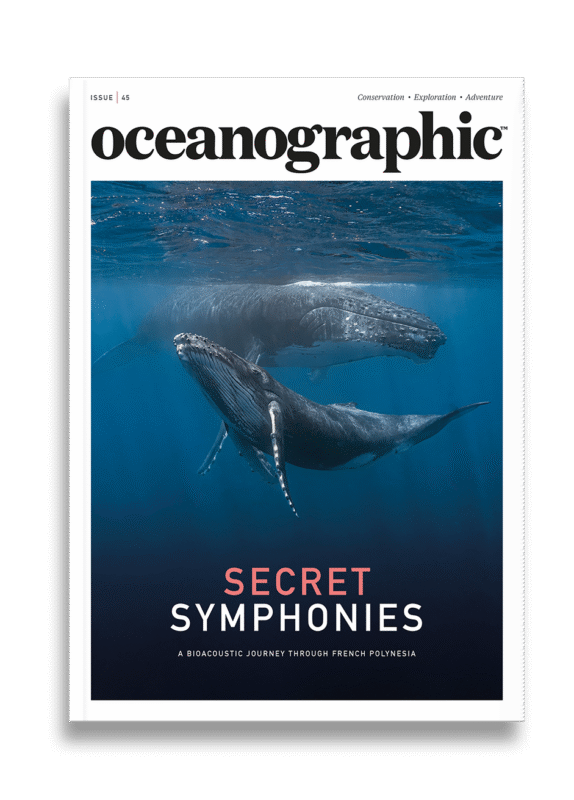
Back issues


Enjoy so much more from Oceanographic Magazine by becoming a subscriber.
A range of subscription options are available.
