Lieutenant Commander Hugo Mitchell-Heggs
Lieutenant Commander Hugo Mitchell-Heggs is a Royal Navy Submariner; record-breaking ocean rower; co-founder of HMS Oardacious.
More from The Innerview

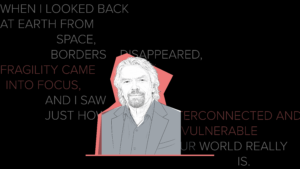




My relationship with the ocean has changed over time. On the surface, I have been deployed on warships, I have sailed and rowed across the Atlantic – where the ocean felt vast, beautiful, humbling, and deeply connecting. You feel small beneath the Milky Way, carried by something ancient and alive. As an ocean rower, you work with it. It is your environment, and your lifeline.
A submarine is different.
You do not see the ocean. You do not feel connected to it in any romantic sense. In fact, you are completely cut off from it. And yet, paradoxically, you are more dependent on it than ever.
Inside a submarine, the ocean is everything. It cools our systems. It enables propulsion and power generation. It is transformed into drinking water. It is split to create the oxygen we breathe. Every aspect of life onboard depends on our ability to understand and work with it. In that sense, it is less like being a sailor and more like being an astronaut, surviving in a hostile environment inside a fragile steel ‘people tube’.
Because that is the truth we never forget: the ocean does not care that we are there.
It is vast, indifferent and unforgiving. If something goes wrong, it can go catastrophically wrong. There are no second chances. Submarine history is shaped by that reality. Our culture, in part, is written in it. So our relationship with the ocean is not one of belonging, but of respect. Absolute, disciplined respect.
That respect underpins everything. Before any notion of adversaries or operations, there is the environment itself. We operate safely not because we dominate it, but because we have spent over a century learning to coexist with it. Procedures, training and culture are all built on that foundation. The elite nature of submarine operations is not bravado. It is humility in the face of risk.
Life onboard reinforces this. A modern nuclear submarine is one of the most complex engineering environments on Earth. A nuclear reactor, high-pressure systems, life-support machinery, propulsion systems, and 150 people living in a confined steel tube. There is no space for complacency. Routine and structure create order, reflected in the Dolphins we earn and the standards we uphold. You become attuned to every sound, every smell, every subtle change. You rely completely on your crewmates. Together, you are not individuals, but a single connected organism, coexisting within the ocean.
And yet, over time, the danger can become normalised. That is the real risk. You must constantly remind yourself and your team where you are: deep underwater, in an environment that would destroy you in an instant. Standards must never slip.
The sensory experience reflects this separation. For most onboard, the ocean is not something we hear or see. It is an absence. Instead, we are immersed in an industrial soundscape, the constant hum of ventilation, the rhythm of pumps, the subtle frequencies of machinery. Silence is survival, so we listen primarily to ourselves. Here, every sound matters.
For sonar operators, this is different. They listen outward, interpreting the ocean as a living acoustic environment. For the rest of us, the connection is indirect, understood through systems, physics and discipline – rather than sight or sound.
Ironically, I feel closest to the marine environment not at sea, but alongside it in Scotland. Living and working within the lochs of Argyll and Bute, surrounded by seabirds, seals and porpoises, you are constantly reminded of what we are there to protect. The proximity to marine ecosystems reinforces the importance of environmental stewardship and the responsibility that comes with operating in such spaces.
This is my submariner’s Innerview.
It is not shaped by beauty or visibility, but by dependence, risk and respect. It is the understanding that we do not belong in the ocean, but we can survive within it if we learn from it. It teaches humility, discipline and the importance of collective responsibility.
The ocean will outlast us all. We are only ever passing through it.
Our role is not to conquer it, but to respect it. Because that is what allows us to exist within it at all.
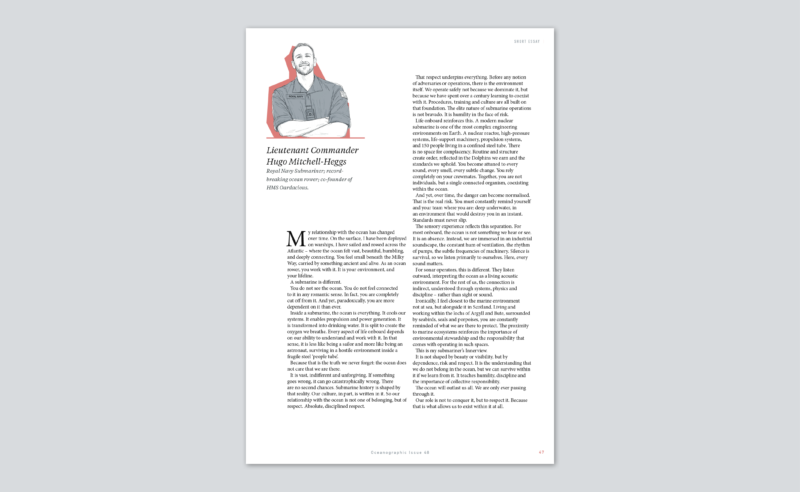
This is how this short essay appears in the special Oceanographic publication, The Innerview
Printed editions
Current issue
Back issues


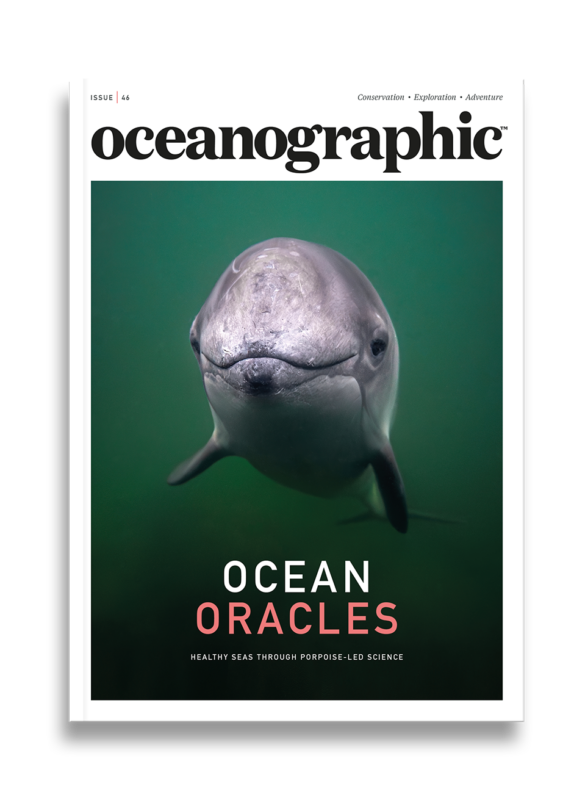
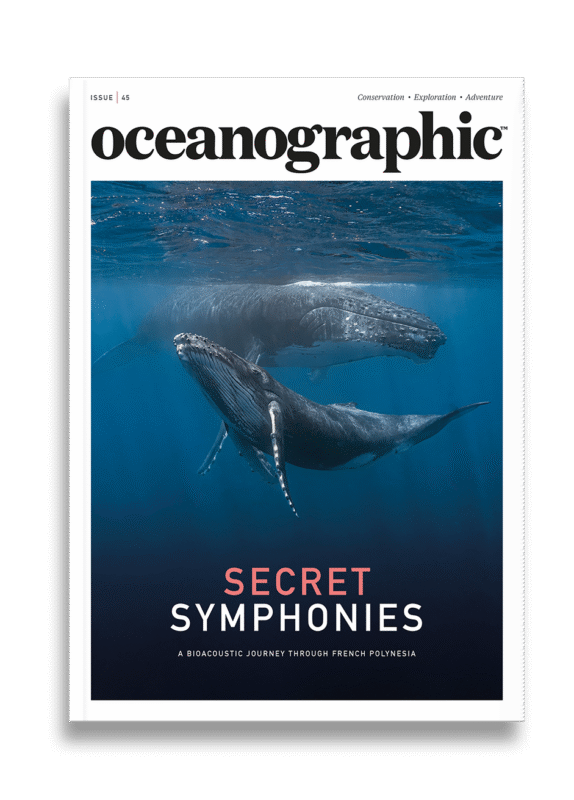
Enjoy so much more from Oceanographic Magazine by becoming a subscriber.
A range of subscription options are available.
