Noam Yaron
Noam Yaron is a Swiss-born world-record ultra-swimmer and an environmental advocate and ambassador for the ocean.
More from The Innerview



People dream of the ocean for its freedom. I learned to respect it for another reason entirely: its brutal and unforgiving indifference.
In August 2025, I accomplished what no one else on Earth has done before. I spent five days and four nights in the Mediterranean without once leaving the water. The challenge involved swimming 191 kilometres from Calvi, in Corsica, to Monaco. There was no shore, and no escape. Just the sea, my strokes and the slow unravelling of everything I thought I knew about myself.
The ocean does not care if you are tired. It does not care if you are afraid. And it certainly does not negotiate. Which is precisely where its teaching begins.
When you are inside the ocean long enough, it stops being a place. It becomes a condition. It dictates your breathing, your rhythm and your thoughts. Its waves come and go on their own schedule while its currents redirect you without asking.
At night, the horizon disappears and you are left with nothing but darkness and the sound of your own body moving through water. Beneath you is 3,000 metres of open water. Somewhere within that darkness are the low sounds of whale song. Beings you will likely never see – even though they are watching you. Just as thousands of other species do, drawn by your presence, circling something they have no name for. For the first time in your life, you are not the observer. You are the observed.
It’s in those hours that something happens which no sport, therapy or summit of achievement could ever replicate. Not fully.
Fatigue strips you down to the person you actually are.
Not the version you present to the world or the one shaped by habit or comfort, but the one underneath it all: raw, uncertain and surprisingly capable. No, the ocean does not build you. It reveals you. And once you have seen that version of yourself, you cannot unsee it. You are changed, permanently and quietly, from the inside.
But there is another transformation that happens in those kilometres. A slower one.
When you cross a sea stroke by stroke, you stop seeing it as a backdrop, and begin to feel it as a living thing.
You notice the silence where there should be life. The debris in the waters that no one watches. The long stretches of blue that feel somewhat emptier than they should. The ocean is powerful enough to break you, and fragile enough to need you. It’s that paradox that stayed with me long after that World Record for Nature.
Because when you swim through the ocean, you don’t just feel it, you witness what we are doing to it. Plastic drifts in the open ocean, far from any coast, while chemical traces – invisible to the eye – are present in everything you can see. Cargo ships and fast ferries cut through vast swathes of marine protected areas, striking whales in the very same waters where they sing. They are routinely the victims of the speed and blind indifference of a world that never slows down.
I swam to help people experience and feel what lies beneath the surface. Not the picture-perfect seaside postcard, but the truth. After all, how can we protect what we don’t know?
We can write reports, sure. We can sign agreements. We can even set targets – and all of it matters. But none of it is enough without something that cannot be legislated: a personal relationship with the ocean and its inhabitants.
People do not protect what they study. They protect what they love. And love, with the ocean, requires contact. Real contact. The kind that humbles you.
My swim was never just about distance or endurance. It was a story I needed to tell. That the ocean is not a concept. Nor is it just a backdrop for a summer vacation. It is the oldest living system on Earth, and – louder and louder – it is asking something of us. Not for heroism or sacrifice. Just presence, and an understanding.
So go and be near it. Stay with it long enough to be changed by it. And then ask yourself what you are willing to do to answer it. Because once the ocean has touched you at that depth, protecting it stops feeling like a duty being asked of you. It becomes a mission, and that mission becomes you.
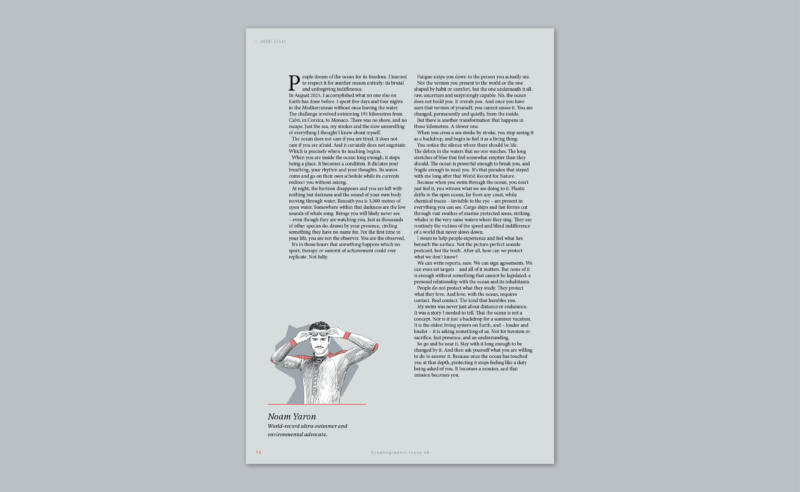
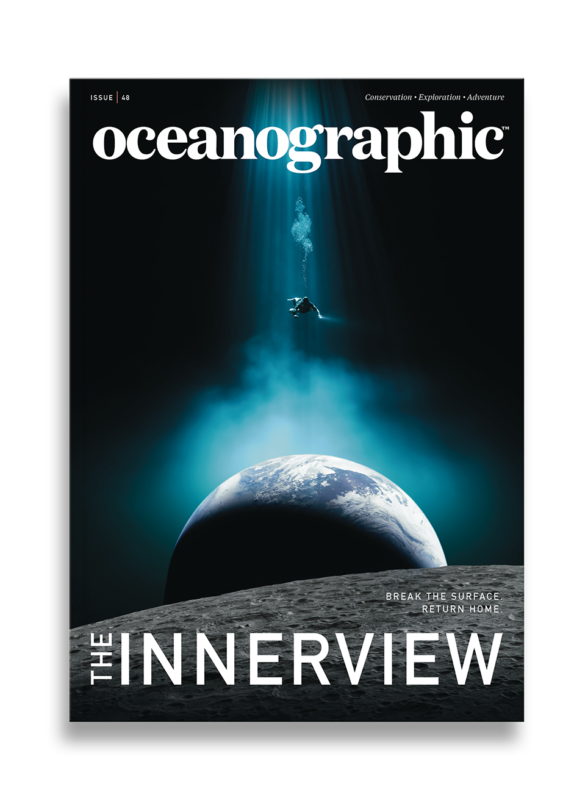
This is how this short essay appears in the special Oceanographic publication, The Innerview
Printed editions
Current issue
Back issues

Enjoy so much more from Oceanographic Magazine by becoming a subscriber.
A range of subscription options are available.
