Patrick Lahey
Patrick Lahey is a submersible pilot; CEO of Triton Submarines; five-time pilot to the Challenger Deep.
More from The Innerview

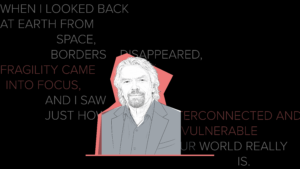




In 1983, on a drilling rig off the coast of Santa Barbara, I made my first dive in a sub to 450 metres, three times deeper than I had been as a commercial diver, but with no decompression, no limits: get in, dive to depth, stay as long as you want, come back up, get out.
In the space of that dive, my life changed and my career pivoted to a focus on creating these magical machines we call human occupied vehicles, or subs. I had a simple belief: the ocean was the most important but least understood place on Earth, and the barrier between human beings and this world was not depth, pressure, or darkness but access.
Since then, I’ve worked with more than 60 subs, spent tens of thousands of hours underwater, and even made dives to the deepest points in the ocean. I’ve seen things with no names and visited places no other human beings have seen. But, the thing that’s stayed with me most is not what I’ve seen, as much as what I’ve witnessed happening to other people when they have the immense privilege to dive in a sub.
Aside from the full ocean depth sub we built, most of the subs I’ve helped to create have transparent pressure hulls made of acrylic. Acrylic has a refractive index like water, so when you dive in a sub made of acrylic, the hull appears to vanish as you submerge, and you feel immersed in the environment: almost as though there’s nothing between you and the fish you’re seeing – they could swim into the cabin, or you could reach out and touch them.
A person gets in, gripping the armrests, carrying their misconceptions of the ocean as cold, dark, lifeless, hostile. Then they dive. The light changes. And somewhere between the surface and the seafloor, their grip loosens, their eyes widen and whatever they thought the ocean was, doesn’t apply any longer. I have witnessed this hundreds of times and never tire of seeing it.
From inside a transparent-hull sub, the ocean is not what people fear. The deep is not dark and lifeless. Below 200 metres, bioluminescent creatures produce their own light; not darkness but a living constellation, burning since long before the first human being looked up and named the stars. At the bottom of the Mariana Trench, at a depth no human reached until 1960, the ocean is not barren. Life – extraordinary, improbable, endlessly adapted – has been living and thriving in the ocean’s trenches for millions of years, entirely indifferent to our stark lack of understanding of it.
To sit in a sub over 10,900 metres deep and see this world with your own eyes is to understand something no book or policy document can convey: the ocean does not need us to exist. She only needs us to stop what we are doing and to begin living in harmony with her.
The Innerview I have built toward, dive by dive, sub by sub across 43 years, is the moment when this understanding stops being abstract and becomes visceral and permanent. Forty-three years of diving has also taught me that the Innerview accumulates. It does not diminish with repetition – it deepens. Each dive adds to the body of memory, compounds the understanding, sharpens the sense of what’s at stake.
More than 90 per cent of the ocean lies below 200 metres. In fact, the average depth of the ocean is 4,000 metres. Yet, it was 2019 before humanity had a reusable vehicle capable of diving to any depth in any ocean. In the 40 years since I made that first dive in a sub, advances in materials, battery technology, electronics, and analytical software have transformed what’s possible – taking transparent hulls from a few hundred metres to 1,000, then 2,300 and now 4,000 metres in the machines we’re creating today.
The next frontier is high pressure glass or transparent ceramics – sometimes referred to as transparent aluminium – materials that could take people to full ocean depth inside a hull that feels like it vanishes the moment it enters the water.
Battery advances are extending endurance and range in ways unimaginable even a decade ago. Communication, navigation, imaging and lighting technologies allow us to capture footage, collect samples, document these observations and share them in ways that amplify the message. They enable us to share this with the rest of humanity, creating advocacy and interest in a place most will never get to see.
Captain Nemo’s Nautilus is no longer fiction: subs operating at great depths with vast acrylic windows, capable of becoming seafloor habitats and deploying mini subs, robotic vehicles and autonomous systems, are already on the drawing board.
We’re at the beginning of understanding the place, which covers 71 per cent of our planet and makes all life here possible – and the pace of discovery is quickening.
The machine is how we get there but the machine is not the point. The point is the moment the hull vanishes and a human being understands – perhaps for the first time – that they are not just looking at the ocean, but a part of this magnificent place. That’s the Innerview. I have spent 50 years building the vehicles that make it possible. Access carries responsibility. Wonder deepens with familiarity. And the ocean rewards, above all else, the willingness to enter…
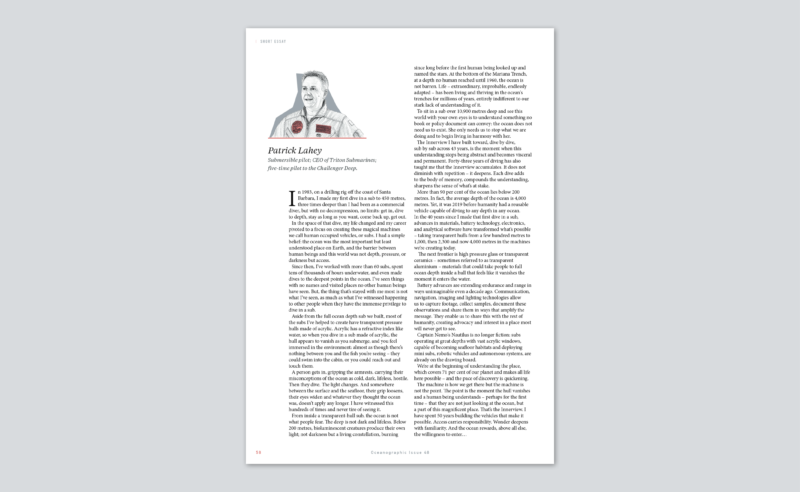
This is how this short essay appears in the special Oceanographic publication, The Innerview
Printed editions
Current issue
Back issues



Enjoy so much more from Oceanographic Magazine by becoming a subscriber.
A range of subscription options are available.
