Paul Rose
Explorer and BBC broadcaster; National Geographic Pristine Seas Expedition Leader and former Base Commander at Rothera Research Station, Antarctica.
More from The Innerview



Easter 1969 at Chesil Cove and my first ocean scuba dive.
When that fresh English Channel flushed through my homemade wetsuit, it instantly exposed my poorly taped wetsuit seams – of course they were poorly made, I had no time to fiddle about gluing a perfect suit, I was all about getting into the water. That icy flush brought me something far more important than discomfort. In that instant I felt, with absolute clarity, that I had crossed a threshold. I was no longer just a swimmer in the sea: I was inside it, part of it, immersed in the most powerful, least explored and least protected ecosystem on Earth. That feeling has never left me.
As base commander at Rothera Research Station for the British Antarctic Survey for ten years, the demands were among the highest imaginable, and consequences of even the slightest mistake were always serious – especially in extreme cold and with ice-choked seawater at -2°C. But that is where the new discoveries lay and I was privileged to be charged with setting up the Rothera dive programme in support of marine science.
Autonomy is the key to safe operations and so we built a world-class standalone team, supplied with the very best facilities, including a recompression chamber, the finest dry suits and scuba gear, world-class dive boat support and a powerful base of operations as backup. Every dive was a world’s first, the deep life was previously unseen and undescribed, new species were in abundance, and in that inhospitable environment, we found extreme beauty – underscoring the need for us to fight for a healthy, sustainable ocean.
Coming from such a powerful place as Antarctica, home to one of the world’s most extreme and crucial environments, our work on climate change, ocean currents and biodiversity delivered the results that proved our responsibility for the ocean and gave us all a sense of urgency. I am excited to be back south next year – I need to catch up with a lot of me that is still there!
The global commitment to protect 30 per cent of our land and ocean by 2030 is not just another target we can miss. Our health and the very survival of the planet is at stake. Every dive I make in my current role as Head of Expeditions for National Geographic Pristine Seas reminds me what we are fighting for. Descending onto pristine reefs exploding with life, discovering new species and witnessing how protected ocean ecosystems rebound are not just scientific observations – they are powerful calls to action.
My Innerview of the ocean has been shaped by a 57-year global journey: diving beneath Antarctic and Arctic ice, exploring complex underwater caves, revealing extremophiles in hazardous waters, teaching thousands of new divers, pushing the outer limits of technical diving, and delivering science by leading high-performing teams in the most remote and unforgiving conditions on Earth.
I don’t have a photograph from my first dive, but my eyes would have betrayed my feeling of invincibility and boundless freedom. A lifetime on and under the sea has worn away the illusion of invincibility, but I’m happy to report the feeling of freedom is as powerful as ever.
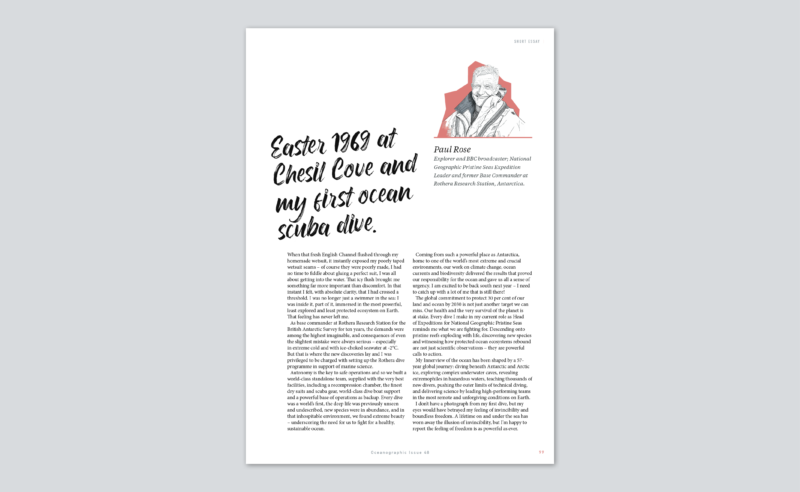
This is how this short essay appears in the special Oceanographic publication, The Innerview
Printed editions
Current issue
Back issues


Enjoy so much more from Oceanographic Magazine by becoming a subscriber.
A range of subscription options are available.
