Phil Short
Phil Short is a cave, technical, and saturation diver. He is also the Underwater Mission Lead at the pioneering DEEP organisation.
More from The Innerview





Imagine, waking from a desperately needed sleep to nothingness!
Absolute dark – no light at all and no possibility of your eyes adjusting. Slowly, your other senses tune in and you become aware of a slight earthy smell and the occasional drip, drip of water far away. Then you remember, ah yes! I’m at Camp 4, one kilometre deep, and over a kilometre horizontally into the Earth, beyond a 200-metre-long flooded section of cave. I’ve been here in this camp for five days and in the cave for two weeks. My teammate and I will set off today to explore the unknown – but first coffee!
This is ICE: isolated, confined and extreme. This kind of environment is what I have spent a lifetime training and preparing for: to touch a frontier and walk where no light has ever shone, where no human has been and no surrogate technology could visit. True exploration in the purest sense of the word; standing on the shoulders of giants like Amundsen, Shackleton, Hillary and Armstrong, who have inspired my journey.
Our home planet has so much exploration potential remaining. This includes areas in forests, deserts, mountains and caves on land, but most importantly in the ocean.
My exploration journey led me to the water and to my desire to learn about and understand our ‘water world’. I find each dive as fascinating and magical as my first: whether under Arctic ice, in flooded caves or mines, or on reefs, walls and shipwrecks.
All of this led to the latest chapter of my life, joining DEEP to play a part in the incredible mission to ‘Make Humans Aquatic’ through subsea habitats. A project that’s using the knowledge gained from thousands of hours underwater to engineer a new future of exploration and productive capabilities.
By way of example, I had the honour of serving as diving operations manager on a mission to recover and repatriate a US Veteran from a WWII heavy bomber in 70 metres of water. At that depth, it took us six weeks with a six-man dive team. The same mission using an underwater habitat could achieve that same outcome in three days. The study of marine life, maritime archaeological sites, coral restoration and climate research will all benefit from the increased productivity and safety offered by underwater habitats.
Humans are inquisitive by nature. Some of us have the ‘explorer gene’ and are even more driven by an urge to discover and share that new knowledge. DEEP’s mission excites and inspires me personally as it offers the potential to extend true exploration achievements for generations ahead.
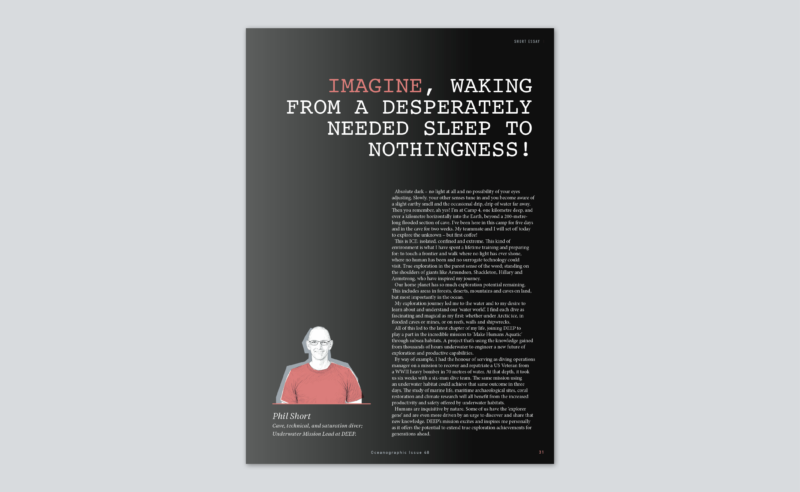
This is how this short essay appears in the special Oceanographic publication, The Innerview
More from The Innerview
Printed editions
Current issue
Back issues
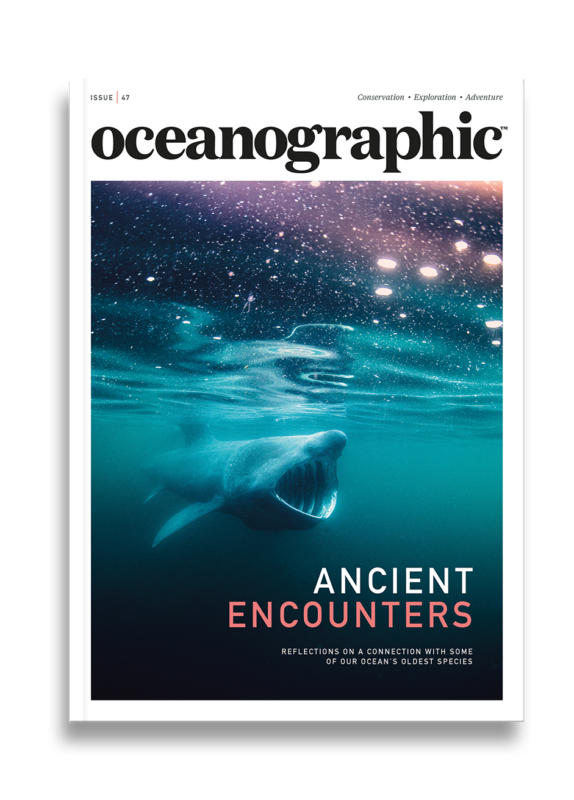
Enjoy so much more from Oceanographic Magazine by becoming a subscriber.
A range of subscription options are available.
