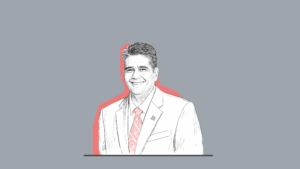
Robert Calcagno
Robert Calcagno is the Chief Executive of the Oceanographic Institute of Monaco.
More from The Innerview


I do not belong to the category of fatalists. Quite the opposite. After a lifetime spent alongside the ocean, I remain convinced that human nature carries within it remarkable qualities – among them, the capacity to understand, to adapt and to change course. We are fortunate to live in a time when deep transformation is not only possible, but already underway. A growing societal and political awareness is taking shape. The age of excess is behind us, not the age of hope.
For decades, the ocean was the great absentee of international climate discussions. When climate change was debated, its role was too often overlooked – or, at best, underestimated. And yet, the ocean regulates our climate, absorbs vast quantities of heat and carbon, and sustains life on Earth in ways we are only beginning to fully grasp. Today, the ocean has gradually reclaimed its rightful place at the heart of international dialogue.
In this evolution, the commitment of the Principality of Monaco, driven by the vision of HSH Prince Albert II, deserves particular recognition. Monaco, I think, has played a pioneering role in ensuring that the ocean is no longer an afterthought, but a central pillar of global environmental governance.
But the time for observation alone has passed. Awareness, however essential, is no longer sufficient. Agreements must now be translated into concrete action. The priority is clear: implementation.
For centuries, it remained largely inaccessible, a vast and mysterious expanse beyond the reach of human activity. Today, technological advances are transforming our relationship with it. Exploration is accelerating, and with it, the expansion of economic uses. This new accessibility brings both opportunity and responsibility. It must be guided by a single imperative: sustainability.
Not all forms of exploitation will meet this standard. Some, by their very nature or environmental impact, are incompatible with the preservation of marine ecosystems. This is where the concept of the blue economy emerges – not as a slogan, but as a necessity.
Between two extremes – unregulated exploitation driven solely by profit, and total preservation excluding all human activity – there exists a narrow but essential path. Along this ridge lies the possibility of a model that reconciles human needs with the integrity of the ocean: a strong, sustainable blue economy.
Today, nearly half of the wealth generated from the ocean still comes from hydrocarbon extraction. This reality underscores both the scale of the challenge and the urgency of the transition ahead. The blue economy must become the cornerstone of our roadmap for the ocean; an economy that creates value while preserving the ecosystems upon which it depends.
It is my belief that a small state can do what large ones cannot. There is something in Monaco’s particular combination of sovereign authority, scientific legacy, philanthropic ambition and sheer conviction that allows it to act in ways that larger, slower institutions cannot.
Encounters with the ocean in its most remote and extraordinary places – through expeditions that reveal both its fragility and its resilience – remind us of what is still within our reach to protect. These experiences confront us with a simple truth: the future of the ocean will not be decided by what we know, but by what we choose to do with that knowledge.
My relationship with the ocean has evolved over time: from one of admiration to one of understanding, from one of understanding to one of responsibility. What it has come to mean, above all, is a call to act. Not out of fear, but out of conviction. Because if the ocean has taught us anything, it is that resilience is possible, but never without respect. And hope, very much like the ocean itself, remains vast.
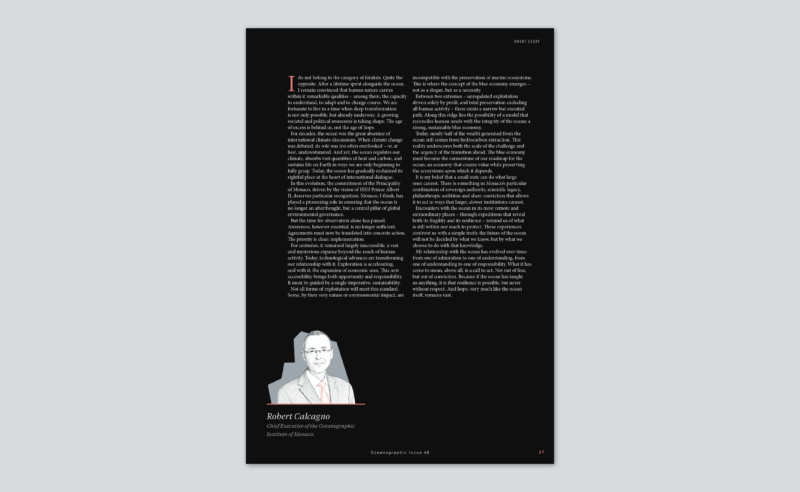
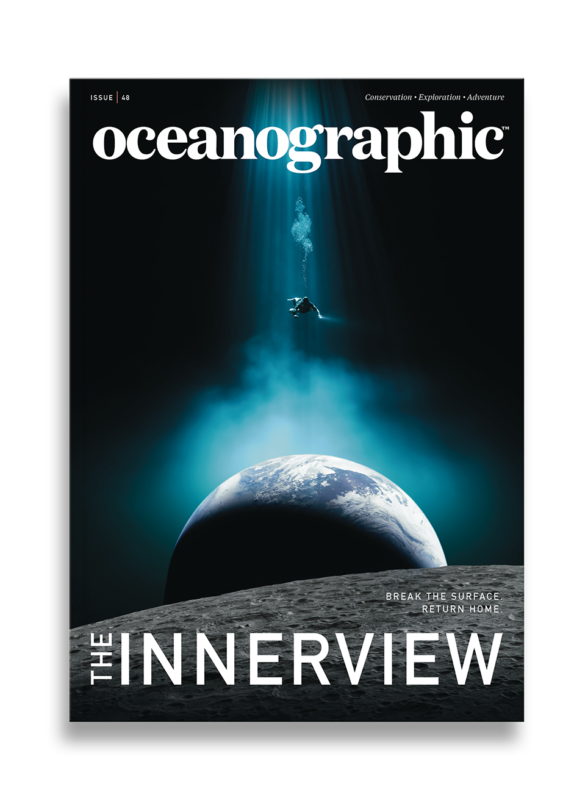
This is how this short essay appears in the special Oceanographic publication, The Innerview
Printed editions
Current issue
Back issues
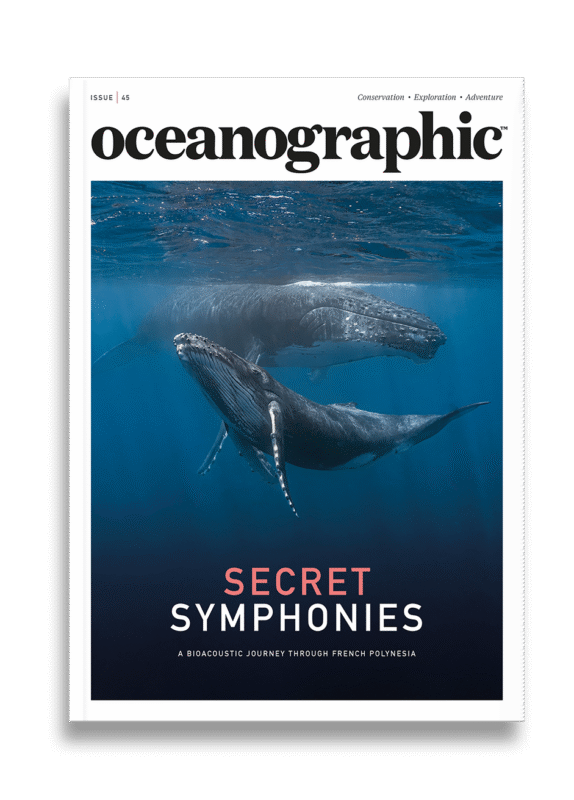
Enjoy so much more from Oceanographic Magazine by becoming a subscriber.
A range of subscription options are available.
