Sheena Talma
Sheena Talma is a Seychellois marine biologist and expedition leader.
More from The Innerview

I am from the Seychelles, a large ocean state in the Western Indian Ocean. And if the ocean and I had a relationship status, it would be labelled ‘complicated’.
I am not more than five years old, playing where the sand meets the sea on a normal Sunday. Today is different. A rogue wave pulls me in and pins me under, and I cannot breathe. I don’t remember much of the rest. My parents say my eldest brother pulled me out. What I do know is that she lost my trust. My first immersion. Involuntary. Terrifying. And the beginning of everything.
My journey to trusting the ocean again is like the course that water takes from the mountaintops to the deep sea.
I grew up at the foot of one of the highest mountains on Mahé Island. My playground was the streams, glacis, forests and highland marshes.
As a teenager, my journey moved from the mountains into the plateau and the shoreline. I spent every holiday on a private island as a conservation officer, taking tourists on hikes, giving presentations, and digging up hatched turtle nests, pretty much smelling like a dead reptile. It would explain my love life at the time.
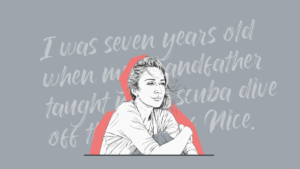
That island is also where the water leaves the plateau and enters the shallows. I journeyed back into the sea. I was 17. I went off on my first dive, and as my feet left the comfort of the sand, my heart raced and my breathing quickened.
There is something quietly devastating about that. And something revolutionary.
Overcoming that fear, every time I set foot into the ocean and away from the safety of the shore, was one of the hardest things I have ever done. But boy, it was worth it. Not only was I amazed by the colours and the way a porcelain crab blends into its coral home, but also by the patience required to observe it. Breathing underwater is mind-boggling. My second immersion. Chosen this time. And the trust, slowly, began to return.
I pursued a degree in marine science and fisheries, earned a position at the Ministry of Environment, and was entrusted with helping to coordinate the first systematic deep-sea expedition in the Seychelles. And just like freshwater is forced into the deep sea through the action of downwelling, I found myself in a new space.
Close your eyes. Imagine entering a bright yellow submersible – this one feels like a bubble – with a 360-degree view. We are not alone; there is a pilot. We are lifted off the deck and slowly lowered into the open ocean. There is a coralline island on the right-hand side; the vessel is behind us. The rest is just a deep, open, dark-blue ocean. Today, we’re plunging to 1,000 metres, slightly deeper than the mountain I grew up beneath
was tall.
Water starts to engulf us. The island disappears. Small jellies dance in the water column; fish jet past. Light dissipates ever so quickly now. It is quiet, except for the sound of the radio and a constant, calming ping in
the background.
We are past 250 metres and plunged into complete darkness. We flush the thrusters, and a display of light comes alive. Bioluminescence lights up the water column. Our eyes adjust. The seabed comes into view. Cliffs tower over us, and I feel like an ant at the bottom of a very tall tree. Sheer cliffs, meandering ravines and caves. Colours, so many reds, pinks and whites. I cannot decide where
to look.
Sponges that look like lilies. Shrimp imprisoned in an intricate glass sponge. Tentacles of corals sieving through the water, catching sea snow falling from the surface. Suddenly, something balloons into view. Something with interesting ear-like flaps, and a light shade of pink and brown. I count them: there are eight arms folded into an umbrella shape. It’s a dumbo octopus – my first. And the excitement cannot be contained.
When I looked out through that glass sphere at 1,000 metres, I wasn’t just a scientist having an experience. I was a Seychellois, finally seeing what had always been mine but never visible. There is something quietly devastating about that. And something revolutionary.
The ocean that pulled me under at five years old, the one I had to fight to trust, the one I descended into with a racing heart at 17, she had been keeping secrets. Not from the world. From us.
That is what the Innerview gave me that no Overview ever could. Not just wonder, though there was plenty of that. But a belonging. The deep sea of the Seychelles had perhaps been seen, mapped, measured and documented by people who then went home.
What it had never had was a Seychellois looking back at it. The instant of mutual recognition, citizen and ocean, finally facing each other, is the most political act I have ever committed. And the most personal.
The water that started at the top of the mountain, that pulled me under at the age of just five and then pulled me back at 17, had been waiting all this time, patiently, for the right moment to show me what was mine.
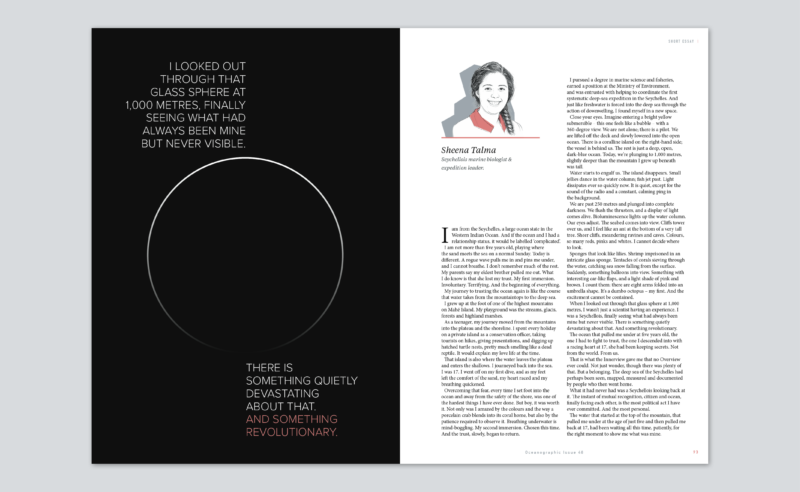
This is how this short essay appears in the special Oceanographic publication, The Innerview
Printed editions
Current issue
Back issues
Enjoy so much more from Oceanographic Magazine by becoming a subscriber.
A range of subscription options are available.
