Sir Robin Knox Johnston
Sir Robin Knox Johnston is a sailor, he was the first to single-handedly, non-stop circumnavigation of the globe (1969).
More from The Innerview



312 DAYS ALONE IN A SMALL BOAT AT SEA MEANS IMMERSING ONESELF IN AN INCREDIBLE RELATIONSHIP WITH NATURE

I navigated, without human contact, through the great oceans: the Atlantic, the Roaring Forties across the Indian and Pacific, then back into the Atlantic again.
Life was dominated by the winds, and the waves they created. A barometer represented the only modern human invention on board; I compared its readings by constantly watching the clouds, the clouds that indicated how these winds would change my existence from hour to hour. My navigation method would have been recognised by James Cook two centuries before; there were no satellites at that time.
Communication was vague and ceased completely when my radio broke down early on. For long periods no one knew where I was and I had no way of telling anybody. In those circumstances, undistracted by news of the outside world, one becomes as much a creature of the sea as the birds, whales and dolphins. Their visits, playful swimming and flying alongside provided pleasant company and made me feel less alone.
Out in the middle of the ocean bird life was scarce, but storm petrels – tiny fluffy little things that seem too fragile for the harsh environment – and huge, graceful gliding albatross were welcome visitors. I was far more cautious when encountering a blue whale, ten times the weight of my boat. I tiptoed past, hoping it would not become too curious.
The oceans have their own contrasting identities but of them all the Roaring Forties are in a class of their own, only matched by the worst storms of the North Pacific. In these southern latitudes there are no land masses to interrupt the constant flow of the waves so they can roll uninterrupted all around the world. This results in a very large, majestic swell, punctuated by often vicious depressions. The swell is manageable, but when the extreme winds in the depressions produce a more local effect, the steep wave faces these winds create can be extremely dangerous. The combination of swell and waves builds them to heights of 30 metres with spindrift rushing across the surface so hard it can temporarily blind you if you look into that wind.
Caught in one such storm in mid-Pacific, and seeing a huge wave about to break over the stern of my boat, I realised that I would be swept off the deck. There was no time to reach the safety of the cabin so I climbed up the ropes and mast to get clear of the deck. Luckily my boat did not broach – swing parallel to the breaking wave. That would have risked capsizing. Six hundred feet of rope towed behind restrained it. The moment felt like an eternity.
Then my boat disappeared underwater leaving me and two masts the only things in sight; the nearest land 1,500 miles away. The boat shook herself to the surface, the water flowed off, and my home reappeared. I was fortunate.
In a recent solo race, five boats got caught in similar weather. They weren’t so lucky. They broached – the boats rolled and
then dismasted.
You long to escape the open ocean and reach Cape Horn, even though the winds there are intensified and squeezed between the Andes to the north and Antarctica to the south. This narrow gap accelerates the current which, combined with the shallower waters, can create horrendous conditions. But once that infamous Cape is passed, you are finally in the ‘lee’ of South America. You are past that relentless swell and into the relatively benign calm of the South Atlantic.
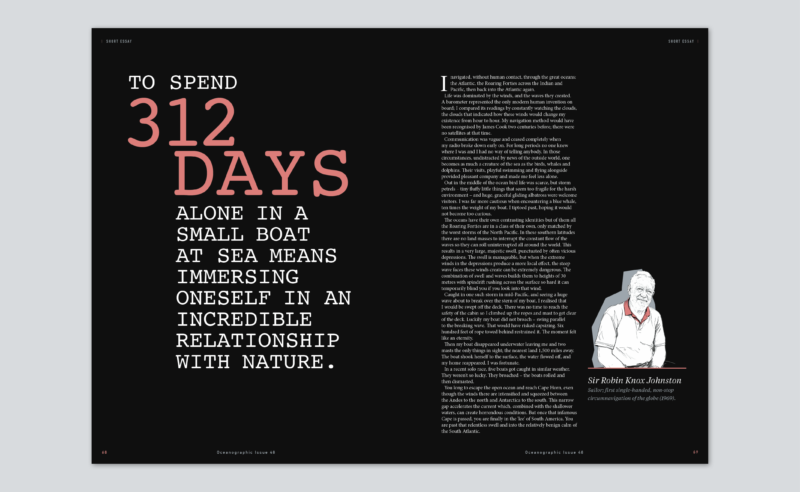
This is how this short essay appears in the special Oceanographic publication, The Innerview
Printed editions
Current issue
Back issues


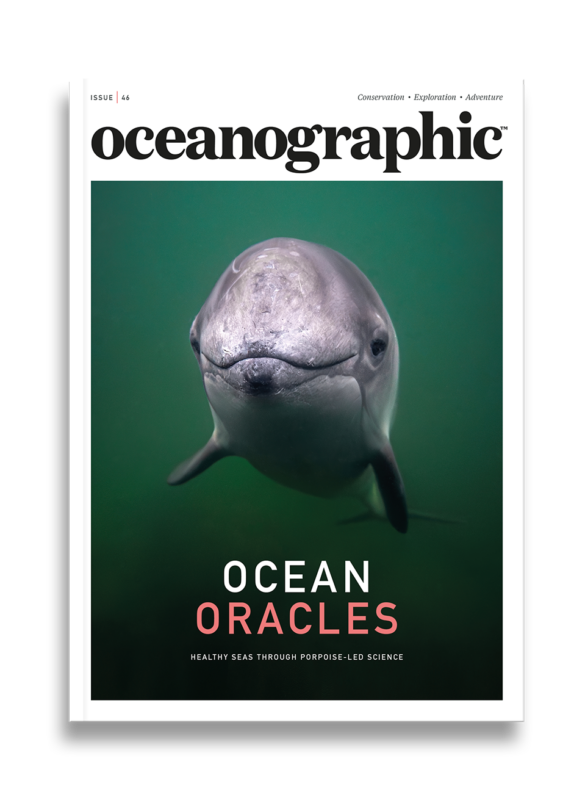
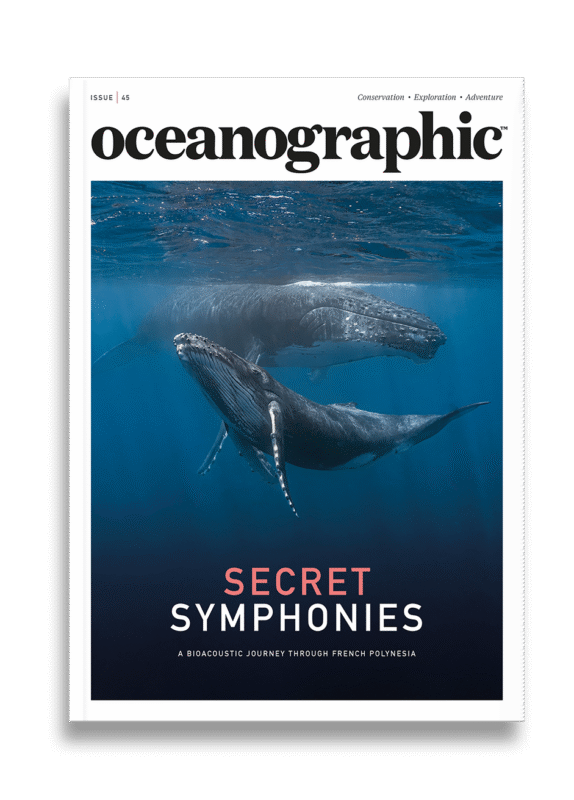
Enjoy so much more from Oceanographic Magazine by becoming a subscriber.
A range of subscription options are available.
