St Kilda, an archipelago at the edge of the world, is an internationally important seabird stronghold, and to its core, a seabird archipelago. When the Avian Flu hit St Kilda’s shores, three quarters of Scotland’s great skua population died. Ecologists and conservationists are now trying to better understand the birds’ immune responses to exposure of different strains of Avian Flu to better protect them in the future.
St Kilda lies in the remotest part of the UK – 40 miles west of the Outer Hebrides in the North of Scotland, in the middle of the Atlantic Ocean. The main island, Hirta, was inhabited until 1930, and the St Kildans survived only because of the seabirds. Gloriously noisy, smelly, busy, but ultimately beautiful, these birds would be harvested for their meat and eggs during the nesting season and stored in stone structures (called cleits) to provide food for the locals throughout the winter. In later years, their feathers would be used to trade for products from the mainland, while even the oils from the birds were used for medicinal purposes.
St Kilda is somewhere I had long wanted to explore – in part because of its remoteness and wild ruggedness amidst the restless Atlantic Ocean, but mostly for the half a million seabirds which nest there every year between May and July, including the UK’s largest puffin colony and internationally significant numbers of gannet, fulmar and great skua.
My dream came true this year when I was invited by the National Trust for Scotland, who care for the islands, to spend five weeks there with their amazing seabird team. I had several roles for my visit – firstly to make a series of films with my partner, James, in my role as ambassador for the National Trust for Scotland, but also as a veterinarian to help the seabird team to catch and sample puffins and great skua for a wider research project looking into the effects of Avian Flu on seabirds in Scotland.
The Highly Pathogenic Avian Influenza outbreak in 2021 and 2022 was devastating for many of Scotland’s seabirds. None so much as for the great skua, or as they’re commonly known by their Shetland name, ‘bonxies’. They are large brown and white seabirds which are cleptoparasites which means they harass other birds until they drop their catch and steal it, as well as eating other seabirds themselves. They’re known as the ‘pirate of the sea’ on account of their behaviour, and those who are prone to anthropomorphise could well see them as a brutal predator, but they’re really just highly adapted to life within a mixed seabird colony. There’s also a vulnerable side to these ‘pirates’ which was revealed during the Avian Flu outbreak, when three quarters of Scotland’s population of bonxies died. Scotland is home to two-thirds of the world’s great skua population, so those remaining, estimated to be just over 2,000, are now even more endangered.
Our work with the bonxies involved catching and sampling them. Being up close and personal with these magnificent birds was a real privilege. They’re truly beautiful birds, bigger than a herring gull, with a strong beak and incredible markings on their feathers. But in the hand, they were calm and quiet – the perfect patients. I developed a real fondness for great skua during my time on St Kilda, a bird I had encountered several times on my explorations of Scotland’s coast and waters, but had no idea of their plight. They nest on the grassy hillsides and tops on St Kilda, and fiercely protect their eggs and young, which are easy to miss amongst the undergrowth. But if you accidentally approach a bonxie territory you’ll soon know about it, as they swoop out of the sky and dive bomb you from above, occasionally hitting your head with their feet. We had the joy of seeing some of the eggs on the island hatch and witnessing the most unbelievably cute, brown fluff balls sitting helplessly in the grass, their protective parents on high alert overhead for any dangerous intruders. They might have a bad reputation for eating other seabirds and stealing their food, but there’s no denying that they’re impressive survivors, and excellent parents.
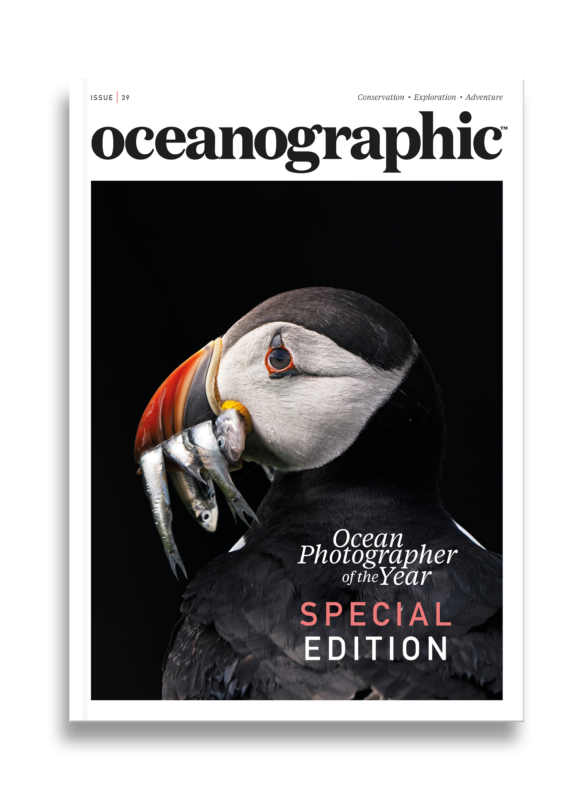

This feature appears in ISSUE 39: OPY SPECIAL EDITION of Oceanographic Magazine
Continue reading
This story is exclusively for Oceanographic subscribers.
