My first Shark television programme was way back in the year 2000, while working for National Geographic’s TV channel as their adventurer in residence. I would be working with ‘Sharkdoc’ Dr Sam Gruber, an eminent shark scientist, following his work with lemon sharks in the mangroves of Bimini.
 The doc and I travelled out into the mangroves of Mosquito point, where another Dr; Martin Luther King, famously came to ‘find somewhere tranquil’ while preparing his final ‘I’ve been to the mountaintop’ speech. In the tangled roots and narrow channels we disturbed feeding herons and egrets, and waded waist-deep catching lemon shark pups. Doc showed me how you could flip them onto their backs to put them into ‘tonic immobility’, a sort of dazed torpor. This enabled him to do all sorts of tests on them, without any anaesthesia. He even used a long pair of forceps to reach down through their mouths and evert their stomachs, getting the most tangible evidence of what they’d been eating.
I didn’t know it at the time, but Bimini was to become a second home for me, and to gain an international reputation as the finest shark diving location on earth. When I returned for the first series of Deadly 60, Doc’s work had shown that these lemon shark pups made friends – other lemon compatriots they’d hang out and hide with. He also crucially showed that lemons return to pup in the same mangroves over and again, and indeed the same mangroves where they themselves were born.
My first dive site with the Doc was ‘Triangle Rocks’, where dozens of Caribbean reef sharks span around us at dizzying speed. 18 years later, I was to dive here live, the images beamed around the world to tens of millions of people. About a kilometre away on the sandy banks I was seen ‘hurdling’ a great hammerhead shark that nuzzled at my ankles, a first for global live television and one of the highlights of my career.
In 2008, the North Bimini marine reserve was ratified as the most important marine protected area in the whole Bahamas. However the mangroves were under more and more pressure. At first this was due to fairly small-scale building work and natural expansion from North Bimini. However in 2012 despite widespread protests from residents a huge development led by Genting casinos was started here, leading to the eventual opening of Resorts World, a mega hotel complex that led to the uprooting of miles of mangroves. The involvement of Richard Branson’s Virgin cruises led to the dynamiting of reefs to create a huge loading pier and ship terminal. Vast cruise liners sat incongruously at port on the tiny island, chugging endless smoke from their funnels, which form a layer of grey haze over the once perfect blue skylines. Run off and fuel coated the reefs in silt.
When I next returned in 2019 and 2020, the mangroves of Mosquito Point were completely gone, devastated to make way for identikit multi-million dollar homes for the Florida glitterati. As we cruised around the soulless docks where the sharks once roamed, we saw not one single person. Many of these outrageous homes are used but once a year.
Related features
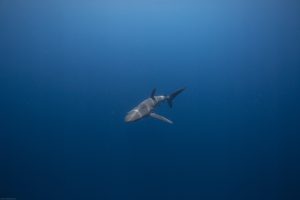
I didn’t know it at the time, but Bimini was to become a second home for me, and to gain an international reputation as the finest shark diving location on earth.
Continue reading
This story is exclusively for Oceanographic subscribers.
