Tessa Campbell Fraser
Tessa Campbell Fraser is a celebrated sculptor and painter, known for her work underwater.
More from The Innerview

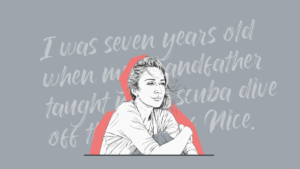



I can’t sculpt what I can’t see and feel. I need to be present and listening to reveal what is beautiful. So, to be given the opportunity to free dive in Dominica with what I now call ‘my beloved sperm whales’ was not only a necessity but an honour.
If I was to do any justice to the interconnectivity between human and non-human species in a sculpture, I needed to be in their environment. In the least intrusive way possible for marine life, but in a manner that opened me up to any sensory experience I might encounter.
What I felt was far beyond what I expected. I thought I was dropping into the water to hear the unique, coda click patterns – that scientists believe are an advanced form of communication between whales – to form a starting point for an artwork.
I didn’t quite know how I would feel being face-to-face with these giant creatures in their environment. I’d hoped I would hear them click and, indeed, they did – but it wasn’t the sounds that gave me the intense feeling of interspecies communication. It was the fact that I was one female in a group of females; I felt part of the clan. I had no sensation that I didn’t belong in their underwater world, or that we were alien to each other or that I was in any way in danger. It was almost as if we had come from the same beginnings. And perhaps we have; after all, they still have finger-like bone digits in their pectoral fins left over from roughly 50 million years ago when whales were walking land animals. Like humans, their bodies are also covered with skin.
One encounter that gave me a particularly strong and special sense of bonding was when a pregnant female swam straight towards me. I didn’t know whether to side swim to the left or right, but she passed by gently with less than a foot between us. As she swam by her eye looked at me in a knowing way as if to say, “See…we are not so different, you and I”. It was a very intimate female-to-female moment.
These not-so-alien species that I was swimming with facilitated a more knowledgeable conversation within me about myself, my personal views of being a woman today – perhaps I was connecting, like Inuit people do, on a deeper, more spiritual level with these magnificent animals? I certainly surfaced from the water with a clear message from my encounter that to exist in this world peacefully and fulfilled, I would do well to listen to their ancient tongue. It made me realise this world is uniquely special and worth cherishing.
The Romantics believed in ‘the concept of the sublime’: that every person upon seeing a grand, majestic object is affected with something which extends one’s very being, expanding the sense of ‘self’ to a kind of immensity. The ocean and its occupants certainly does this for me, confirming as the Gaia hypothesis states, ‘the breath of every living creature is connected’.
Because of this, my relationship with the ocean leads me beyond myself, to something greater than myself; validating the fact that this wonderful world needs protecting for us all to enjoy.
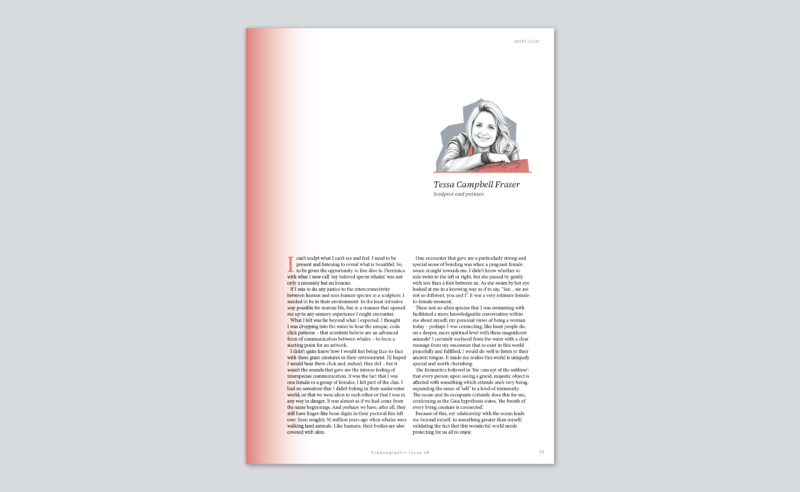
This is how this short essay appears in the special Oceanographic publication, The Innerview
Printed editions
Current issue
Back issues
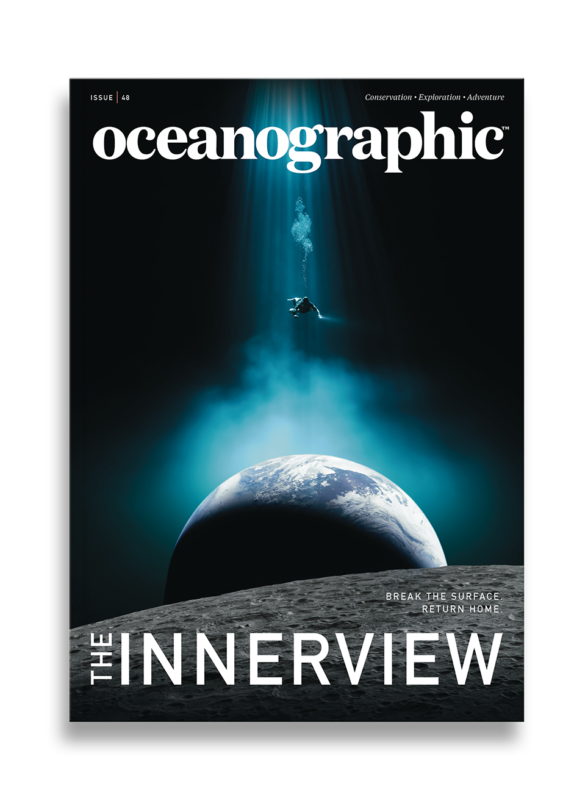
Enjoy so much more from Oceanographic Magazine by becoming a subscriber.
A range of subscription options are available.
