Lasers reveal sharks' ages with unprecedented precision
The new research technique is far more accurate than traditional aging, offering a breakthrough in protecting the Speartooth Shark, which has fewer than 2,500 individuals left.
Researchers have developed a groundbreaking technique to determine the age of sharks using laser beams and X-rays, which is set to help to protect one of the ocean’s most threatened species.
The study, led by a team from the University of Melbourne and partner institutions across Australia and Oceania, applies geochemical analysis to shark vertebrae (the bony segments of the spine) to build an accurate picture of a shark’s age and life history.
The findings have been published in the Marine Ecology Progress Series and are supported by the Save Our Seas Foundation.
A focused laser beam removes tiny amounts of material from a vertebrae sample, which is then analysed for its chemical composition. Like tree rings, shark vertebrae grow concentrically over time, absorbing elements from the surrounding environment, including potassium, calcium, and the trace element strontium, as they do so.
Because strontium concentrations in the vertebrae reflect those of local water systems, and because precipitation records provide an anchor in time, scientists can trace seasonal wet and dry cycles directly within the vertebrae’s chemical layers. This allows them to estimate a shark’s age with a level of precision not previously possible.
Crucially, the research challenges long-standing assumptions in shark biology. Conventional ageing methods rely on counting light and dark banding visible under a microscope, with each pair of bands assumed to represent one year of growth.

In other news




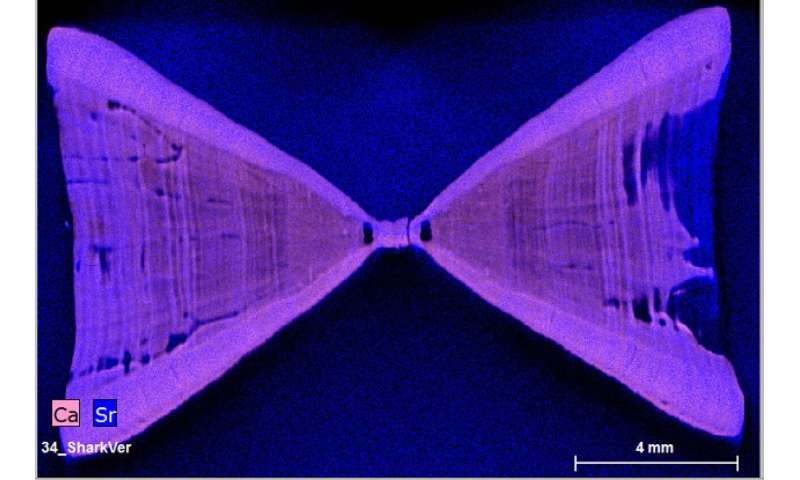
However, the new geochemical data did not consistently align with these bands, suggesting that, at least for some species, conventional methods may be unreliable.
The study focused on the Speartooth Shark, a vulnerable river shark found in northern Australia and southern Papua New Guinea, with fewer than 2,500 mature individuals thought to remain in the wild. Samples were taken from sharks that died naturally or were accidentally caught in fishing nets.
Beyond ageing, researchers say the technique could be used to reconstruct historical waterway chemistry, track the accumulation of heavy metals, and monitor environmental changes over time.
With more than a third of shark, ray and chimera species now listed as threatened with extinction, accurate age data is considered essential for designing effective conservation strategies. The team plans to expand the research to additional species in the coming years.


"*" indicates required fields
Printed editions
Current issue
Back issues

Enjoy so much more from Oceanographic Magazine by becoming a subscriber.
A range of subscription options are available.
