Ocean Photographer of the Year brings story to UK for first time
The Ocean Photographer of the Year exhibition opens at Historic Dockyard Chatham this weekend - its first UK showing - featuring 116 backlit images from ocean photographers and storytellers around the world.

After touring Sydney, Melbourne and Cape Town, the Ocean Photographer of the Year exhibition has finally crossed the hemisphere. This Saturday, the Historic Dockyard Chatham in Kent becomes the first venue in the UK to host the showcase – 116 backlit images drawn from one of the world’s most celebrated ocean photography competitions, arranged across a space that has been building ships for the Royal Navy since the 17th century.
The exhibition – produced by the team at Oceanographic – spans the full sweep of ocean storytelling: from close-up portraits of its tiniest creatures to the vast, churning ecosystems they inhabit; from images of human kinship with the sea to unflinching records of its fragility.
“There’s a certain idea people have when you think of ocean photography,” said Nick Ball, collections, galleries and interpretation manager at Chatham Historic Dockyard Trust. “What was really striking was just the diversity of images – underwater, above water, close-ups of really small creatures or huge creatures. Just the different environments as well.
“Each image has its own feel. You can really immerse yourself in that environment.”
All images are backlit, a technique recommended by the exhibition’s Australian predecessors and one that, according to Ball, transforms the experience. The gallery lighting is kept deliberately low so that each photograph illuminates itself out of the dimness. “It just makes it look really otherworldly, but also very connected and almost vulnerable,” he said of one favourite – an image of a dwarf minke whale, ghostly white against black and “looming out of the image” with what Ball described as a “friendly look in its eye.”
Spread across an 80-acre site, the dockyard contains some of Britain’s best-preserved naval and maritime buildings, and its permanent Maritime Treasures Gallery – shared with Royal Museums Greenwich and the Imperial War Museum – traces the story of British seafaring from its earliest sailing ships to modern battleships. Meanwhile, the quarter-mile-long Victorian ropery still makes rope using traditional techniques to this day.
Ball sees the exhibition as a natural extension of the site’s identity. “The story here is of the sea,” he said. “Previously the focus of the dockyard was building ships that could sail around the world. Now the focus on oceans is environment and conservation. It’s that jumping-off point – the sea as the centre of our history – in a completely new direction.” For a country that is, as Ball put it, fundamentally “an island nation”, the exhibition offers the chance to rediscover a relationship with the ocean that has defined Britain for centuries.
In other news
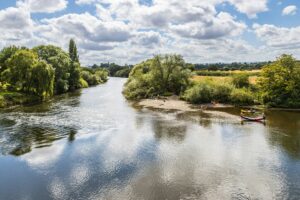
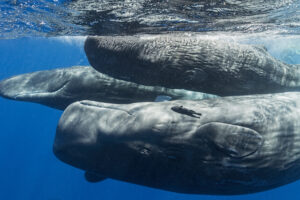
Two finalists from the 2025 competition were present at the gallery this week, and their stories speak to the breadth of what the exhibition encompasses – one a young Londoner who spent a decade away from the water before finding his calling above the waves of Baja California; the other a seasoned BBC documentary camera operator who turned to underwater photography in search of a story told entirely on her own terms.
Growing up in Croydon with no meaningful access to the ocean, Kaushik Subramanian’s relationship with the sea began at 17 when he learned to dive in order to assist scientists in South Africa. Nearly a decade passed before he returned to the water – this time to pursue a master’s thesis, then drone photography, and eventually wildlife cinematography. In 2023, on his second trip to the grey whale lagoons of Baja California, he captured the image that now hangs at Chatham: a drone shot of more than twenty grey whales – each one forty tons and longer than the boat – surrounding a small vessel, drawn in by curiosity and the social pull of watching one another seek attention from the humans aboard.
The captain, who had been running trips for 24 years, said he had never seen that many whales around a single boat before, and hasn’t since.
Subramanian described the grey whale as a recovered species – one that had been on the brink of extinction – and spoke of that recovery as a source of genuine hope. “Every day we’re talking about species on the edge of extinction,” he said. “But there are so many that have also recovered from the impact of humans as a result of protection.” The image, he explained, was intended to capture something broader: the intelligence and natural curiosity of an animal capable of choosing to seek out human contact. “These whales really do seek out our attention,” he said. “I really just wanted to invoke a sense of connection – interspecies connection.”
Jenny Stock, meanwhile, spent a decade making documentaries for the BBC and ITV before the limits of broadcast storytelling prompted a turn to still photography. “I wanted to tell my own stories,” she said, “and it suddenly gave me a huge amount of control about what I was presenting to my audiences.”
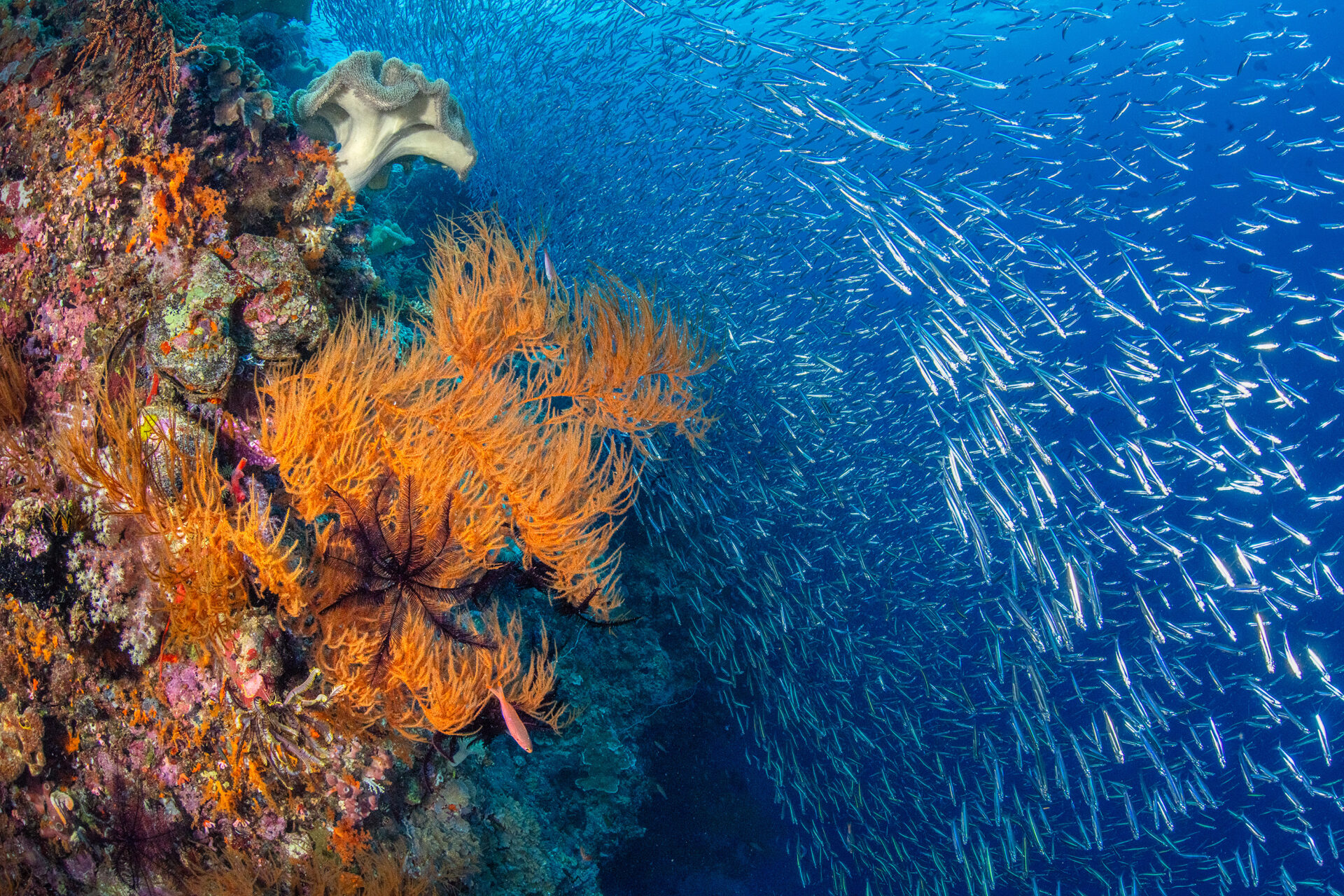
Her competition entry – a blazing orange coral wall with a dense school of small fish spiralling past, driven at speed by pursuing jacks – was captured during a dive that lasted only seconds at its most intense. “The sound of it was incredible,” she said. “I’ve only ever experienced that once in all my many years of diving.”
For Stock, who grew up in Hull – a city shaped by its fishing and shipping heritage – the emotional power of exhibitions like this one is rooted in memory. She recalled standing as a child in front of a whale skeleton in a local museum, the sound of whale song playing around her.
“To bring something to an audience or a child or somebody who’s not in that world and put it in front of them and inspire them to go on a journey is just such an incredible thing to be able to do.”
All three voices – curator, wildlife cinematographer, documentary camera operator – return to a common theme: access. The ocean, they agreed, is not only for divers. Its power to offer peace, wonder and connection is available to anyone willing to stand in front of a well-made image and let it do its work.
The Ocean Photographer of the Year 2025 exhibition opens to the public on Saturday 28 March and runs at Historic Dockyard Chatham through the end of August.


"*" indicates required fields
Printed editions
Current issue
Back issues
Enjoy so much more from Oceanographic Magazine by becoming a subscriber.
A range of subscription options are available.
