Pregnant scalloped hammerhead shark tagged in first for science
Offering groundbreaking new insights into the complex life cycle of scalloped hammerhead sharks, it was during the nearly seven months the shark - nicknamed Alicia - was tracked, she travelled almost 6,000km - the furthest distance one has been tracked to date.

Scientists from across a consortium of environmental NGOs and marine research institutes have published what is believed to be the first-ever scientifically recorded birthing migration for the critically endangered scalloped hammerhead shark.
It marks the start of what could be some breakthrough research into the species, providing critical insights into the complex life cycles and long-range movements that scalloped hammerhead sharks undertake to give birth.
“It’s hard to believe how little we still know about the basic life history of most shark species, including this one critically threatened with extinction,” said Dr Pelayo Salinas de Leon, senior marine scientist at the Charles Darwin Foundation, one of the many NGOs behind the study.
The satellite-tagged shark – an adult female displaying a clearly distended abdomen, strongly suggesting pregnancy – travelled between the Galapagos Islands, the coast of Panama, and international waters to the west of the Galapagos.
During the nearly seven months the shark – nicknamed by the team of researchers Alicia – was tracked, she travelled almost 6,000km – the furthest distance a scalloped hammerhead has been tracked to date.
Scientists from the Charles Darwin Foundation’s shark ecology and conservation programme were joined by those from the Save Our Seas Foundation Shark Research Centre and Guy Harvey Research Institute at Nova Southeastern University as well as the Galapagos National Park Directorate on the publication of the study.
The study was published this week in the special issue Frontiers in Elasmobranch Biology of the journal Environmental Biology of Fishes.
To achieve the feat, the researchers used Closed Circuit Rebreathers to closely approach the elusive species, when shark visited the numerous reef fish cleaning stations around Darwin Island, the northernmost island in the Galapagos Marine Reserve in Ecuador.
Scalloped hammerhead sharks are known to be very shy to the bubbles and sounds produced by traditional SCUBA diving gear as well as extremely sensitive to handling stress produced when captured. Silent Closed Circuit Rebreathers produce no bubbles, meaning scientists were able to approach within two metres of the sharks to deploy minimally-invasive, towed satellite transmitters near the base of the dorsal fin with a modified speargun.
Towed satellite transmitters – similar to GPS – provide accurate location data to resemble a remora fish swimming next to the shark, allowing researchers to follow the movements of the 2.7-metre-long, likely pregnant shark for nearly seven months.
In other news

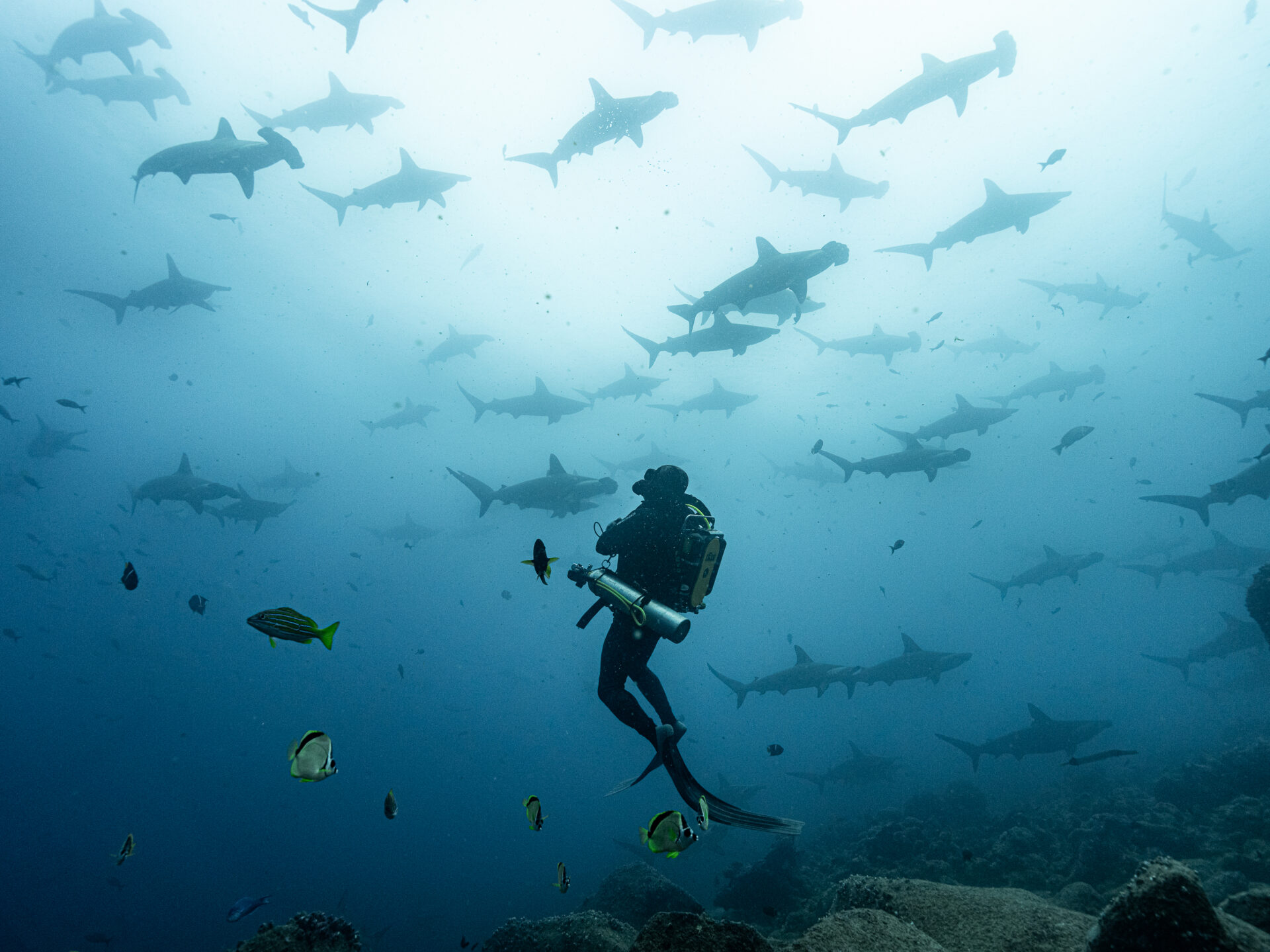
This all took place on February 11th, 2023 at Darwin Island. The shark lingered within the vicinity of Darwin for more than two months before – in early May – travelling 1,300km to the Gulf of Chiriqui on the Pacific coast of Panama – a known nursery for this species.
After just six days in Panama’s coastal waters, where researchers believe Alicia gave birth to somewhere between 15 to 30 pups, the shark initiated a 3,000km westerly migration, settling by late July in an area in international waters more than 1,800km west of the Galapagos Marine Reserve. She remained there until the tag’s battery exhausted and emitted its final location on September 3rd.
“Alicia’s clearly distended abdomen at tagging, combined with her brief visit to known birthing grounds in Panama coastal areas during the peak time of newborn sharks occurrence, made us conclude this published satellite track represents the first documented birthing migration recorded for this species,” said Dr Salinas de Leon.
“Importantly, it provides critical insights on the complex life cycles and long-range movements scalloped hammerhead sharks undertake to give birth to their young, and underscores the need to further protect endangered sharks beyond already established Marine Protected Areas.
“Despite their critical conservation status, pregnant hammerheads continue to be fished while migrating, and newborn sharks are fished daily within most coastal nurseries.”
The scalloped hammerhead shark was categorised in 2019 as Critically Endangered by the Red List of Threatened Species issued by the International Union for Conservation of Nature (IUCN), based an estimated global populations decline of more than 80% over three generation lengths (72.3 years).
Despite this critical conservation status – which is at the same threat level as the Eastern gorilla or the Galapagos Mangrove finch, fins from scalloped hammerhead sharks fished across the Eastern Tropical Pacific continue to flood shark fin markets mainly located in Asia.
The long period of time this shark was tracked within international waters to the west of the Galapagos Marine Reserve also highlights the urgent need for international cooperation to reduce fishing mortality in the high seas in order to revert ongoing population declines for this iconic species.
“Getting this unprecedented view of the long-distance journey by this scalloped hammerhead shark from the Galapagos Islands to the mainland coast to give birth, followed by her return travel westward going well beyond Galapagos, far into the Pacific Ocean, provides new knowledge not only on the reproductive behaviour but also extensive migratory capabilities of this species,” said Professor Mahmood Shivij, director of the Guy Harvey Research Institute and Save Our Seas Foundation Shark Research Centre at NSU Florida.
“Such new knowledge should aid the planning of where to focus additional conservation actions in the eastern Tropical Pacific to preserve this highly endangered shark.”


"*" indicates required fields
Printed editions
Current issue
Back issues
Enjoy so much more from Oceanographic Magazine by becoming a subscriber.
A range of subscription options are available.
