Sewage, sickness and shareholders: Will 'Dirty Business' spark national reckoning?
After Channel 4’s Dirty Business exposed the human toll of sewage pollution, public outrage has surged, with campaigners demanding urgent government action to reform Britain’s privatised water industry.
When the credits rolled on Channel 4’s Dirty Business, the silence in living rooms across the country quickly turned to anger. For three consecutive nights, viewers watched as the UK’s sewage scandal was stripped of statistics and laid bare in human terms: a child lost, lives permanently altered, and families still fighting for accountability.
By morning, social media was awash with outrage. Campaign groups reported surges in website traffic. And for many, the question was no longer whether the system is broken, but for how much longer it will be allowed to continue.
At the heart of the series was Julie Maughan, whose daughter Heather Preen died aged just eight after contracting E. coli on a family holiday in Devon in 1999.
“My daughter Heather was eight years old when dirty water killed her,” Maughan said in the programme. “That summer we went on holiday as a family of four and came home as a family of three.”
Her testimony – both raw and devastating – reframed what for many has, and for too long, felt like an abstract environmental issue. This is a story no longer about percentages or policy frameworks. It’s about human impact and the story of a child.
Alongside her story was that of Reuben Santer, a surfer and teacher who developed Ménière’s disease after surfing in polluted seas. Once defined by his life in the water, he now lives with a chronic, incurable condition.
“This isn’t bad luck,” he said. “It’s the predictable result of monopoly providers prioritising shareholder returns over public health.”
Viewers also met Suzi Finlayson, who developed a blood infection after swimming off the coast of Bognor Regis. She underwent open heart surgery to treat life-threatening infective endocarditis. “I was at risk of dying,” she said. “It shouldn’t have got to that.”
Each story straddles the same dichotomy, because each is unique to the individual yet – perhaps poignantly so – not unique at all. These individuals could have been any one of us. And that is precisely the point of Dirty Business. It presents not isolated cases for dramatic effect, but stories that are emblematic of what campaigners say is a public health crisis hiding in plain sight.
In other news


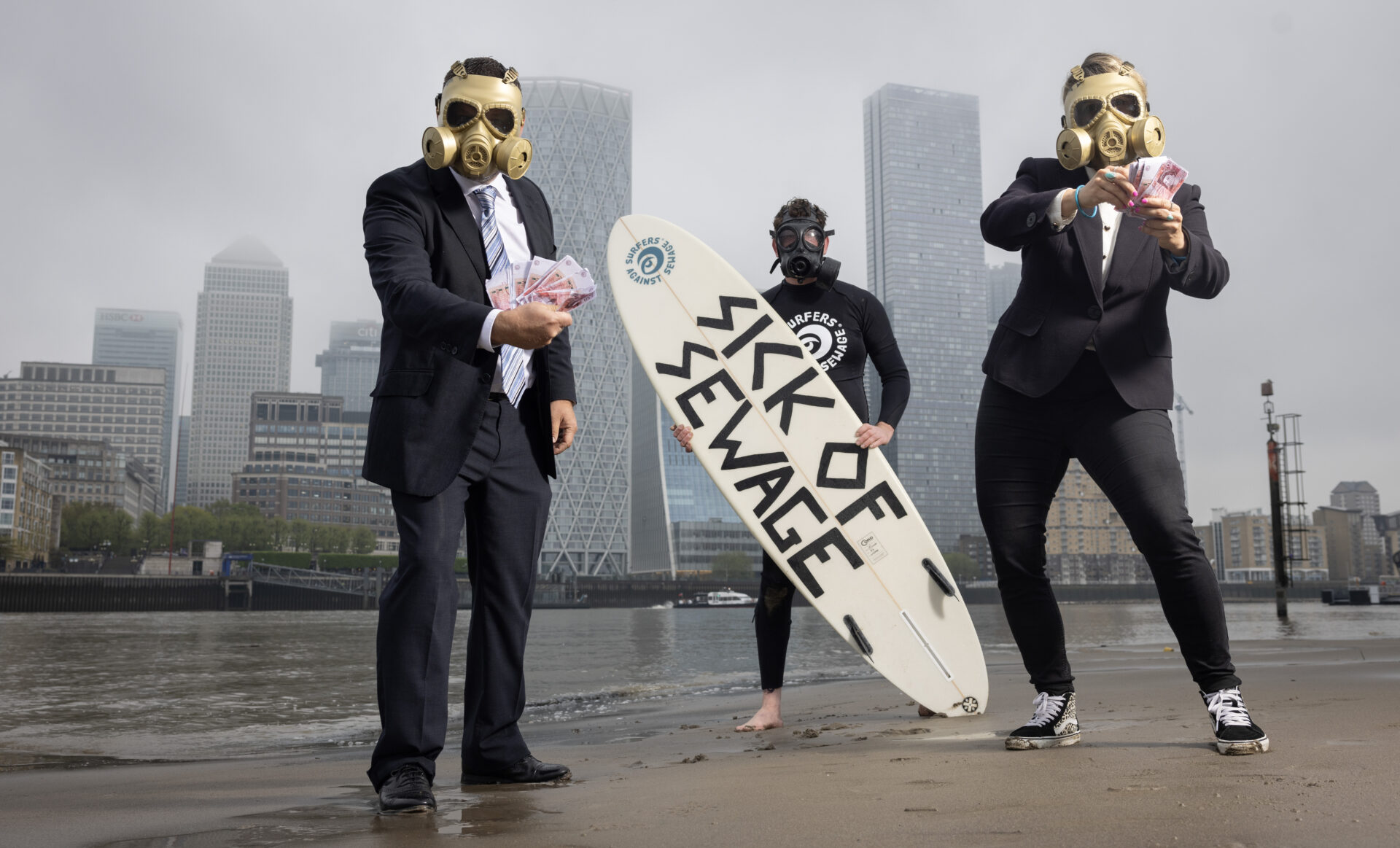
Data compiled by Surfers Against Sewage and released alongside the documentary shows that in 2025 alone, more than 124,000 hours of sewage were discharged into England’s bathing waters. The group also recorded 1,236 reports of illness linked to polluted water last year – nearly three-quarters of them at beaches officially rated “good” or “excellent.”
And 2026 is already following the same trajectory, with more than 46,000 hours of sewage discharged so far. For many viewers, these figures landed differently after watching Dirty Business. They are no longer abstract data points but potential futures.
Perhaps one of the most enraging revelations revisited in the series is financial. Since privatisation 34 years ago, water companies have accumulated debts of £73 billion while paying out £88.4 billion in dividends.
Campaigners argue that while bills have risen, infrastructure investment has failed to keep pace. The result, they say, is aging systems overwhelmed by heavy rainfall and routine discharges of untreated sewage into rivers and seas.
Giles Bristow, chief executive of Surfers Against Sewage, described the government’s proposed reforms as inadequate. The Vision for Water White Paper, published in January, has been billed as “once-in-a-generation” reform. But critics say it leaves the underlying profit-driven model intact.
For viewers fired up by the series, lingering at the edges no longer feels acceptable.


In the days since broadcast, grassroots groups have reported a spike in volunteers and donations. Surfers Against Sewage says supporters are signing petitions, contacting MPs and organising local water quality monitoring. There are also renewed calls for Prime Minister Keir Starmer to meet families featured in the documentary and to consider more radical structural reform – including removing the profit motive from the water industry altogether.
The anger is not confined to activists and campaign groups. Parents are questioning whether it is safe for their children to paddle at the beach. Wild swimmers are checking pollution alerts before every dip. Surfers are demanding real-time transparency.
Charlie Clarke is a triathlete who in 2023 – having recently moved to Bristol – too developed an infection around his heart after swimming in polluted waters during a training swim at Clevedon Marine Lake. After suffering what initially appeared to be a “heart attack” on ECG monitors, tests confirmed that a virus had in fact lowered his blood pressure and caused a ‘minor heart episode’. Doctors confirmed it was brought on by an infection contracted from ingesting polluted water.
“Unfortunately the morning I decided to go to the lake, there had been a release of untreated sewage water. Some 24 hours later, I just collapsed outside of my house, with no underlying conditions. After six months of consultations and hospital visits, it was determined the likely cause was a massive infection in my chest from swallowing polluted water which had spawned inside and caused my entire chest cavity to swell,” said Charlie.
“It really affects your relationship with the water here in the UK. There have been a number of triathlons that I have been signed up to, have checked the water quality the morning of the race and seen that sewage dumping has been taking place there, so I have pulled out of them. It’s a shame.”
Stories like Charlie’s are not uncommon. The recent exposé will no doubt force the public to think twice before diving into the British sea this summer. Yet while this mindset is understandable, Surfers Against Sewage’s Bristow implores this ought not be the end of our connection with the waters that surround us, but the beginning of a clean, new start.
At a time when we need people to feel connected to the natural environment, to feel engaged with and a part of the nature that surrounds them, more than ever, his message is a critical one.
“Don’t not swim, don’t not surf. Don’t not sail. Don’t not be out on the ocean. Because it’s important, we are human and we are part of the environment and we feel so good when we are in them. But go in aware and understanding of what the environmental conditions are like at the time,” he says. “Just as you wouldn’t set sail into a storm, don’t set sail into a shit storm.
“Our coastlines and our rivers are beautiful and we should enjoy them. But check our app for live updates on the water condition. And then, go and sign our petition.”
The UK’s sewage scandal has been brewing for years, surfacing periodically in headlines and parliamentary debates. But Dirty Business has given it a human face – and perhaps, campaigners hope, created a tipping point.
The series has transformed private grief into public scrutiny. It has connected individual illness to systemic failure. And it has forced a difficult national reckoning: how does a wealthy country allow its rivers and seas to become vectors of disease?
For Julie Maughan and others like her, this is not about politics. It is about preventing another family from experiencing the loss she lives with every day. For the millions who watched, the message was equally clear: clean water is not a luxury. It is a right.
And now, after Dirty Business, a growing number of people appear ready to fight for it.
Join Oceanographic for its first ROUNDTABLE discussion next Tuesday, March 10th to hear from some of the experts behind this story and take the chance to be a part of the conversation and help keep the UK’s fight against sewage pollution alive. Click here to be a part.


"*" indicates required fields
Printed editions
Current issue
Back issues


Enjoy so much more from Oceanographic Magazine by becoming a subscriber.
A range of subscription options are available.
