Ambassador Peter Thomson
Ambassador Peter Thomson is the UN Secretary-General's Special Envoy for the Ocean and former President of the UN General Assembly.
More from The Innerview







Growing up in Fiji on the southern tip of the Suva peninsula, I remember the outer lip of the main reef as seeming like the edge of our world. The sound of surf riding across the reef at high tide and ocean swells smashing against the reef’s ramparts at low tide created a constant murmur. During the activity of the day, this was unnoticed background noise. But, in the hush of the night – beyond the occasional screech of a flying fox or the intermittent barking of bored dogs – there was always that rumble of the ocean breaking on the adamance of the great sea reef.
Sitting far out on Suva’s barrier reef, facing the full brunt of the southeast trade winds, is the islet of Makaluva. When I think of Makaluva, I’m forced to think very much in the past tense, for it is not what it once was.
After the big Suva Earthquake in 1955, when a huge crack opened along the length of the main reef and well along the coast, the currents in the area changed and the old Makaluva was gradually devoured by the sea. The same currents that ate away at its northern end formed a sandspit on its southern end, and over some 20 years the island moved the length of itself across the top of the reef. During that process, the buildings and gardens of old Makaluva slipped into the void of never more.
Long ago, Makaluva had served as Suva’s quarantine station, hence the buildings; and we’d make good use of these when my parents and their friends would rent the island for a couple of weeks during school holidays. Sadly, with every visit to Makaluva there was less of what had been there the year before.
The flat coral reef sat tight against all sides of the island, except where that southern sandspit protruded, creating in its lee an expansive sandy-bottomed swimming space between the reef and the dazzling beach. From this we’d snorkel out through the reef’s narrow channels for much of the day; bronzed kids with flipperless feet kicking through the maze of lavish corals, electric blue starfish, zebra-striped sea snakes and flotillas of fish of every description. Our bodies dappled by wavering stars of bright sunlight, we’d swim on out until the reef’s edge was reached. There we would hang in liquid suspension, undulating in the swell, staring down in awe at the big fish cruising by and the blue abyss below.
As large terrestrial mammals, we can relate to elephants, pandas and pangolins and, accordingly, it is about them that we teach our children. But we make little mention of the trillions of plankton with which we cohabit the planet, which is strange when you think that one of their kind, Prochlorococcus, produces 20 per cent of the oxygen of the planet’s biosphere.
For the next half century, I lived most years in, on or by the ocean; but this is not the place to account for the bounty of that experience. Just let me say that for more than a decade now I’ve been working at a global level to bring attention to humanity’s increasingly unsatisfactory relationship with the ocean. One need only look at worsening indices of pollution levels, overfishing and global warming to find the veracity of that assertion. Most of that work has been spent in large conference halls, windowless meeting venues and cloistered media rooms – very far from places like Makaluva, where wistful memories are of little use in persuading those standing in the way of logically required action, or indeed in combatting the obfuscations of the unwilling. But where they are useful is in fortifying adherence to the principle of intergenerational justice: in affirming the moral right of our grandchildren and theirs to experience the natural wonders of our planet.
And with what astonishing wonders we are surrounded. We are rightly astonished and baffled by contemplation of the billions of stars out there in the night sky; for though so much of the properties of the universe are now known to us, so much more remains to be explained. But if we turn from the heavens to the ocean, we are confronted by the same truth. And when we contemplate the trillions of plankton drifting in the ocean, we have to make great adjustments of scale to fully fathom that there are more plankton in the ocean than stars in the sky. If we took just one litre of water from the ocean’s surface, and had the eyes to see them, we would be looking at some one million phytoplankton and half a million zooplankton.
Scale matters. As large terrestrial mammals, we can relate to elephants, pandas and pangolins and, accordingly, it is about them that we teach our children. But we make little mention of the trillions of plankton with which we cohabit the planet; which is strange when you think that one of their kind, Prochlorococcus, produces 20 per cent of the oxygen of the planet’s biosphere. Might our children be more devoted to preventing pollution of the ocean if they knew more about the contributions and living conditions of Prochlorococcus? It is thus that I join with those who say if we are to teach our children well, let us teach them ocean literacy.
In spite of the obfuscations, it is gratifying to live at a time when ocean science attracts more attention than ever before. There’s no room for doubt that through a better understanding of the scale of the ocean’s properties, humanity’s lot on this planet will improve. The doors of perception creak wider, and we begin to appreciate the nature of our own liquidity, our natural place in the hydrologic cycle, our connectivity with – and spiritual reverence for – the watery world we inhabit.
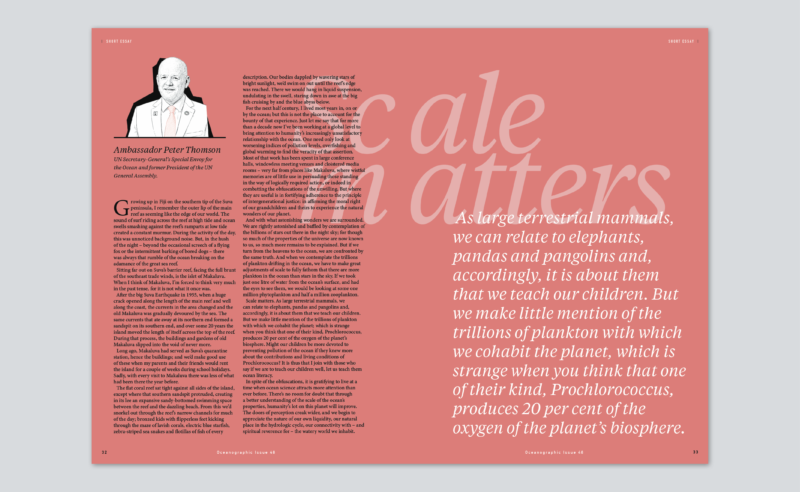
This is how this short essay appears in the special Oceanographic publication, The Innerview
Printed editions
Current issue
Back issues


Enjoy so much more from Oceanographic Magazine by becoming a subscriber.
A range of subscription options are available.
