In Florida, Coral Restoration Foundation™ is tackling the seemingly impossible task of restoring an entire ecosystem. Alexander Neufeld, the organisation’s Photomosaics and Technology Coordinator, reveals what hurricanes, coral restoration and cameras have in common.
As part of their camera rental partnership with Coral Restoration Foundation™, the Danish dive camera manufacturer Paralenz seeks to help restore corals throughout Florida by providing important data. Their Blue Friday campaign will not only make their Vaquita camera more widely available, but will also directly help Coral Restoration Foundation™ in their efforts to plant and protect coral reefs in Florida. Scroll down for more info.
About half an hour south of Miami International Airport, the bustling Ronald Reagan Turnpike merges with US Highway 1 and southbound travelers enter ‘The Stretch’. For the next 18 miles, you hardly even need to touch the steering wheel, as you traverse the sea of grass at the boundary of Everglades National Park. This part of the highway spans the last bit of continental United States before you enter the Florida Keys, a string of islands that run southwest towards the country’s southernmost point of Key West.
It was New Year’s Day in 2016 when I drove The Stretch for the first time. As midnight approached, I was wrapping up my 24th hour of driving, a two-day trek from my hometown of Goshen, Indiana to Key Largo, Florida. My front passenger seat slowly accumulated granola bar wrappers and empty energy bottles. My backseat and trunk were stuffed with all of my worldly possessions (not much, admittedly, for this recent college grad) and my pet salamander, Hades. It was pitch black (to this day The Stretch still has almost no streetlights) so all I saw was a lane line that marked an unsettlingly narrow highway shoulder.
I made this first of what would be many trips across The Stretch to begin a four-month internship with Coral Restoration Foundation™, a marine conservation non-profit headquartered in Key Largo. By the time I arrived at CRF™, the organisation had already been around for over a decade, but was on the cusp of a massive growth spurt. CRF’s core work involves growing endangered species of Caribbean coral – primarily the branching species staghorn and elkhorn – in offshore nurseries and then ‘outplanting’ these coral colonies to degraded reefs sites throughout the Keys once they reach maturity. Conceptually, there is nothing new about this. Aquarists have been fragmenting and growing clonal coral colonies for decades. Scientific studies have consistently shown coral outplanting to be an effective way of safely reintroducing individual colonies to wild reefs. But by 2016, it was the scale at which CRF™ was beginning to operate that was truly revolutionary.
Related features

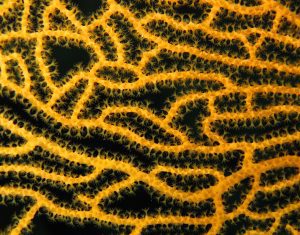
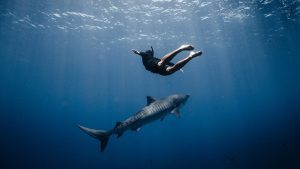

CRF’s core work involves growing endangered species of Caribbean coral in offshore nurseries and then ‘outplanting’ these coral colonies to degraded reefs sites throughout the Keys once they reach maturity.
Continue reading
This story is exclusively for Oceanographic subscribers.
