Dr Diva Amon
Dr Diva Amon is a Caribbean marine biologist and National Geographic Explorer. She is also the Founder of SpeSeas.
More from The Innerview

I grew up on the shores of Trinidad and Tobago, a child with sand between my toes and my eyes fixed on the horizon. I loved everything the ocean gave freely: the warmth, the colour, the life flickering in the shallows. But it was what I couldn’t see that called me. I would stand at the water’s edge and wish, with the particular intensity only a child can muster, that I could reach out and pull back that dark water to see what was living in the depths beneath. I had no name for it then. Now I do. That longing was the Innerview: the moment the ocean stops being a backdrop and instead
comes beckoning.
Years later, I answered that beckoning in ways I could not have imagined as that barefoot child. I have descended in submersibles into the Cayman Trench, one of the deepest points in the Atlantic, as well as the Tongue of the Ocean and to the Mid-Atlantic Ridge. I have hovered over hydrothermal vents and methane seeps: entire ecosystems powered not by sunlight but by the chemistry of the Earth itself. I have been among the first humans to ever look upon a species. That is a feeling that resists easy description. A privilege so vast that it edges towards vertigo.
And yet, inside the submersible, in those hours of descent and exploration, there is always a moment I wait for without admitting it: the moment when, rising back towards the ocean surface, I catch the first faint glimmer of sunlight filtering down through the water column. Something in me exhales. I love the deep with my whole heart, but that light means I am going home. The ocean holds you, and then it releases you, and both feel like grace.
Not all of it has been grace. Working in the Clarion-Clipperton Zone, a vast abyssal plain in the Pacific that holds extraordinary, undescribed life, I felt something I struggled to name: a confusion close to grief. Here were thousands of creatures no human eye had seen before, living in a place that could be fundamentally altered by deep-sea mining within my lifetime. To discover and to fear for what you have discovered in the same breath is a particular kind of sorrow. It reminded me that wonder alone is not enough. Knowledge without stewardship is merely a better-documented loss.
This is why the question of who gets to know the ocean matters as much as the science itself. Most of the world’s nations, including Trinidad and Tobago, have been largely excluded from exploring and understanding the depths of the ocean, including their own waters. The deep ocean has been the domain of wealthy countries and individuals with the ships, the submersibles and the budgets. That is not just an inequality of access. It is an inequality
of belonging.
The ocean is, for me now, something like a family member. Ancient, unknowable in full, worthy of understanding, protection and respect. It called me from a shoreline in the Caribbean. I am still answering.
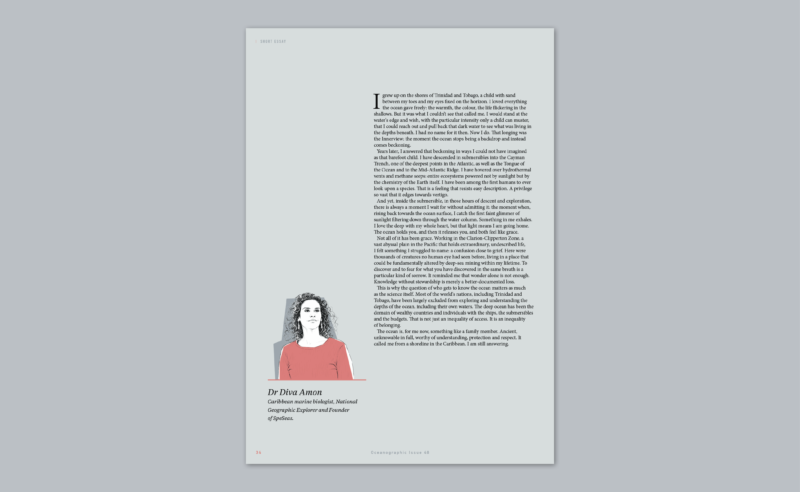
This is how this short essay appears in the special Oceanographic publication, The Innerview
Printed editions
Current issue
Back issues


Enjoy so much more from Oceanographic Magazine by becoming a subscriber.
A range of subscription options are available.
