Professor David Gruber
Professor David Gruber is a Marine biologist and National Geographic Explorer; Founder of Project CETI (Cetacean Translation Initiative).
More from The Innerview





What happens when we immerse ourselves in the heartbeat of our planet?
For decades, astronauts have described the Overview Effect: a profound cognitive shift that comes from seeing Earth from afar – suspended and fragile in the vastness of space. But there is another journey available to us, one that moves in the opposite direction. We can slip beneath the waves and descend into the blue.
This descent is not passive. A descent means crossing into a physiologically and perceptually different world: a world where pressure increases, light dissolves, all wavelengths of the sun except blue are absorbed and sound becomes a primary architecture of life. In these conditions, something begins to change within us. As humans in a more-than-human space, we begin to experience a shift defined by complete immersion.
Over time, I have come to understand these encounters as a form of perception through borrowed senses. To enter the ocean is to begin, however imperfectly, to see and hear as other life forms do and step beyond the narrow bandwidth of human experience.
Years ago, while studying biofluorescence of marine life, I realised that the ocean is filled with signals invisible to the unaided human eye: bursts of colour and light that marine organisms transform from blue light into greens and reds to communicate, camouflage and survive. To witness this hidden spectrum is to confront a simple but profound truth: our perception of reality is partial. Entire dimensions of life exist just beyond our awareness.
That realisation has deepened through my work with Project CETI (Cetacean Translation Initiative), a nonprofit organisation and a National Geographic Society collaboration that is applying advanced machine learning and state-of-the-art robotics to listen to and translate the communication of sperm whales.
Central to this effort is our collaboration with New York University School of Law’s More Than Human Life (MOTH) programme – a transdisciplinary initiative that brings together scientists, technologists and philosophers to explore how emerging technologies might help us better understand and relate to nonhuman intelligence. Together, we are asking not only how to detect patterns in whale communication, but how such understanding might become a force for good – reshaping our ethical relationship with the living world.
Within this collaboration, advances in machine learning are allowing us to analyse vast datasets of sperm whale vocalisations – intricate sequences of clicks, known as codas, that structure their social lives. These tools help us begin to identify patterns, rhythms and recurring structures. But what is emerging is not simply a technical challenge of translation. It is a deeper confrontation with the possibility that we are encountering another form of intelligence, one that has evolved along a radically different sensory and ecological pathway.
The question then, is not simply if we can understand them, but if we are willing to change in response to what we might learn.
Trying to think and feel beyond our humanness…listening, in this context, is not a neutral act. It requires humility. It asks us to move beyond a long history of treating the natural world as something to extract from, and towards a posture of attention, reciprocity and care. If we succeed in decoding even fragments of whale communication, we will not simply have learned something about them. We will have expanded the boundaries of what we recognise as mind, meaning
and community.
What does it feel like to perceive the ocean through whale senses – to glimpse a world structured not by sight, but by sound and returning echoes? What will be revealed about the limits of human perception? What will the click of a sperm whale reveal about the possibility of ‘language’ in another sentient mammal with whom we last shared a common ancestor 90 million years ago?
These encounters begin to unsettle the idea that consciousness is singular or bounded. Instead, they suggest something more distributed, more relational – something that emerges through connection.
In this way, we see this work and Project CETI as an invitation to reconsider what it means to belong in the natural world. An invitation, ultimately, to the Innerview.
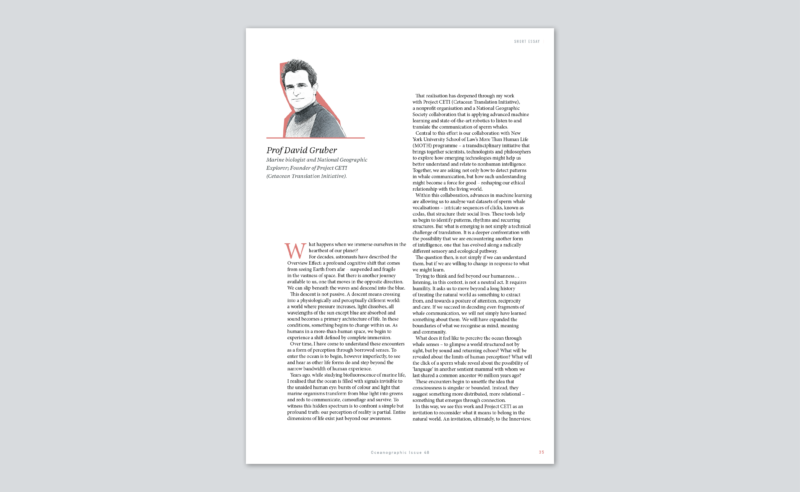
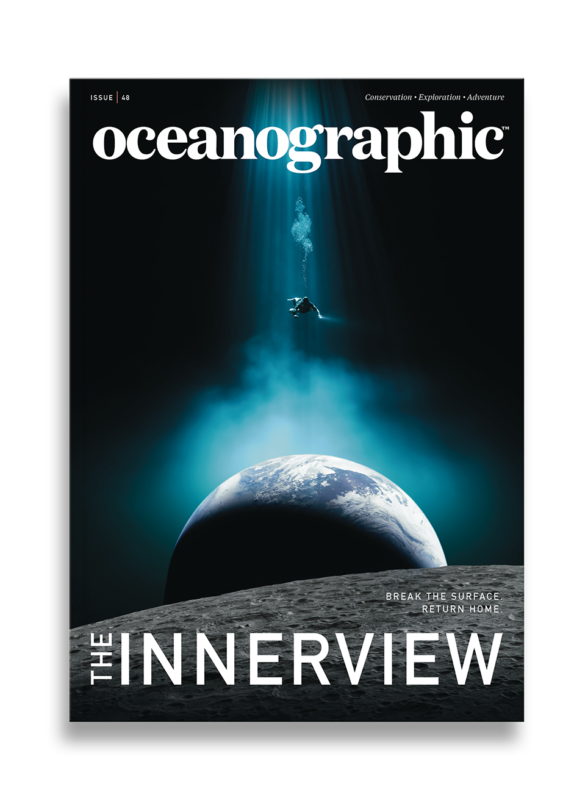
This is how this short essay appears in the special Oceanographic publication, The Innerview
Printed editions
Current issue
Back issues
Enjoy so much more from Oceanographic Magazine by becoming a subscriber.
A range of subscription options are available.
