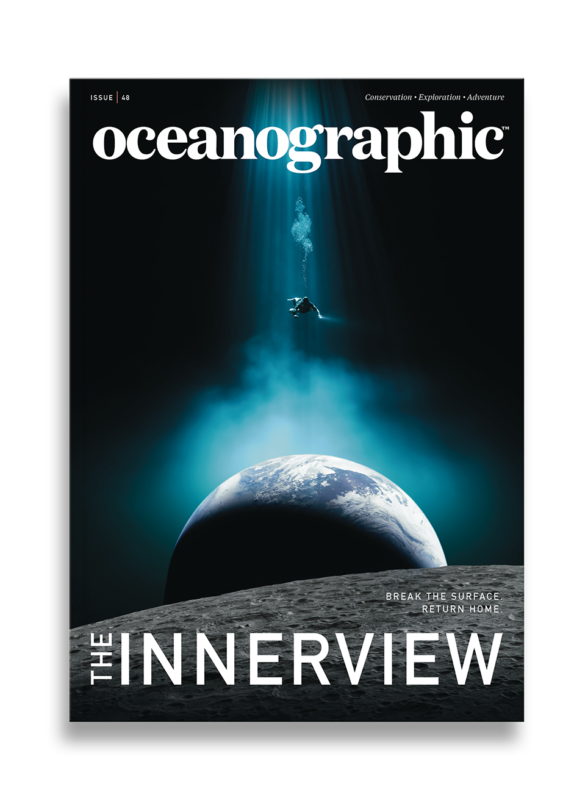
Victor Vescovo: An Innerview
In the first of five pillar essays, American explorer Victor Vescovo dissects the Innerview Effect, comparing it with its foil, the Overview, and considers how the elemental experience of being submerged in water transforms our perspective on how to protect the planet.
I believe we are born alone, self -contained within the limitations of our own senses, constantly searching for a means to reunite with the universe in which we live.
And this, my reader, is why the concepts of the Overview Effect – and now – the Innerview Effect are so important. Two related, but different pathways to achieve just such a reunion and live deeper, more connected, and more meaningful lives.
But what are these two effects? Let us start with the one that came first.
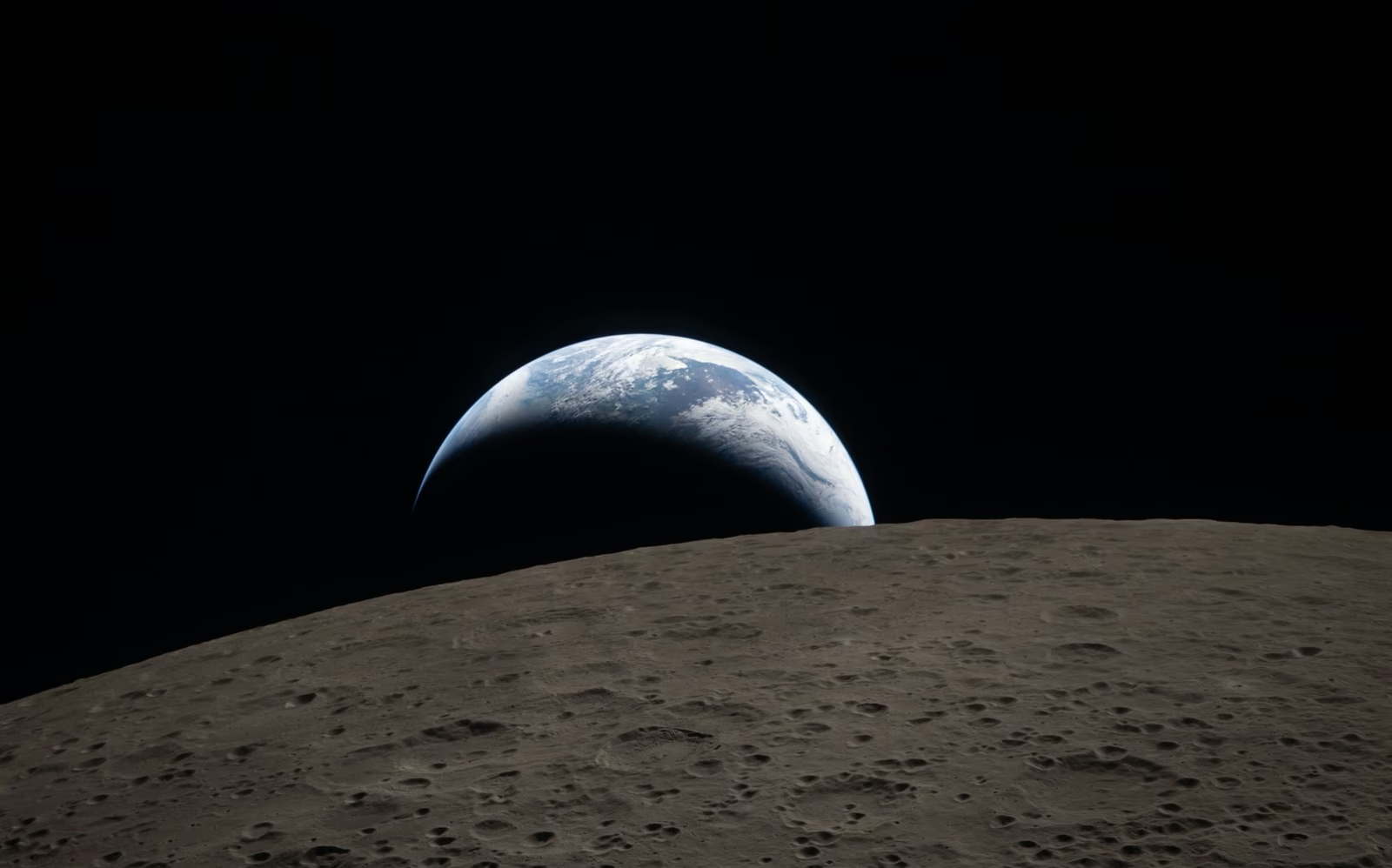
The Overview Effect was coined by author Frank White in the 1980s after discussions with astronauts who described it. Generally, it describes the experience of viewing Earth from space as causing a renewed appreciation of its beauty, its fragility hanging in the vast void of space, and an increased sense of connection to other people and the Earth as a whole.
I have been to space, on Blue Origin’s New Shepard flight #21. Even in that very brief time above the Kármán line, floating in space and looking out over the Earth, I did indeed experience the Overview Effect.
I would argue, however, that one doesn’t need to get into a rocket and journey to outer space to feel some level of the Overview Effect. As a teenage pilot, I had a more limited experience of it when flying over the United States in small propeller planes. Looking down over the planet from such a high vantage point, one can see no borders or strife. Lately, as a glider pilot, the experience of flight is even more spiritual, though one is still safely ensconced in Earth’s protective atmosphere.
And then there was climbing Mount Everest. Have very little doubt: climbing Everest is an epic beat-down – mental and physiological mortal combat with nature that makes you realise just how fragile you, not the Earth, are. But in the act of climbing above 8,000 metres and looking down on the slate-grey-and-white expanse of the Himalayas, you also get a taste of the Overview Effect, in a colder, more brutal way. You can just make out the curvature of the Earth from the summit, and see how thin our skein of atmosphere is – you are so busy trying to breathe however that the lessons of the Effect are drowned out by the howling wind and instinctive urge to simply stay alive.
Both extreme mountaineering and flying were just low-altitude prologues for ascending into space, however. Not 8,000 metres on a mountain, nor 13,000 metres flying a jet, but an order of magnitude higher – into hard vacuum and feeling the full force of the Overview Effect.
What immediately struck me, after floating vertically out of my seat at apogee, was that I saw a white sun against a black, twinkling sky. The Earth was most definitely below me. A shimmering line of atmosphere sliced between Earth and space like a sheet of paper.
Taking all this in, without a word, I did indeed feel the impact of the Overview Effect. Seeing the fragility of Earth. The lack of borders. The void and sheer scale of outer space. The embarrassment of how we treat others on the planet below when it is quite obvious that we are all in this together. Those feelings stay with you, seared into your consciousness during an extreme, out-of-context experience.
You land back on Earth truly wanting to appreciate more, be better, and work towards improving the planet. It is very real, and I believe that it is the most positive aspect of putting humans into space.
So now we turn to the Overview Effect’s fraternal, yet very different, twin. The yin to its yang. That which we are – within the pages of this publication – calling the Innerview Effect.




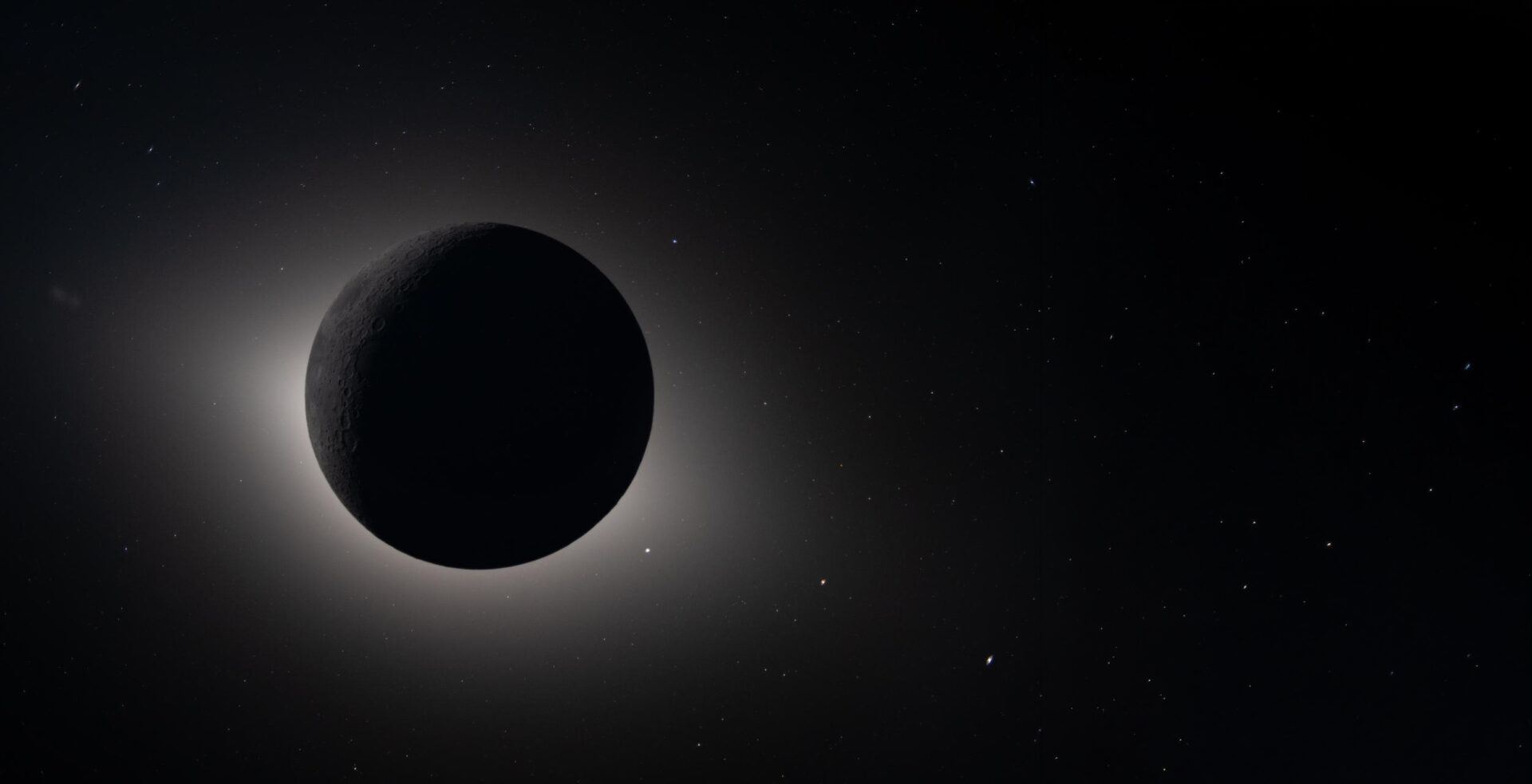

Ask yourself: “Counting the land and sea together, what is the average accessible place on planet Earth? Where, exactly, would you be? What would it feel like to be there, and what would you see?”
It might surprise many that the ‘average place’ on planet Earth is 2,367 metres underwater – in complete darkness, at 3°C and under 3,450 pounds per square inch of pressure. That is the average place on our accessible Earth. To our terrestrial minds, it is a deep, dark and cold place, under unliveable pressure. Author Arthur C. Clarke related this well when he wrote: “How inappropriate to call this planet Earth when it is clearly Ocean.”
To his point, in order to understand the Innerview Effect, one must first appreciate the sheer scale of the world ocean that encompasses us and dominates our planet. The world ocean covers 71 per cent of the Earth’s surface. We small, evolved primates live on the one-third of the world that is dry.
Like most people, my own first memory of interacting with the ocean came with a family visit to a beach on the Eastern Seaboard. I was fascinated by wet sand, and how the waves instantly and easily refilled the holes I had so laboriously dug. That was mesmerising power. It smelled fresh and salty. It was huge, and loud. It was alien, but wonderful, and more than a little frightening to a small boy. I turned back to land and stayed there a while.
In my early 20s, going to college in California, I was exposed to the sea once more when, on a lark, I took scuba lessons.
Breathing underwater, in the open sea, for the first time was a major awakening. Here I was, in an environment that would kill me if I didn’t have technology strapped to my back to keep me alive. I was no longer near or on the ocean, I was in it: floating weightless in three dimensions, interacting with kelp forests, the occasional otter and more fish than I had ever seen in my life.
The ocean enveloped me. I could feel the cold water, taste its salt, hear muffled aquatic calls in the distance and see the shimmering of light breaking through the surface. Four of my senses were engaged simultaneously and with an absolute directness I found alarming, but completely new and fantastic.
This was a different world. And yet, it was actually the true world in a sense, the majority of it. I just never saw it nor could feel it this way. And that, for me, was my introduction to the Innerview Effect.
Over the next three decades, I dived in beautiful places all over the world, but to just a maximum depth of 35 metres. I experienced the shallows of our ocean, where there is light, corals and an abundance of life. And yet I eventually learned there was a deeper, more profound area of the ocean to visit.
The Hadal Zone. The very rarely visited underworld below 6,000 metres that deserves to be capitalised.
From 2018 to 2022, I had the unique fortune to dive in 17 deep ocean trenches and visit the Challenger Deep 15 times. I took 13 different people with me to that supremely inaccessible place in the extraordinary two-person submersible Limiting Factor.
From that amazing piece of engineering, I have seen the seam where tectonic plates are slowly colliding in geologic time at the bottom of the Mariana Trench; the absolute absence of light below 6,000 metres, where no photons can further penetrate – a place where one is reminded that, “If you gaze long into the abyss, the abyss also gazes into you.” (so said F. Nietzsche)
Let us talk, then, about this Innerview Effect. In my experience, instead of the top-down and outward perspective achieved by the Overview Effect, it is the potentially more profound experience of seeing the majority of our world, the ocean, from the inside and through all of its levels: the bright, dappled coastal areas overflowing with abundant marine life; the midnight zone where leviathans like whales and squid live and hunt; and the Hadal Zone where the Earth moves in time measured in epochs.
In the absolute deepest part of our world, where I have spent more collective time than anyone, I have seen massive hadal cliffs rivalling El Capitan, sheared off in unwitnessed cataclysms, bioluminescent creatures moving in rhythms I can’t understand and wrecks so deep they rest like sleeping time machines – nearly pristine from the day they went down fighting enemies almost a century ago.
But going into the depths, whether in scuba gear or a submersible, is quieter, softer, more subtle – but can be no less powerful than going into space.
In the ocean, you are not exploring a foreign world but moving through different rooms of your own home, not just gazing out a window into a vast void beyond.
Embraced in the ocean, you can feel a deeper connection to the fundamental processes that gave birth to us as a species, its sustaining power to life on Earth and an almost Zen-like connection between land and sea.
In diving into the ocean and experiencing all its depths, life and mostly undiscovered wonders, one can feel a deeper connection to our own existence – a connection not afforded by the sterility and black emptiness of space. Space is beautiful, but in very great measure, empty. The ocean, by contrast, is full. Full of water, sustaining and embracing us when we visit. Full of energy, which powers our planet. And full of life, which evolved to become us.
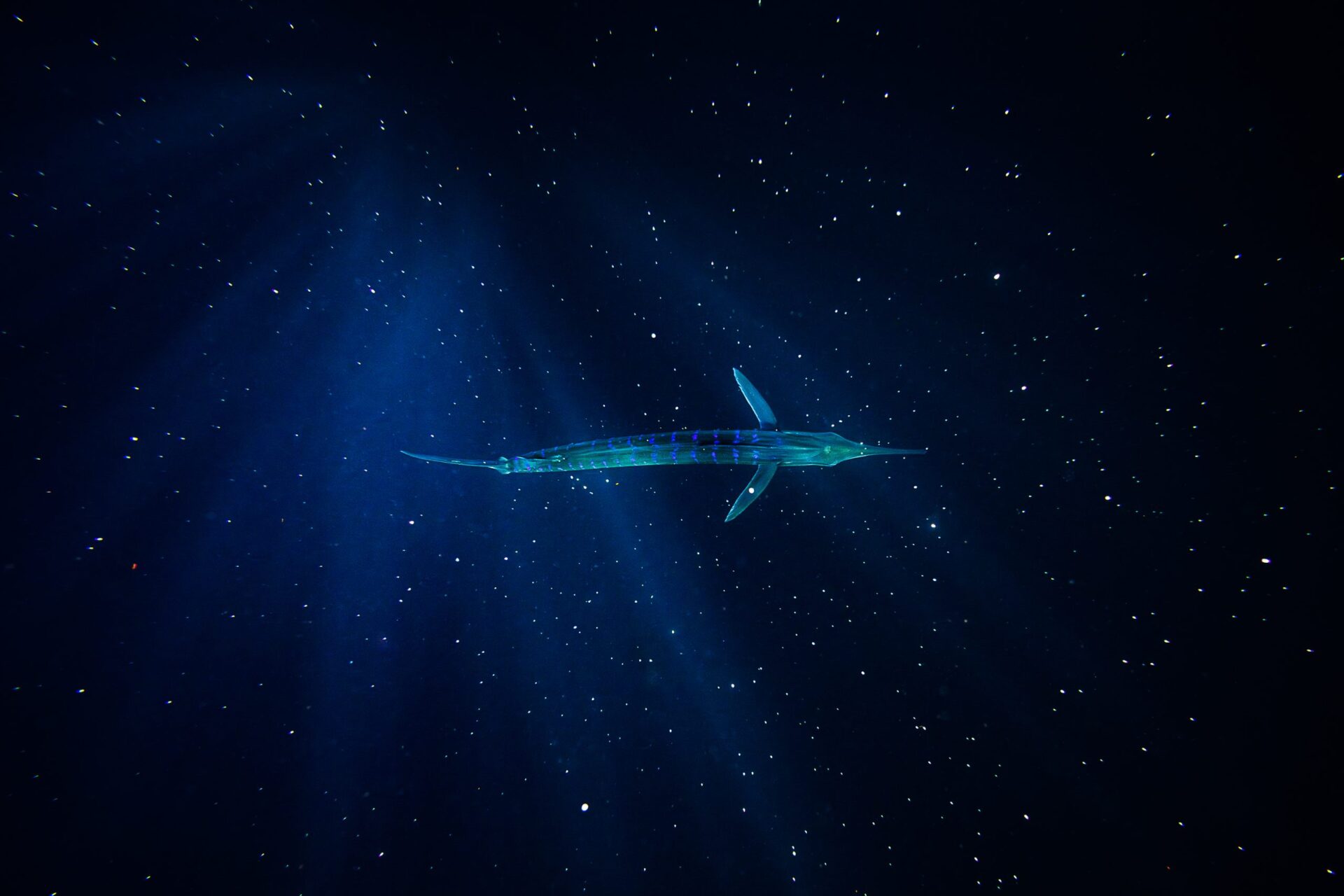
Diving in can awaken something in a human that may not be as rapid as the fast-acting drug of the Overview Effect that happens on a – literally explosive – rocket ride. It’s slower, quieter, but fundamentally more meaningful. Most of the life on our planet is in the ocean, not on land. It is the true reservoir and cradle of our planet’s life force.
In our earliest stages of embryonic development, we are grown with gill-like features, losing them only at our later stages in the womb. It’s a shame because we are not really creatures of space, but of our ocean. In the grand sweep of history, the ocean is actually our home, our birthplace.
In talking with Ocean Elders about how to get more people to care about the ocean, the same piece of advice is always given: “Get people in the water.”
The advice is so consistent because immersion in the ocean penetrates into one’s psyche and helps us achieve that feeling that we often search for our whole lives: being physically touched, embraced even – and feeling part of something greater than ourselves.
We realise, upon emerging from that elemental experience, surrounded by water, that we treat that extraordinary world no better than our wastebasket or local strip mine. We plunder it like a reckless, drunk gambler and then throw the tailings and toxins of this consumption back with little regard for the consequences.
But the Innerview Effect helps stay the hand of reckless destruction. Like the Overview Effect, it helps us consider the uniqueness of our world and realise that by harming it, we will ultimately devastate ourselves. What we experience, we begin to understand. What we understand, we begin to love. And what we love, we absolutely will protect.
Few of us can go into space, it’s far easier to experience water: many can get a snorkel, or strap on a tank and experience zero-gravity on our own planet.
So dive deep. Feel it surround you. Breathe underwater. Swim with fish, otters, sea lions and sharks. You will appreciate how much we lose if we casually obliterate it. If the Overview changed how we see our planet, the Innerview may determine how we preserve it.
Printed editions
Current issue
Back issues
Enjoy so much more from Oceanographic Magazine by becoming a subscriber.
A range of subscription options are available.
