Deep sea shark caught on camera in Antarctica's waters for the first time
There have been no prior records of sharks in this area, and researchers believe that other Antarctic sharks are living at these depths, feeding on the carcasses of whales and giant squids to sustain themselves.
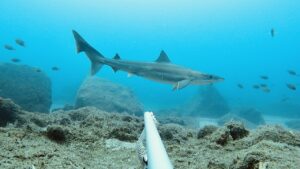
Researchers were delighted by a significant and serendipitous discovery while on expedition in the Antarctic, as they captured the first ever image of a shark in the area’s near-freezing waters.
Experts largely assumed sharks did not live or swim in the area. That was until this sleeper shark (somniosus antarcticus), swam slowly across their camera frame.
The shark was estimated to be between 3 and 4 metres in length, and was recorded at 490 metres below sea level – where the temperature was a near-freezing 1.27ºC, or 34.29 ºF.
Alan Jamieson, the founding director of the University of Western Australia-based research centre, said he found no record of another shark found in the Antarctic Ocean.
“We went down there not expecting to see sharks because there’s a general rule of thumb that you don’t get sharks in Antarctica,” said Jamieson.
“And it’s not even a little one either. It’s a hunk of a shark. These things are tanks,” he added.
Peter Kyne, a Charles Darwin University conservation biologist independent of the research centre, agreed that a shark had never before been recorded so far south.

In other news

Climate change and warming oceans could potentially be driving sharks to the Southern Hemisphere’s colder waters, but there was limited data on range changes near Antarctica because of the region’s remoteness, Kyne added.
“This is great. The shark was in the right place, the camera was in the right place and they got this great footage,” Kyne said. “It’s quite significant.”
In light of this new footage, Jamieson expects other Antarctic sharks to be living at the same depth, feeding on the carcasses of whales, giant squids and other marine creatures that die and sink to the bottom.
Only a few research cameras are positioned at that specific depth in Antarctic waters, and those that are can only operate during the Southern Hemisphere summer months – from December through February.
“The other 75% of the year, no one’s looking at all. And so this is why, I think, we occasionally come across these surprises,” Jamieson said.


"*" indicates required fields
Printed editions
Current issue
Back issues


Enjoy so much more from Oceanographic Magazine by becoming a subscriber.
A range of subscription options are available.