Penguins from space: A new window into the Antarctic winter
Researchers have demonstrated that radar satellite imagery can track emperor penguins through the dark Antarctic winter, unlocking a critical window into breeding populations and offering new hope for conservation of the endangered species.
For nearly two decades, scientists have watched emperor penguins from space. But only in daylight. Now, for the first time, researchers have found a way to follow them through the Antarctic winter – the period of complete darkness that has, until now, been a black hole in our understanding of how these birds breed, and whether their populations are truly declining.
A new study led by Professor Michelle LaRue from the University of Canterbury, published in Remote Sensing in Ecology and Conservation, demonstrates that high-resolution Synthetic Aperture Radar (SAR) imagery can detect and track emperor penguins through the darkest months of the Antarctic year – opening a critical new window into the breeding season of a species recently listed as Endangered by the IUCN.
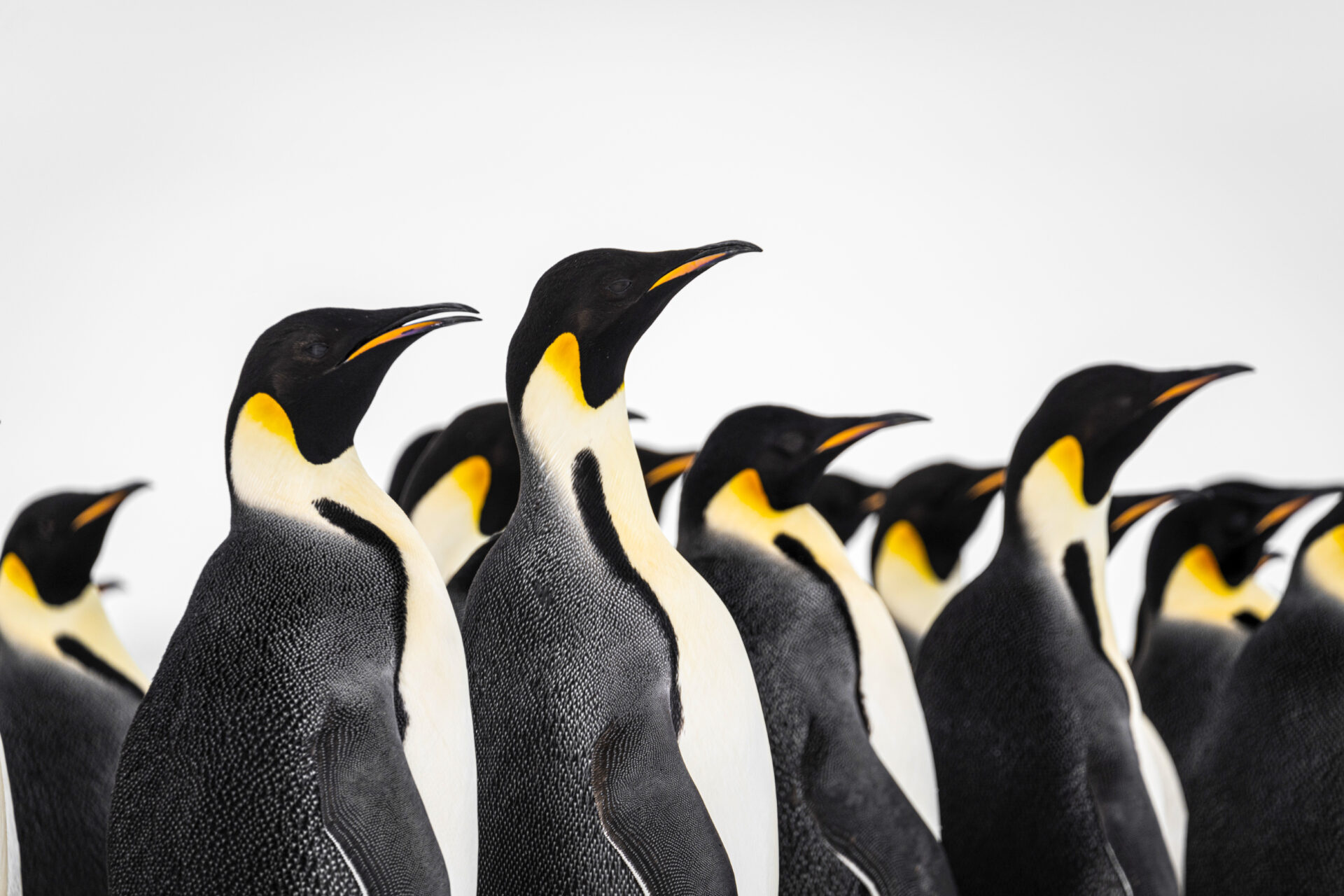
Emperor penguins breed in winter. After mating, females leave for the sea to forage, and males remain at the colony, huddling together in dense groups to incubate their eggs through some of the harshest conditions on Earth. If scientists can count how many males are present in those huddles, they can estimate how many breeding pairs came to the colony, offering a far more meaningful measure of population health than spring counts of chicks and adults alone.
“The problem is that the best time to understand emperor penguin breeding populations is in winter, when light is limited,” said Professor LaRue. “What this study shows is that with SAR imagery we can now see them during that critical winter period, when we know exactly who we are looking at: the males incubating their eggs.”
Emperor penguins are among the most direct living indicators of change in Antarctica. Their breeding success depends on stable sea ice, a habitat that is now under mounting pressure as the climate warms. Spring satellite counts over the past 10-15 years have shown fewer birds at many colonies, but the reasons have remained elusive, in part because so little has been observable during winter.
“We have seen fewer birds in springtime imagery over the last 10 to 15 years in many places, and we are still trying to figure out why that is,” Professor LaRue said. “A lot can happen between winter, when birds come together to breed, and spring, when chicks have hatched and are being fed by their parents. However, if we can estimate breeding pairs in winter, we can get a much better metric for understanding population change.”

In other news

SAR technology makes this possible by bypassing the need for sunlight entirely. Rather than capturing photographs, it sends radar signals toward Earth and measures what bounces back – building images from the texture and roughness of surfaces rather than reflected light. For this study, the team used high-resolution commercial SAR imagery provided by Umbra, with each pixel representing an area as small as 25 to 30 centimetres across.
At that resolution, penguins become visible against the ice “in a way that is both elegant and surprisingly intuitive”. Fast ice – sea ice anchored to the coast or an ice shelf – tends to be smooth. A huddle of penguins standing on it creates a rougher surface, scattering the radar signal differently from the surrounding ice.
The researchers were able to follow the colony through distinct seasonal stages – loose early-season aggregations, denser courtship and mating clusters, and the tight winter huddles of incubating males – each visible and distinguishable in the radar imagery. Confidence in those interpretations was strengthened when a film crew shooting a documentary at one of the colonies provided ground-level observations that could be directly compared with what LaRue was seeing from space.
The next stage of the study will be to deliver a final breeding population estimate and the University of Canterbury team is now working toward what could become the first winter-based breeding population count for emperor penguins using SAR. Researchers plan to link those winter observations with spring imagery to track what changes between the two seasons.
For Professor LaRue, the significance of the work extends beyond any single dataset or season.
“We have been studying emperor penguins for only about 100 years, and there is still so much we do not know,” she said. “This is just the beginning. We can now see them and track what they are doing through winter, and that opens the door to much more discovery.”


"*" indicates required fields
Printed editions
Current issue
Back issues



Enjoy so much more from Oceanographic Magazine by becoming a subscriber.
A range of subscription options are available.
