World's rarest shark species found living off Welsh coastline
Footage of the critically endangered Angelshark has been shared as part of The Wildlife Trust of South & West Wales’ mission to ‘reveal the secrets of its seabeds’ and re-engage communities with its local marine biodiversity.

One of the world’s rarest species of shark has been captured on camera for the first time in four years off Cardigan Bay to the west of Wales, giving conservationists new evidence to support arguments to ban bottom trawling across the country’ marine protected areas.
Footage of the critically endangered Angelshark has been shared as part of The Wildlife Trust of South & West Wales’ mission to ‘reveal the secrets of its seabeds’ and re-engage communities with its local marine biodiversity.
It was captured using Baited Remote Underwater Video Systems (BRUVS) which were deployed by a research team as part of the Dolphin Diet Detectives project – an ongoing investigation into dolphin diets and the marine diversity found across Cardigan Bay. The BRUVs were deployed in a range of habitats and left to record for just one hour at each location.
Over the course of the project so far, the cameras have captured what scientists call a “huge range of wildlife” both inside and outside of Wales’ marine protected areas, including spider crabs, wrasse, and of course the critically endangered Angelshark.
There are 139 marine protected areas across Welsh waters, none of them offering full protection from destructive fishing practices such as bottom trawling – a process by which huge nets and chains are dragged along the ocean floor, sucking up marine life indiscriminately while bulldozing anything in their path.
Evidence of Angelsharks in the region – the world’s rarest species of shark – provides strong evidence to support the argument for a ban on bottom trawling within Wales’ marine protected areas.
“We were thrilled to record an Angelshark in Cardigan Bay, a rare and exciting encounter,” said Dr Sarah Perry, marine conservation and research manager at the Wildlife Trust of South & West Wales. “Before this project started, Angelsharks hadn’t been captured on film in Cardigan Bay since 2021. This sighting comes at a crucial time, as the Senedd and UK Government discuss a ban on bottom trawling in marine protected areas.”
In other news
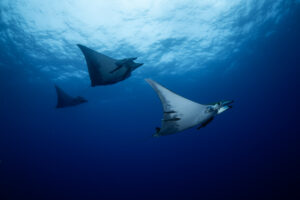
Angelsharks are a critically endangered species, suffering significant declines as a result of fishing and habitat degradation. They live on the seabed where they are well camouflaged to ambush flatfishes, crustaceans, and molluscs. However, their bottom-dwelling lifestyle makes them vulnerable to being caught in trawl nets, and along with their slow reproduction rate, this puts them at a high risk of extinction.
“Our Dolphin Diet Detective project – funded by the Welsh government through the Nature Networks Fund – uses underwater cameras to reveal the incredible diversity of life on the seabed,” continued Dr Perry. “These findings highlight the urgent need to protect these fragile habitats from damaging activities like bottom trawling.”
The Dolphin Diet Detectives project itself is a groundbreaking piece of work for local marine protection. Funded by an almost quarter-of-a-million-pound grant from the Welsh government and working in partnership with both Aberystwyth and Cardiff universities, the project is extracting DNA from dolphin faecal samples collected from Welsh waters to reveal what dolphins are consuming at various times and locations.
These samples are also being used to generate individual profiles for each dolphin, allowing the team to work out their sex, investigate family relationships, population size, breeding potential, and their movement patterns.
The team will then match these unique profiles with individual bottlenose dolphin photo ID records.
Of this project, Dr Perry said: “Our focus on understanding dolphin diet, population dynamics, and interactions with prey species through innovative research methods will not only inform vital conservation strategies but also actively involve the community. This project is a collaborative endeavour, uniting science and community for a sustainable future.”
At the UN Ocean Conference, the UK government announced a plan to ban bottom trawling from 41 marine protected areas within English waters. It is currently running a consultation on these plans.


"*" indicates required fields
Printed editions
Current issue
Back issues
Back Issues
Issue 43 Sir David Attenborough’s ‘Ocean’
Enjoy so much more from Oceanographic Magazine by becoming a subscriber.
A range of subscription options are available.