Cal Major is a vet, ocean advocate and world-record stand up paddleboard adventurer who founded the UK charity Seaful to reconnect people to the ocean. In this column, she explains why Scottish salmon farms are not as positive as they are made out to be.
More of Cal's columns
Wild salmon are majestic, perfectly adapted migratory creatures which swim vast distances back to their birth river to spawn. Domesticated farmed salmon do not.
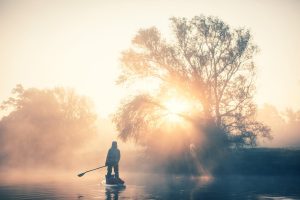
I recently reflected on the incredible wildlife encounters and experiences I’ve had paddleboarding, and how the endless hours on the ocean have been interspersed by some of the most wonderful gifts – rafts of guillemots, pods of orca, and eagles soaring overhead. All that time out to sea also puts me in a place to experience some really harrowing sights: A first-hand insight into what’s happening in our ocean.
I have found a dead, entangled humpback whale calf, a gannet skewered with barbed fish hooks, and areas of seabed scraped bare by dredgers. And one of the worst things I come across around almost every corner in Scotland is open-cage salmon farms. My partner, James, was a mountain runner and landscape photographer when we first met. He was plunged into this world of ocean exploration, storytelling, and conservation when we made our first film together about my SUP expedition around the Isle of Skye in 2017, and the impacts of plastic pollution there. I remember so clearly the first time he saw a salmon farm for himself. The disbelief that this was where world-famous Scottish salmon actually came from. He felt hoodwinked, lied to, outraged, and swore to never eat it again.
You might have seen them for yourself if you’ve ever cast your eye out over an otherwise picture-perfect Scottish sea loch. If not, I hope my description can do justice to just how painful the juxtaposition between nature and these atrocities is. Salmon farms consist of several enormous, normally circular, pens which sit in the water and are full of thousands of salmon. Wild salmon are majestic, perfectly adapted migratory creatures which swim vast distances back to their birth river to spawn. Domesticated farmed salmon do not.
They swim in circles for the months of their miserable lives in cramped cages. The sounds and smells paddling past a salmon farm are intense. Machinery, ropes, chemicals, and faeces. If you paddle close enough, you can see the salmon breaching the water. I have seen and heard the thump of them jumping out of the sea straight into the metal structures surrounding them. I’ve also seen the dead ones in the cages, some of the millions of farmed salmon that die prematurely each year.
The eyesore is the tip of the iceberg. If this was truly sustainable food, as is often suggested by the multi- million pound international companies that own them, then I could perhaps abide their place amidst the beautiful views. But they are an environmental disaster. All salmon farms in Scotland are ‘open-cage’, which means there is just a net between the salmon and the rest of the ocean, and all its struggling ecosystems and inhabitants. These salmon are packed in so densely that parasitic sea lice have a field day, eating away at their flesh, and then dispersing directly into the environment to harm and kill wild fish species too. Several methods are employed to rid the farmed salmon of their lice, including pouring highly toxic chemicals into the cages, which then end up in the ocean.
Salmon faeces are free to enter the ocean. We are talking about the equivalent of 2.5 million people’s raw sewage every year on the west coast of Scotland. This smothers the seabed underneath the pens and upsets the nutrient balance in the sea lochs.
And then there’s the plastic pollution. Fish farms are not immune to Scotland’s infamous weather and are sometimes ripped apart by storms. Every year on the West coast, on our beaches and islands, we find enormous thick black plastic pipes which are used to transport feed to the salmon. These also release tonnes of microplastics into our ocean every year as feed pellets are blasted through them. Irretrievable microplastics threatening an ecosystem that is already on its knees.
Why am I telling you this? Recently, our community came together to stand up to a Norwegian salmon farming company that wants to install these feed pipes in a salmon farm in our Marine Protected Area. Up until now, the salmon in this farm have been hand-fed, mitigating this disaster. If the proposal goes ahead, our sea loch will have tonnes of microplastics knowingly forced into it.
The otters, porpoise, oysters, prawns, and people here will be subjected to the same poisoning as nearly all the other lochs around Scotland. And the company’s defence is that that’s how it’s done everywhere else. So that makes it ok.
In 2017, on an inaccessible beach on the Isle of Skye, I was horrified that I had to wade through knee deep plastic to find somewhere to pitch my tent. There were plastic bottles, rope and enormous black pipes which, at the time, I did not know came from a fish farm. I regret that my messaging then was focussed on consumers changing their behaviour, choosing a reusable bottle, shunning plastic bags, when there are companies making eye watering profits at the expense of our environment who need to take responsibility too. But when it comes to farmed salmon, we do, as consumers, have the choice, influence, and power to help change all this.
More of Cal's columns
Wild salmon are majestic, perfectly adapted migratory creatures which swim vast distances back to their birth river to spawn. Domesticated farmed salmon do not.
Continue reading
This story is exclusively for Oceanographic subscribers.
