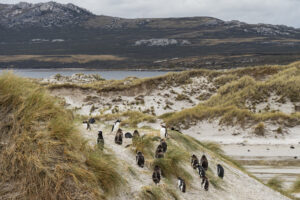
On South Africa's Malgas Island, some 40,000 cape gannets present a vision to be marvelled at. But this island carries an echo of a population that once stretched further than the eye could see. This is a species in decline, and the culprits here are no more than the usual suspects.
How can a bird be a metaphor, you might ask? Especially a boring old seabird like a cape gannet. On first appearances, they may seem as innocuous as a seagull. But these birds hide a wealth of secrets. Some of those secrets are immense fun – and I would suggest that perhaps the best pub facts about any bird, it turns out, indeed belong to the cape gannet.
For a starter, they have – quite literally – evolved airbags in their skulls, the type of protective mechanism that arms them with the fortitude to withstand hitting the water repeatedly at 50mph, before catching fast-moving fish that are swimming away from them, mid plunge. The only thing that makes this seemingly impossible feat of aerobatics, athleticism, and coordination more impressive, is that they do this while dodging the hundreds of sharks seeking an opportune meal.
But much as cape gannets have one of the most impressive natural histories of any animal in the ocean, it is their unnatural history that is their most remarkable story to tell. This is the story we wanted to tell for Sir David Attenborough’s most recent documentary, “Parenthood”. And, in my career of telling stories about the natural world, I have yet to come across one that makes such a powerfully clear alarm call over how we must heal our oceans.
I was fortunate enough to produce and direct the Ocean episode of the BBC’s “Parenthood” series. These series all usually start in the same manner. The process begins with a lengthy research phase as we scour the scientific literature, social media, blogs, books, articles, and random anecdotes on the hunt for new behaviours and stories that will materialise as sequences in our nature documentaries. It’s always an astonishing process, but on this occasion – finding remarkable examples of how animals raise their young in the sea – it was utterly enthralling to the point of disbelief. Particularly the story of the octopus raising her young in the back of a toilet.
Today, the challenge for natural history film makers extends far beyond just ‘wowing’ viewers – we rightly have an obligation to inform and inspire, too in the hope of bringing positive change. My worry was that this wouldn’t be possible to achieve simply by showing the audience great stories about ocean parents having cute babies. I could not have been more wrong.
Related features
Continue reading
This story is exclusively for Oceanographic subscribers.
