Kristen Kilgallen
Kristen Kilgallen is a cognitive psychologist and researcher. She is the author of the study, The Underview Effect.
More from The Innerview








There is a not so uncommon experience that has just begun to be systematically and empirically investigated by psychologists in the past couple of decades – termed self-transcendent experiences – which are transient experiences characterised by a deep sense of connectedness and decreased self-salience. In these experiences, the sense of self becomes quieter, and the feeling of connection with something larger – such as the natural world around you – becomes prominent in awareness. These experiences can be transformative, are often experienced as ineffable and awe-inspiring, and many report them to be among the most meaningful experiences in their lives.
As someone who researches how to shift ingrained and unsustainable human behaviours, I became spellbound on understanding how these single, transient experiences could have such a profound and transformative effect in so many domains of one’s life. While often linked to altered states of consciousness – such as those found in contemplative practices or extreme sports – these profound shifts are also common in those who undergo space missions and view Earth from space. Deemed the Overview Effect, astronauts came back to Earth with a shift in perspective, identity and purpose that was uniquely tied to protecting the Earth and feeling like participants in a global community.
Given the profound experiences of those who have undergone space missions, we explored if similar effects took place in those who went on underwater saturation diving missions, which require aquanauts to live underwater for extended periods – some up to 31 days. Our study indeed found profound shifts in cognitive, affective, behavioural, perspectival and relational domains. The Underview Effect can most strongly be characterised by a sense of profound connectedness to the natural world, along with a sense of urgency, care and commitment to stewarding and sharing the gifts the natural world provides. This sense of connection was not merely cognitive, but included an intimate sense of belongingness, reverence, awe and empathy with and for marine ecosystems and life. As one aquanaut put it: “You know, you just want to stay out there and be one… [the ocean is] so diverse, so large, so encompassing. That’s where you transcend, I think, into something, because you’re not like a visitor any longer. It’s like you belong there. And if you’re really comfortable, it’s just… all-embracing. And… you’re meant to be there.”
This sense of immersion in the natural environment showed aquanauts that humans are not separate from the natural world and marine ecosystems – we are extensions of the Earth and part of a larger community of beings we so often ignore and dismiss in our everyday lives. Although the Underview Effect is a profound and somewhat extreme experience, we believe these sorts of shifts are available to everyone and exist along a variety of intensity. Similar to the characterisation of self-transcendent experiences, everyone has had moments when they are less self-focused, get out of their own heads and feel connected to the world around them in a fully embodied way. We believe cultivating an awareness and practice for grounding oneself in the present moment and immersing oneself in the world around you is the foundation for this shift. This allows one to remain open to the profound mystery that always surrounds us, and gives you glimpses into the doorway that we here call the Innerview.
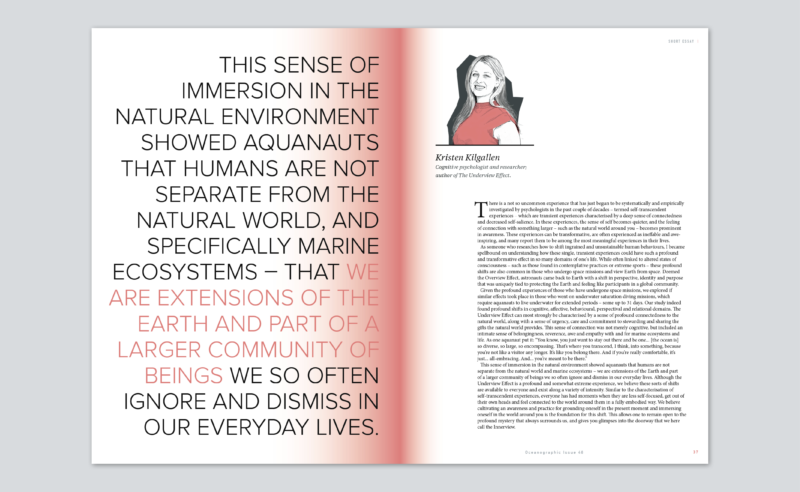
This is how this short essay appears in the special Oceanographic publication, The Innerview
Printed editions
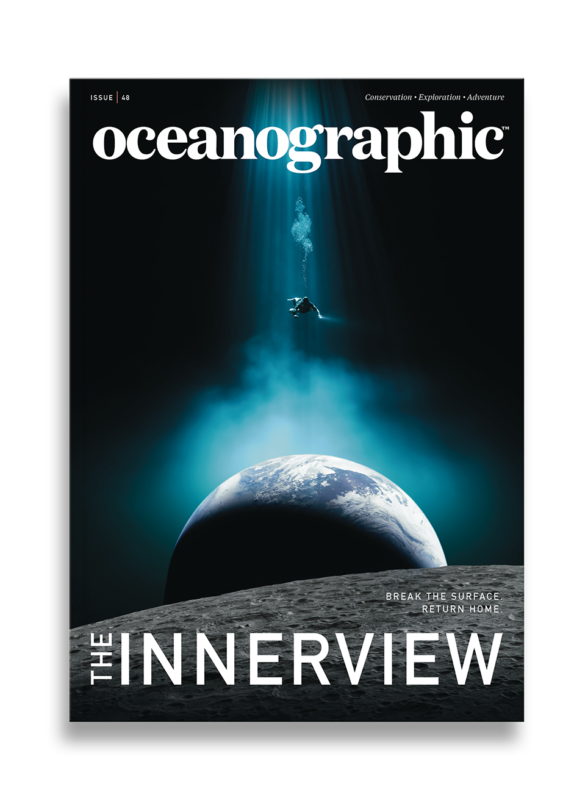
Current issue
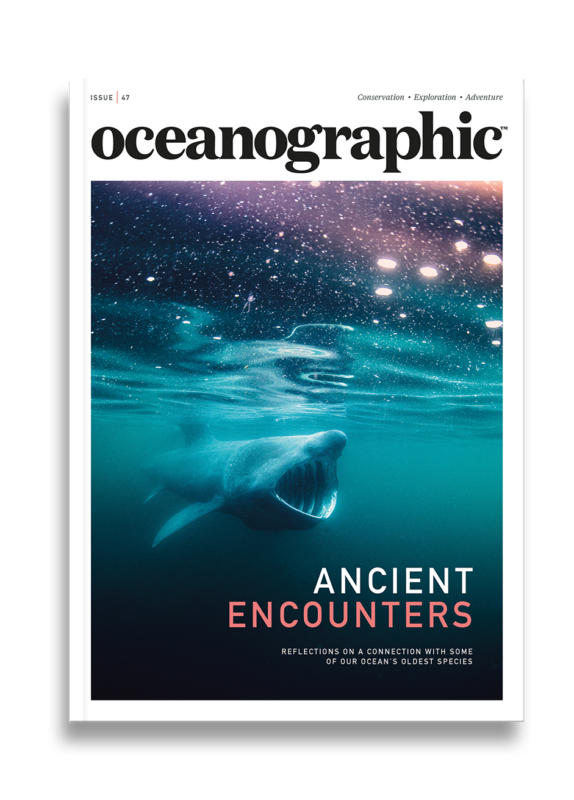
Back issues
Enjoy so much more from Oceanographic Magazine by becoming a subscriber.
A range of subscription options are available.
